You’re chatting with someone new online — could be a dating app, an Instagram DM, maybe a Discord server — and out of nowhere they send:
“wyf?”
No hello. No buildup. Just three letters and a question mark, and now you’re either totally fine with it or slightly thrown off, and you’re not sure which reaction is more correct.
Here’s the answer you came for.
What Does WYF Mean in Text?
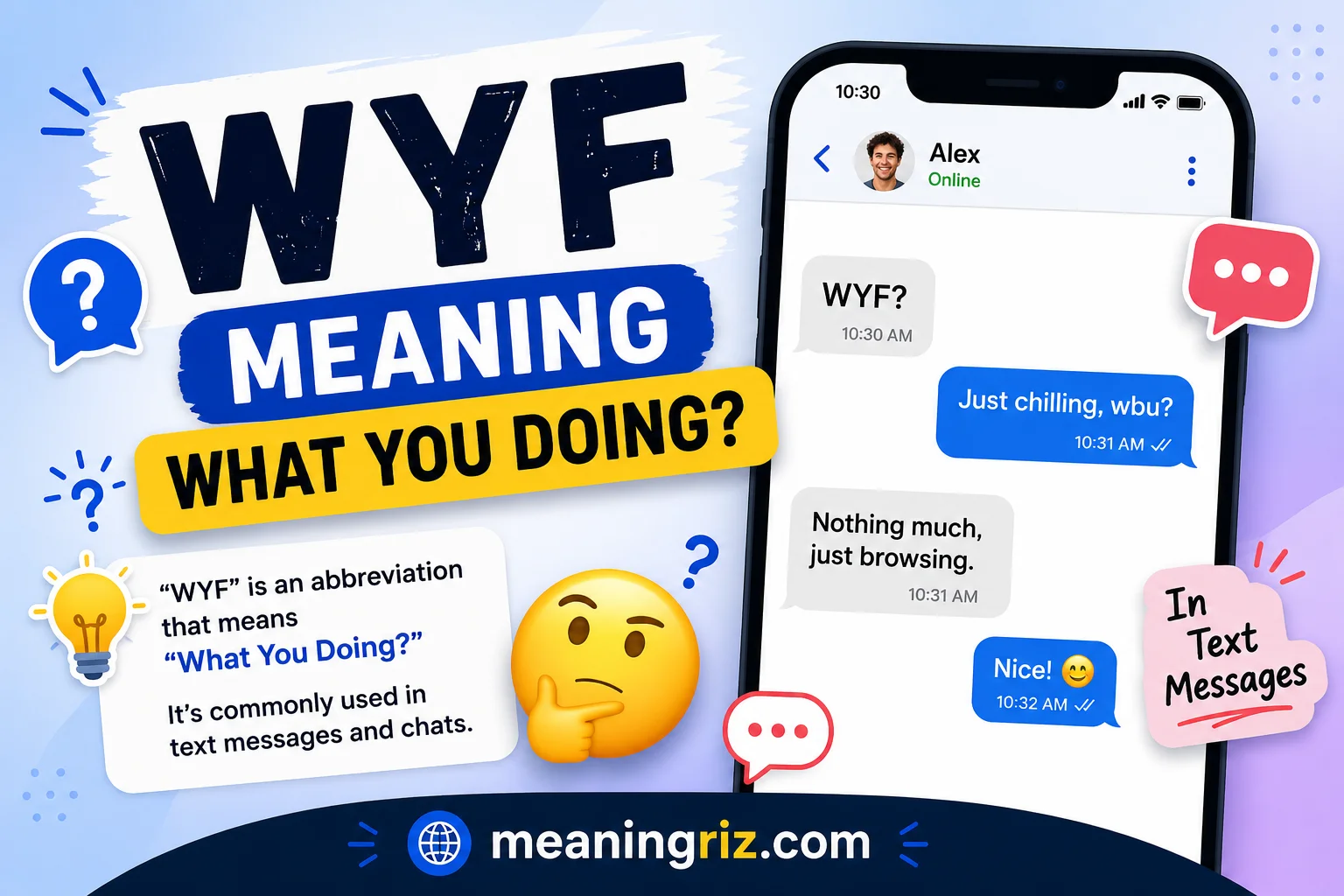
WYF stands for “Where you from?” It’s a casual, shorthand way to ask about someone’s location, hometown, city, or general background. The full phrase would be “Where are you from?” — WYF is just what that looks like at texting speed.
Quick definition for featured snippet:
WYF = “Where you from?” — an informal question asking about someone’s hometown, city, or country of origin. Common in DMs, dating apps, and casual texting.
That’s the core meaning. But like most three-letter slang, what it means in the moment depends heavily on who’s sending it and why.
The Simple Meaning First
WYF is a location-origin question. Not where you are right now (that’s WYA), but where you’re from — your city, state, country, background.
It’s been around since early texting and chat culture, when character limits and slow keyboards pushed people to abbreviate everything. “Where are you from?” was one of the first questions people asked when meeting someone new online, so naturally it got shortened fast.
In casual conversation, WYF carries a friendly tone by default. It’s usually the start of a conversation, not a confrontation.
But WYF Has More Than One Meaning
Most guides list the meanings but don’t actually explain when each one shows up. Here’s the realistic breakdown:
“Where You From?” (Primary Meaning — Most Common by Far)
This is the one you should assume unless context clearly points elsewhere. Someone wants to know your location or background. It might be curiosity, small talk, or an icebreaker. That’s it.
“What You Feeling?” (Secondary, Less Common)
Sometimes — especially in closer friendships or when someone’s checking in on your mood — WYF can mean “what are you feeling?” Think of it like “how are you doing?” in slang form. This version is more emotional than geographical, and it usually appears mid-conversation, not as an opener.
“Why You Flexing?” (Gen Z / Niche Usage)
On TikTok comment sections, Discord servers, and gaming communities, WYF has developed a third meaning — “why you flexing?” — used playfully to call out someone for showing off. This is mostly Gen Z humor, not a standard texting meaning. You’ll know it’s this version because the context is social commentary, not a question about location.
The safe rule: if someone sends “wyf” with no other context, they almost certainly mean “where you from?” The other meanings are real but much more situational.
Real Chat Examples (How It Actually Looks)
These aren’t made-up textbook scenarios — this is how WYF actually appears in conversations.
As an Opening on a Dating App or Instagram DM
“hey wyf 👀”
Short, casual, maybe slightly flirty. The person wants to know if you’re local or just testing whether you’ll engage. The emoji does a lot of work here — it signals playfulness rather than interrogation.
Between New People in a Group Chat or Server
“you new here? wyf”
No pressure, just curious. This is WYF at its most neutral — someone wants context about who you are.
Checking In on Someone’s Mood
“you been quiet today.. wyf”
This is the “what you feeling?” version. The tone is softer, and there’s emotional intent behind it. Notice how the setup (“you been quiet”) tells you it’s about feelings, not geography.
Casual Between Friends
“lowkey wanna visit you lmao wyf again”
Friendly, joking. Even people who already know each other use it as a throwaway line.
The Niche “Why You Flexing” Version
[Someone posts a photo of their new car] “wyf bro 😂”
The context (a flex post, a laughing emoji) makes it clear this isn’t a geography question. It’s light teasing.
WYF Meaning by Platform
The word stays the same. The intent shifts slightly depending on where you see it.
WYF on Snapchat
Almost always means “where you from?” — often used early in a new streak or DM conversation. Snapchat culture favors short, quick openers, so WYF fits naturally there.
WYF on Instagram DMs
Common as an icebreaker after someone follows you or replies to your story. Slightly more likely to carry a flirty undertone than the same message on WhatsApp, just because of how Instagram conversations tend to start.
WYF on Dating Apps (Tinder, Hinge, Bumble)
Very common as a second or third message. It’s being used to see if you’re geographically compatible — whether there’s any point in continuing to chat. If it’s the very first message with nothing else, it can feel lazy, but it’s not inherently rude.
WYF on Discord or in Gaming
Usually the “where you from” version, used to figure out someone’s timezone or region. Sometimes the “why you flexing” version appears here among close server friends.
WYF in Regular Texting
The most direct and literal version. Between people who already know each other, it often means “what are you feeling” more than “where are you from” — because they already know your location.
When to Use WYF — and When Not To
When It Works Well
- Starting a conversation with someone new on a casual platform
- Getting to know someone in a group chat or community
- Checking in on a friend’s mood in a low-pressure way
- Any informal exchange where slang feels natural
When to Avoid It
- Your first-ever message to someone — it can feel blunt without a greeting before it
- Professional settings, work chats, or with anyone you’d use full sentences around
- Serious emotional conversations where the abbreviation feels too casual for the moment
- International conversations where English slang may confuse the other person
A practical guideline: WYF works as a follow-up, not usually a cold opener. Even something as small as “hey, wyf?” with a greeting attached changes the energy completely.
Is WYF Rude?
Not by itself. But it can land poorly depending on how it’s packaged.
Sending just “wyf” — nothing else, no greeting, no emoji, no warmth — can feel dry or demanding, especially from a stranger. It’s not the word itself; it’s the absence of context around it. The same question phrased as “hey! wyf? 😊” reads completely differently from “wyf.” even though the core meaning is identical.
There’s also a subtler issue worth knowing: asking “where are you from?” can carry weight for some people. For those who’ve grown up being asked this question as a way of questioning their identity or belonging — particularly people of color or immigrants — even the casual WYF version can feel like more than small talk. This doesn’t mean the sender always intends that, but it’s a real reason some people respond to it more guardedly than others. Reading the response, not just the question, tells you a lot.
Why People Actually Use WYF (Psychology)
The speed argument is real — typing three letters beats fifteen. But that’s not the whole story.
“Where are you from?” is one of the most identity-loaded questions that exists. It asks about origin, background, belonging. When someone sends WYF, they’re usually doing one of three things:
Practical screening. On dating apps especially, location is a filter. Someone asking WYF early is often checking whether proximity makes this worth pursuing. It’s less romantic than it sounds, but it’s honest.
Building common ground. People bond over shared geography — same city, same country, same region. WYF is a quick way to search for that overlap. “Oh you’re from Karachi? Same!” is a faster social bridge than almost any other opener.
Signaling informality. Using slang is a social signal. It says “I don’t need to be formal with you.” When someone sends WYF instead of “where are you from?”, they’re also communicating that they expect the conversation to be relaxed, not structured.
The version that means “what you feeling?” works on a different level — it’s an emotional check-in disguised as three letters. It’s low-commitment enough that the person asking doesn’t feel like they’re making a big deal, but it still opens the door for a real answer.
A Common Mistake People Make
The biggest misread with WYF is treating every instance as the same question. Replying with your city when someone was checking in on your mood — or responding emotionally when someone literally just wanted to know what country you live in — both create unnecessary awkwardness.
The fix is simple: look at the line before WYF, not just WYF itself. The setup almost always tells you which version you’re getting.
WYF vs. Similar Slang: Quick Comparison
| Term | Full Meaning | Tone | Emotional Undertone | Risk of Misreading | Best Context |
|---|---|---|---|---|---|
| WYF | Where you from? | Casual, curious | Curiosity, connection, or identity | Medium — can feel blunt solo | New conversations, casual DMs |
| WYA | Where you at? | Direct, practical | Logistics, urgency, or interest | Medium | Coordinating meetups |
| WYD | What you doing? | Open, relaxed | Boredom, interest, conversation opener | Low | Starting a chat |
| HMU | Hit me up | Inviting | Low pressure, openness | Low | Inviting future contact |
| ASL | Age, sex, location | Dated, formal | Old-school internet curiosity | High — feels dated | Rarely used anymore |
The key distinction: WYF asks about origin. WYA asks about current location. They sound similar and get mixed up constantly, but they’re asking two fundamentally different things.
How to Reply to WYF
Friendly Reply
“I’m from Lahore, you?”
Give your answer and turn it back. Keeps the conversation going naturally.
Playful Reply
“Somewhere you’ve definitely not been 😏 wyf”
Deflects slightly, sounds confident, invites them to go first instead.
Vague Reply (If You’re Not Comfortable Sharing)
“South Asia, you?”
Gives regional context without being specific. Totally reasonable, especially with strangers.
Checking If They Mean “What You Feeling”
“Location or mood? 😅”
Works when you’re genuinely unsure which version they meant. Lightens the moment and gets you the clarification without making it awkward.
Frequently Asked Questions
What does WYF mean in a text from a girl or guy?
The meaning doesn’t change based on gender — it’s still “where you from?” What can change is the intent. In a flirty context, it might be a soft icebreaker. In a friendly one, it’s just curiosity about your background.
Is WYF the same as WYA?
No. WYF asks where you’re from (hometown, origin, background). WYA asks where you are right now (current location). They look and sound similar, which is exactly why people mix them up.
Can WYF be offensive?
Not usually on its own. But depending on who’s asking and why, the question “where are you from?” can feel loaded for some people. If someone responds guardedly or doesn’t answer, that’s worth respecting without pushing.
What does WYF mean on Snapchat specifically?
On Snapchat, WYF almost always means “where you from?” — used casually as an early conversation starter or during a new streak.
What’s the difference between WYF and WYD?
WYF asks about your origin or hometown. WYD asks what you’re currently doing. Both are casual and often used at similar points in a conversation, but they’re asking entirely different questions.
Should I reply to WYF with just my city?
Usually yes, especially if it’s from someone new. Adding a follow-up like “wyf?” keeps the exchange going and doesn’t leave them doing all the work.
Is WYF appropriate to use with people outside my age group?
Be cautious. Older generations or people less familiar with texting slang may not recognize it. “Where are you from?” spelled out is always clearer and never reads as rude.
The Bottom Line
WYF means “where you from?” in almost every case you’ll encounter it. The secondary meanings — “what you feeling?” and “why you flexing?” — are real but context-dependent, and the context will almost always tell you which one you’re looking at.
The bigger skill isn’t decoding the letters. It’s noticing the setup before them: who sent it, where, and what the conversation was doing before those three letters appeared. That reading tells you more than any guide can.
DISCOVER MORE ARTICLES
GMFU Meaning in Text Explained (Usage, Tone & Real Examples)
What Does Happy Ending Mean in Text? Full Breakdown 2026
Grand Rising Meaning in Text Explained (Usage, Tone & Real Examples)
Bilateral Meaning in Text Explained (Usage, Tone & Real Examples)
Bane of My Existence Meaning in Text: Usage, Tone & Examples
PU Meaning in Text Explained (All Meanings, Tone & Real Examples)

I’m the person behind this website, handling both the writing and content management myself. I focus on explaining word meanings, slang, and modern expressions in simple, clear language, using real-life examples so readers can understand how these terms are actually used in everyday conversations.