You’re reading through a chat, someone drops “happy ending,” and suddenly you’re second-guessing yourself.
Does it mean what you think it means? Or are you reading too much into it? Or maybe not enough?
Here’s the thing — “happy ending” in a text doesn’t always mean the same thing. Context changes everything, and that’s exactly where most people get confused. This article breaks down every version of the meaning, clearly and honestly, so you know exactly what someone meant when they sent it.
What Does “Happy Ending” Mean in a Text?
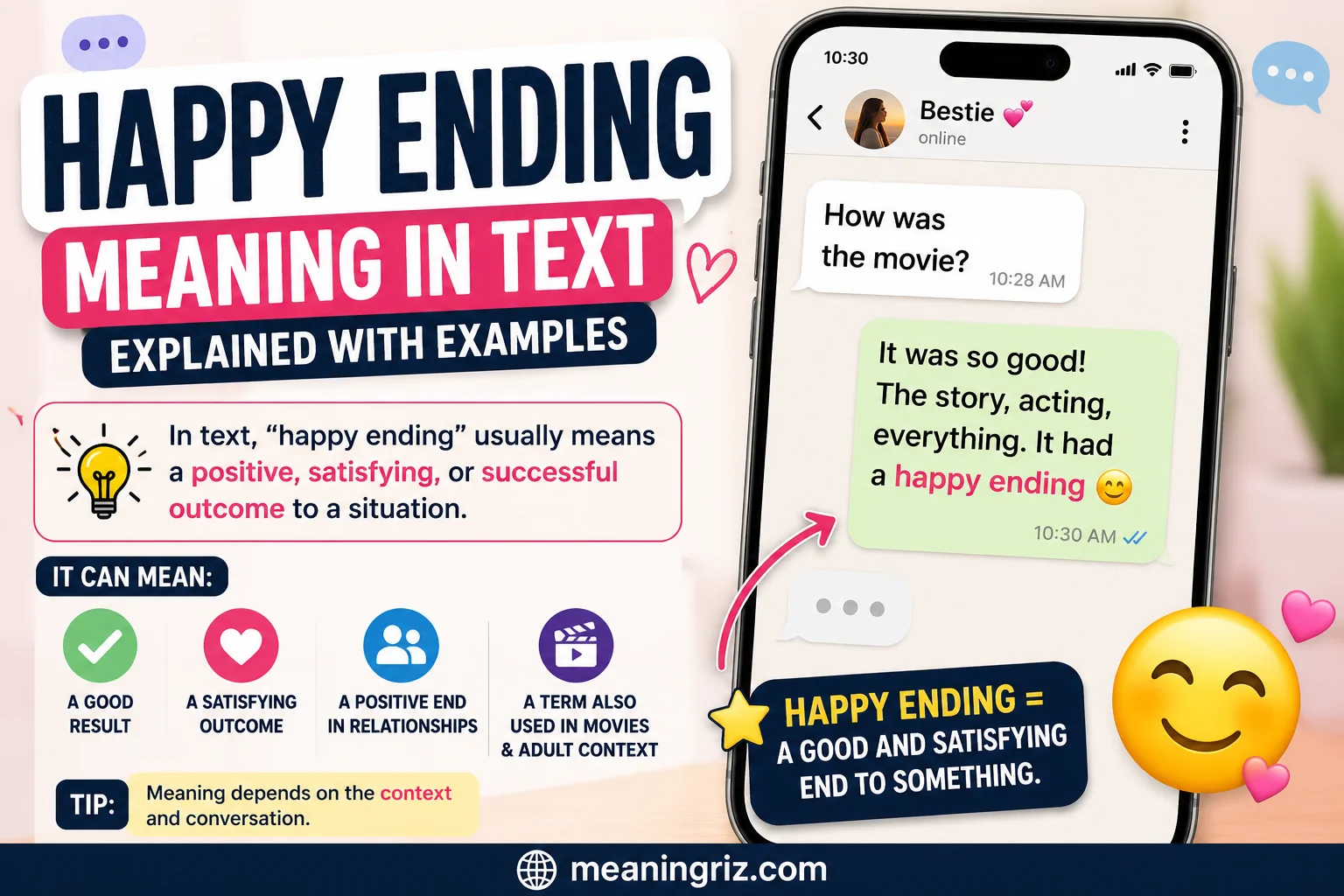
In everyday texting and online chat, “happy ending” most commonly means one of three things, depending entirely on the context:
- The literal, everyday meaning — a situation, story, or experience that ends well. Everything works out. Positive outcome.
- The adult slang meaning — a well-known euphemism, most associated with massage parlors, referring to a sexual act at the end of a session.
- The ironic or meme meaning — used sarcastically in casual chats or group messages, often about something that clearly did not end well.
Quick definition: In text, “happy ending” usually means things worked out well — but in certain tones or contexts, it’s a slang euphemism for something adult in nature. The emoji, the conversation history, and the relationship you have with the sender will tell you which one it is.
That’s the featured snippet version. Now let’s go deeper into each meaning so you can read it correctly every time.
The Three Main Meanings of “Happy Ending” in Chat
Meaning 1: Things Worked Out (Everyday Use)
This is the original meaning and still the most widely used — especially in casual conversation, relationship updates, or storytelling in chat.
Someone sharing an update might text:
“We almost broke up but we talked it out. Happy ending 😊”
Or after a stressful day:
“Thought I was going to miss my flight. Happy ending though — made it with 3 minutes to spare.”
Nothing hidden, nothing coded. Just someone expressing relief or satisfaction that something resolved positively. This is the most common version you’ll see in everyday texting, especially from friends sharing life updates.
Meaning 2: The Adult Slang Version
This is the meaning people are usually Googling when they land on this page.
In adult slang, “happy ending” refers to a sexual act — specifically a manual act — performed at the end of a massage. This meaning is well-established in pop culture, movies, comedy, and memes. It’s not a new term and it’s not exclusive to any one platform.
In a text, someone might use this meaning:
- As a joke between close friends referencing a funny situation
- In a flirty or suggestive conversation where context is already adult-oriented
- As a meme reference or pop culture callback
The tone signals that usually indicate this meaning:
- Winky or smirking emojis 😏😉
- It appears in the middle of an already flirty or adult-themed conversation
- There’s a teasing or joking quality to the sentence it appears in
If the chat before it was completely normal and platonic, this meaning is unlikely unless the person is making a deliberate, out-of-nowhere joke.
Meaning 3: Sarcastic or Ironic Use
This version shows up a lot in modern texting and group chats — especially among younger people and in meme-fluent conversations.
Someone texts:
“Lost my job, my car broke down, and my takeout order was wrong. Real happy ending type of day 🙃”
That’s sarcasm. The phrase is being flipped on its head — they’re using “happy ending” to describe the opposite of one, which makes it funnier and more relatable than just saying “today was terrible.”
This ironic use is extremely common on social media and in group chats. The 🙃 emoji is often a strong signal that the happy ending being referenced is definitely not a happy one.
Real Chat Examples (How It Actually Looks in Conversation)
Between Two Friends After a Stressful Situation
Sam: So did you sort things out with your landlord? You: Yeah finally. Happy ending, he’s not raising the rent. Sam: Thank god 😭
Pure everyday use. No subtext.
In a Flirty Conversation
“Don’t worry, I’ll make sure this story has a happy ending 😏”
Here, the winky face and the word “story” being used playfully tips this into the suggestive territory. The emoji is doing a lot of work.
In a Group Chat, Sarcastically
“Drove 45 minutes to the restaurant. It was closed. Happy ending as always 🙃”
The 🙃 flips the meaning completely. Classic ironic use.
On Social Media or in a Meme Caption
“Me thinking my situationship was going to have a happy ending: 💀”
This is meme language — self-deprecating, relatable, and using “happy ending” as a cultural shorthand for naive optimism that didn’t pan out.
After Sharing a Story With Good News
“She said yes. Happy ending achieved 🥹”
Sincere, wholesome, and straightforward. No other reading possible in this context.
Platform-by-Platform: Does the Meaning Change?
Happy Ending on WhatsApp
WhatsApp tends to be more personal — used with family, close friends, and work contacts. Here, the everyday meaning dominates. If someone says “happy ending” in a WhatsApp family group or a work chat, they almost certainly mean things resolved well. The adult meaning would be wildly out of place in most WhatsApp contexts.
Happy Ending on Snapchat and Instagram DMs
These platforms skew toward younger, more social conversations. The ironic and meme versions of “happy ending” are common here — especially in reaction to dramatic situations like relationship drama, friend group fallouts, or relatable fail stories. The adult meaning can also appear in already-flirty conversations, but it usually comes with emojis to signal the tone.
Happy Ending on TikTok Comments
TikTok comment culture is heavily meme-based and ironic. “Happy ending” in TikTok comments almost always means either the sarcastic version (“wow, what a happy ending 💀”) or a reference to storytelling (“was this supposed to be the happy ending??”). The adult meaning does exist but is usually filtered out or flagged by the platform’s moderation.
Happy Ending in Regular Texting (SMS/iMessage)
In direct text messages, context is the entire key. The same phrase from your best friend and from someone you just started talking to romantically will land completely differently. With close friends, the adult reference is usually a joke. In early conversation with someone new, pay attention to the surrounding messages.
When to Use “Happy Ending” in Text — And When to Be Careful
When It’s Fine to Use
- Wrapping up a story with a positive outcome: “happy ending!”
- In casual chats with close friends who understand your humor
- In ironic, self-deprecating messages where the tone is clearly playful
- When referencing books, films, or shows that literally have happy endings
When to Think Twice
- Early conversations with someone you don’t know well — the double meaning can create unintended awkwardness
- Professional messages or work chats — always rephrase to something like “it all worked out” or “resolved well”
- Any message going to a family group chat or a mixed audience where ages and humor levels vary
- If you’re not sure whether the other person will take it in the spirit you intend, don’t use it without an emoji to guide the tone
A general rule: the phrase travels well when context is already established. Without context, it creates confusion. That’s true for the everyday meaning and especially true for the ironic or adult versions.
Is “Happy Ending” Flirty?
It can be — but it isn’t automatically.
The phrase itself carries no inherent flirtatious weight. It’s the delivery that makes it flirty. A simple “hope it has a happy ending!” in response to someone’s job interview update is just warmth and encouragement.
But “I’ll make sure it has a happy ending 😏” in a late-night conversation is clearly using the double meaning on purpose.
The difference is entirely in:
- The emoji used (or lack of one)
- The conversation context before the message
- The relationship between the two people
If all three of those lean casual or neutral, the message almost certainly isn’t flirty. If even one of them tips toward intimate or teasing, the person probably intended the double meaning.
Why People Use This Phrase (Psychology)
There’s a reason “happy ending” has stayed in everyday language for this long — in both its meanings.
The innocent version taps into something deeply human. People want resolution. They want to know a story ends well before they commit emotional energy to hearing it. Texting someone “happy ending!” at the end of a long update gives the listener permission to feel relief. It’s a kind thing to say.
The ironic version is a coping mechanism. When something genuinely goes wrong, reframing it as a “happy ending” with a 🙃 is a way of processing it without sounding like you’re fully falling apart. Humor creates distance from frustration.
The adult double meaning persists because ambiguity is useful. It lets people test the waters of a conversation without fully committing to a direction. If the other person laughs and plays along, the door is open. If they respond straightforwardly to the innocent version, no harm done — you just meant things worked out fine.
One real-world communication insight: people who use the double meaning as a joke in casual conversation are usually not making a serious statement — they’re checking whether you share the same humor register. It’s a social temperature test, not a proposition.
A Common Mistake People Make
The most common mistake is using “happy ending” in a professional or semi-formal context without realizing how easily it can be misread.
Someone wrapping up a project update might type:
“And that’s how we resolved it — happy ending for everyone!”
To them, it’s lighthearted and positive. To someone who picks up on the double meaning, it lands unexpectedly. Neither person is wrong — but the writer didn’t account for the audience.
The fix is simple: In professional or mixed-audience messages, swap it for “great outcome,” “resolved well,” or “everything worked out.” Same feeling, zero risk of misread.
Happy Ending vs. Similar Phrases in Text
| Phrase | Core Meaning | Tone | Double Meaning? | Risk of Misread | Best Context |
|---|---|---|---|---|---|
| Happy ending | Everything resolved well | Warm, hopeful | Yes — adult slang | Medium–High | Close friends, casual chat |
| Happily ever after | Storybook resolution | Romantic, idealistic | No | Low | Relationships, storytelling |
| All’s well that ends well | Positive outcome despite difficulty | Mature, literary | No | Very Low | Any audience |
| Plot twist | Unexpected development | Playful, ironic | Occasionally | Low | Social media, meme chats |
| It worked out | Simple positive result | Neutral | No | None | All contexts, including professional |
The key takeaway: “happy ending” is the most emotionally satisfying of these options, but also the one that needs the most context to land cleanly. When in doubt, “it worked out” does the job without the risk.
How to Respond When Someone Texts “Happy Ending”
If It’s Clearly the Everyday Meaning
“Honestly I needed that — so glad it worked out.”
or
“Love a good happy ending 😊 what happened?”
If It Seems Ironic or Sarcastic
“Absolutely devastating happy ending 😭 what went wrong lol”
or
“Classic 🙃 tell me everything”
If You’re Not Sure Which Meaning They Meant
Respond to the innocent version and let them clarify if they meant something else:
“Aw, I’m glad! What was the situation?”
This is the safest approach. If they meant it innocently, you’ve matched the tone. If they were being playful with the double meaning, they’ll either laugh it off or make the joke more explicit.
If It Was Clearly Flirty or Suggestive
“Careful what you promise 😏”
or
“Bold claim, we’ll see 😂”
These acknowledge the tone without over-committing to a direction the conversation might not go.
Frequently Asked Questions
What does “happy ending” mean in texting?
In texting, “happy ending” usually means a situation, story, or experience that ended well. It can also be used ironically to describe something that went wrong, or as an adult euphemism in flirty conversations. Context — the emoji, the conversation history, and the relationship — tells you which version is being used.
Is “happy ending” always sexual in meaning?
No. The adult meaning is the most well-known in slang culture, but in everyday texting it’s far more commonly used in its innocent sense — meaning things turned out well. Many people use it without any awareness of the double meaning at all.
How do I know if someone meant it in a flirty way?
Look at the emoji (a 😏 or 😉 is a strong signal), the conversation context before the message, and how flirty or casual the overall tone has been. If none of those lean flirty, the person almost certainly meant the everyday version.
Can I use “happy ending” in a work message?
It’s best avoided in professional communication because of the well-known double meaning. Replace it with “great outcome,” “resolved well,” or “everything worked out” to keep the tone appropriate and clear.
What does “happy ending” mean on TikTok or Instagram?
On TikTok and Instagram, it’s most commonly used ironically — captioning a situation that clearly did not end well. It can also appear in storytelling content or comments on romance-related posts in its literal narrative sense.
Why does “happy ending” have a double meaning?
The euphemistic meaning developed in the late 20th century as a coded phrase for adult services at certain massage establishments. It spread through pop culture, comedy, and movies until it became a widely recognized slang term. The innocent meaning is centuries older, rooted in storytelling and narrative tradition.
The Bottom Line
“Happy ending” in a text is one of those phrases that means exactly what it says — until the context shifts, and then it means something completely different. Most of the time, especially in everyday conversation, it’s just someone telling you things worked out well, or sarcastically telling you they really didn’t. The adult reading is the one people are most curious about, but it’s not the one that shows up most often in real, everyday chats.
When in doubt, read the emoji first. Read the conversation tone second. And when you need to respond without being sure — always meet the innocent version of the message and let the other person steer from there.
DISCOVER MORE ARTICLES
FWIW Meaning in Chat, Texting & Social Media
GMFU Meaning in Text Explained (Usage, Tone & Real Examples)
What Does SMT Mean in Text? Meaning in Chat Explained (Usage & Examples)
TMP Meaning in Text: What It Really Means (With Examples)
GNG Mean in Text: What It Actually Means, How It’s Used & How to Reply

I’m the person behind this website, handling both the writing and content management myself. I focus on explaining word meanings, slang, and modern expressions in simple, clear language, using real-life examples so readers can understand how these terms are actually used in everyday conversations.