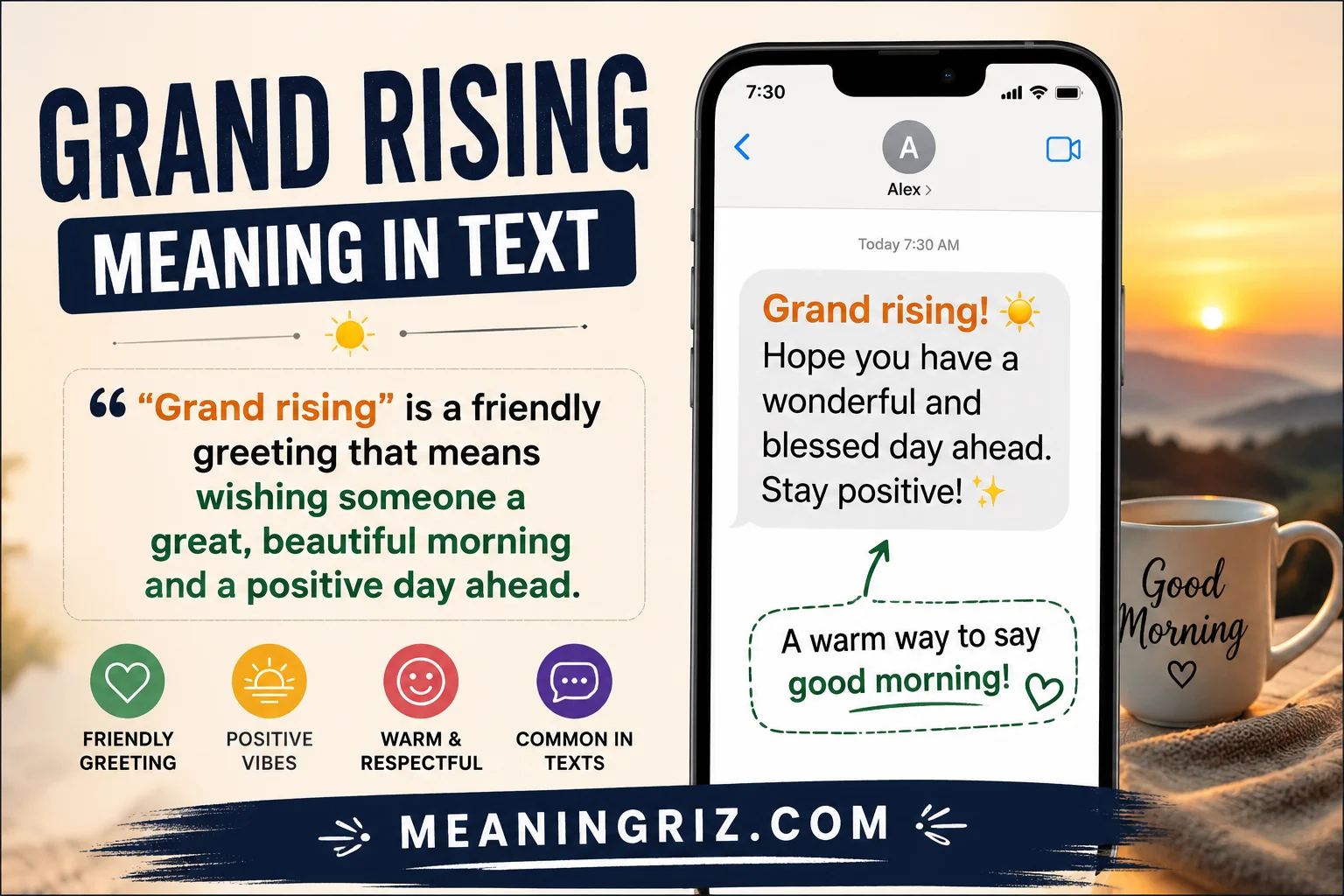
You wake up, check your phone, and there it is — a message from someone that just says:
“Grand rising ✨”
No “hey.” No “good morning.” Just that. And now you’re half-awake wondering what it means, whether it’s spiritual, whether this person is about to try to sell you a crystal, or whether it’s just a greeting you’ve never heard before.
Here’s the answer, straight up.
What Does Grand Rising Mean in Text?
“Grand rising” is an alternative to “good morning.” When someone texts you “grand rising,” they are greeting you at the start of the day — but with a specific intention behind the words. Instead of simply marking the time of day, “grand rising” acknowledges the act of waking up as something meaningful: you rose, the sun rose, the day is beginning, and that’s worth noting with a little more energy than “morning.”
Quick answer for featured snippet:
Grand rising means “good morning” — but with a spiritual or intentional twist. It’s used to greet someone at the start of the day while emphasizing positivity, awareness, and gratitude for waking up. It’s common in spiritual communities, wellness spaces, and on social media platforms like Instagram and TikTok.
That’s the core definition. But like most phrases that carry cultural weight, the full picture is more interesting than the dictionary version.
Where Did “Grand Rising” Come From?
This phrase didn’t appear overnight from a viral tweet. It has roots that are worth understanding, especially before you start using it yourself.
The “Morning” vs. “Mourning” Idea
One of the most widely shared explanations is about sound. “Morning” and “mourning” are homophones — they sound identical when spoken aloud. Some people, particularly in spiritual and conscious-language communities, feel that beginning each day with a word that sounds like grief carries a low, heavy energy — even subconsciously.
“Rising,” by contrast, is purely upward. The sun rises. You rise from sleep. The energy of the day rises. So the phrase swaps mourning-adjacent language for something that feels more intentional and alive.
This is not a fringe idea — it’s a genuine linguistic philosophy that shows up in several spiritual and cultural movements that care deeply about the words people choose and the vibrations those words carry.
Roots in African American Spiritual Culture
The phrase is widely understood to have originated in African American spiritual and conscious communities, and later expanded into broader wellness, New Thought, and mindfulness spaces online. It shares a philosophical DNA with the Rastafarian tradition of “overstanding” (instead of “understanding”) and other intentional language reforms that replace passive or negative-sounding words with more empowering ones.
<cite index=”3-1″>Those who use grand rising sincerely tend to be people who have undergone some kind of spiritual awakening and believe that words carry vibrations with specific meaning.</cite> That context matters if you’re trying to understand why someone sent it to you — or whether it’s appropriate for you to send it yourself.
How It Spread Online
<cite index=”7-1″>The phrase gained notable traction in spiritual and alternative circles throughout the 2010s, and saw a measurable spike in searches and usage around 2020</cite> — a period when many people were reconsidering daily routines, mental health, and how they started each morning. Social media did the rest. Spiritual influencers, wellness coaches, and astrology accounts began using “grand rising” in daily posts, and from there it crossed into mainstream awareness.
What It Actually Means When Someone Texts You “Grand Rising”
This is the part most articles skip, and it’s what you probably actually want to know.
The meaning of the message depends almost entirely on who sent it and what your dynamic with that person is like.
It’s a Sincere Spiritual Greeting
If the person who texted you is genuinely into wellness, mindfulness, spirituality, astrology, or conscious living — this is simply their version of “good morning.” They mean it warmly and sincerely. There’s no hidden agenda. They greet everyone this way, and texting it to you is a sign they feel comfortable enough to be themselves around you.
It’s a Social Media Habit That Carried Over
Some people picked up “grand rising” from following certain accounts online and it just became part of how they communicate — the same way someone might say “no cap” or “periodt” without necessarily being deep into the original culture those phrases came from. For these people, it’s casual, not necessarily spiritual.
It’s Being Used Ironically or as a Joke
<cite index=”3-1″>On social media, the phrase has also been turned into memes and used jokingly or with tongue-in-cheek energy, especially between people who find the overly spiritual framing a little funny.</cite> If the person sending it is known to be sarcastic or is sending it at, say, 2pm, there’s a good chance they’re being playful rather than sincere.
It Signals a Certain Personality or Worldview
On TikTok and in dating culture specifically, “grand rising” has become something of a personality marker. Some people see it as endearing and aligned with their own values. Others — particularly on TikTok — have made it a running joke or even a mild red flag, suggesting the sender might be overly performative about spirituality. This is the internet being the internet, but it’s worth knowing the conversation exists.
Real Chat Examples: How It Shows Up in Text
From a Close Friend Who’s Into Wellness
“Grand rising bestie 🌅 hope today is kind to you”
This is warm, personal, and completely sincere. A normal greeting between two people who are comfortable with each other.
From Someone You’re Dating
“Grand rising 🙏✨ thinking of you”
In a romantic context, this functions as a thoughtful morning message. Whether you find it sweet or a little intense depends on how aligned your energy is with theirs.
Posted to an Instagram Story at 6am
“Grand rising kings and queens 🌞”
This is the social media version — used as a broadcast greeting to followers. It’s more of a vibe-setting post than a direct personal message.
Used Sarcastically Between Friends
“Grand rising my dude. It is 11:47am and I have done absolutely nothing productive”
Here the phrase is being used ironically — the person is aware of the spiritual connotation and is playing with it for humor.
As a Meme or Joke Text
“Grand rising bestie 🧿✨ Mercury is in retrograde and I already spilled my coffee”
Playful, self-aware, using the phrase’s spiritual associations for comedic effect.
Platform-by-Platform: Does “Grand Rising” Mean Different Things?
On Instagram
Most common as a morning post caption or story sticker used by wellness, spiritual, or lifestyle accounts. It’s used broadly and often signals the creator’s niche or personal values.
On TikTok
Has developed a split personality — used sincerely by spiritual communities and ironically by people who find the phrase over the top. There’s a whole genre of TikTok content specifically about “men who say grand rising” and what it supposedly signals in dating, which is entirely its own rabbit hole.
On WhatsApp or iMessage (Direct Texts)
When someone texts it directly to you, it’s almost always personal and genuine — unless you both have an established pattern of joking around. A DM of “grand rising” is more intimate than a story post.
On Twitter/X
Often ironic or meme-adjacent. The phrase tends to show up in jokes about wellness culture or overly spiritual posting habits.
When to Use “Grand Rising” — And When to Think Twice
When It Fits Naturally
- You genuinely connect with the spiritual or intentional meaning behind it
- You’re texting someone who also uses the phrase or comes from a similar wellness or spiritual background
- You’re posting to a community or audience that would receive it warmly
- You want a more intentional way to greet someone in the morning
When to Hold Back
- You’re sending a morning message to someone you don’t know well yet — it can read as immediately intense or presumptuous
- You’re in a professional or work context — “grand rising” in a Slack message to your manager is probably not the move
- You’re not sure of the person’s relationship to spirituality — for some people, this phrase lands oddly or feels performative
- You’re tempted to use it ironically with someone who uses it sincerely — that can come across as dismissive of something they genuinely value
Is “Grand Rising” Rude or Offensive?
No — not inherently. But there are a few ways it can land wrong.
Using it without understanding its cultural roots can come across as appropriation or performativity, especially if the person you’re texting is from a community where the phrase carries real significance and you’re treating it as a trend.
Using it sarcastically to someone who’s sincere about it is its own kind of disrespect — not dramatic, but worth being aware of.
And using it in a context where it clearly doesn’t fit (work email, first text to a new contact, etc.) can make the sender seem unaware of context, which has its own awkwardness.
When in doubt: if you genuinely mean it, send it. If you’re using it as a bit, make sure the other person is in on the joke.
Why People Use This Phrase (Psychology)
There’s a real psychological reason language like “grand rising” resonates with people — and it goes beyond just preferring it over “good morning.”
Words shape how we experience our own moments. Starting a day with language that frames waking up as an elevation rather than simply a time of day creates a small but genuine mental shift. Psychologists who study affirmations and priming have found that the words we use to describe experiences influence how we emotionally process them — even when the effect is subtle.
It creates a sense of community. When you use “grand rising,” you’re immediately recognizable to others who use it too. It functions as a low-key identity signal — a way of saying “I’m someone who thinks consciously about how I move through the world.” That sense of shared language is meaningful for people who feel connected to wellness or spiritual communities, especially online.
It rejects default phrasing. There’s a certain intentionality in choosing a different word when an easier, more automatic one exists. Saying “grand rising” instead of “morning” is a small act of conscious choice — and for many people, that’s the whole point. The message it sends to yourself, before it ever reaches anyone else, is: I’m awake. I’m present. I’m choosing how I begin today.
One real observation from how this phrase travels through conversations: people who use it consistently tend to use it in pairs or groups where it’s already normalized. It rarely lands well as the first new thing introduced into a relationship — but once it’s established as comfortable between two people, it becomes a genuinely warm shorthand.
A Common Mistake People Make
The most common mistake is either over-explaining or under-understanding. Some people send “grand rising” and then feel the need to justify it or add “it just means good morning haha” — which drains all the intention out of it. If you use it, use it without the footnotes.
On the receiving end, the mistake is assuming the phrase is weird or over the top just because it’s unfamiliar. It’s a morning greeting. The person is wishing you well. That’s really all it is.
Grand Rising vs. Similar Morning Greetings
| Phrase | Meaning | Tone | Emotional Undertone | Who Uses It | Risk Level |
|---|---|---|---|---|---|
| Grand Rising | Intentional good morning | Warm, spiritual, conscious | Uplift, gratitude, elevation | Wellness/spiritual communities, social media | Low–Medium (can feel intense to some) |
| Good Morning | Standard morning greeting | Neutral, universal | Polite, conventional | Everyone | Very Low |
| Morning | Casual good morning | Casual, quick | Friendly, no-frills | Friends, family | Very Low |
| Rise and Shine | Wake up + have a good day | Cheerful, slightly pushy | Energetic, sometimes parental | Parents, upbeat personalities | Low |
| Blessed Morning | Spiritual morning greeting | Religious, warm | Devotion, gratitude | Religious communities | Low–Medium |
| GM | Abbreviated good morning | Ultra-casual, crypto/gaming | Familiarity, in-group | Online communities, crypto Twitter | Low (within context) |
The key difference between “grand rising” and “good morning” isn’t the literal meaning — they both greet the day. It’s the intention and identity behind the phrase. One is default. The other is a choice.
How to Respond to “Grand Rising”
Warm and Matching
“Grand rising! Hope your day is full of good energy 🌅”
Use this if you’re comfortable with the phrase and want to match their vibe.
Friendly but Neutral
“Good morning! How’s your day going?”
Totally fine. You don’t have to mirror the phrase. Meeting warmth with warmth in your own words works perfectly.
Curious and Open
“Grand rising! I love that — what does your morning look like today?”
This is a good response if you’re interested in the person and want to keep the conversation going.
Playful (If the Vibe Allows)
“Grand rising ✨ I have risen. Barely. But I’m up.”
Self-deprecating humor can land well here if you already have that kind of rapport.
Frequently Asked Questions
What does grand rising mean in a text message?
“Grand rising” is an alternative morning greeting that means “good morning,” with an added layer of intention and positivity. It emphasizes waking up consciously and with purpose, rather than simply marking the time of day.
Is grand rising a spiritual thing?
It has spiritual roots — particularly in African American conscious communities and wellness spaces — but many people use it casually or on social media without a deep spiritual practice behind it. Whether the person texting you means it spiritually depends on who they are.
Is it cultural appropriation to say grand rising?
This is a nuanced question. The phrase comes from specific cultural and spiritual communities. Using it respectfully and with awareness of that context is different from treating it as a trend. If you understand where it comes from and it resonates with you genuinely, most people see that as appreciation rather than appropriation. Using it performatively, as an aesthetic, without any real connection to the sentiment is where it starts to feel hollow.
Why do people say grand rising instead of good morning?
Because “morning” and “mourning” are homophones, and some people believe the language we use shapes our energy and mindset. “Rising” — as in the sun rising, you rising from sleep — is a more intentional, upward-feeling word. The phrase is a small act of choosing language deliberately.
Is grand rising a red flag in texting?
On TikTok this has become a joke — some people treat it as a personality indicator or even a “red flag” in dating, particularly when used by someone who comes across as overly performative about spirituality. But in reality, it’s just a morning greeting. Whether it fits the person and the dynamic is what matters, not the phrase itself.
How do you respond to grand rising without being awkward?
Just respond warmly in whatever language feels natural to you. You don’t need to say “grand rising” back if it doesn’t feel right. A simple “good morning! How are you?” or “morning, hope your day is great” works perfectly and doesn’t create any awkwardness.
The Bottom Line
“Grand rising” means good morning — but it’s a good morning with a point of view. It says: waking up matters, the day matters, and the words we use to begin it matter. Whether someone texts it to you as a sincere spiritual greeting, a social media habit, or a half-joking morning message, the underlying sentiment is the same: they’re thinking of you at the start of the day, and they want it to be a good one.
You don’t have to adopt the phrase to appreciate that. But understanding what it means — and why people choose it — makes you a better reader of the conversations you’re actually in.
DISCOVER MORE ARTICLES
FWIW Meaning in Chat, Texting & Social Media
GMFU Meaning in Text Explained (Usage, Tone & Real Examples)
What Does Happy Ending Mean in Text? Full Breakdown 2026
Smokeshow Meaning in Chat: What It Really Means & How to Use It
I’m the person behind this website, handling both the writing and content management myself. I focus on explaining word meanings, slang, and modern expressions in simple, clear language, using real-life examples so readers can understand how these terms are actually used in everyday conversations.