You get a message. Two letters. “pu.”
No context. Could be from a friend, could be from someone you’ve been flirting with, could be from your group chat. And now you’re sitting there trying to figure out if you missed something obvious or if this is actually confusing.
It’s actually confusing. And that’s because “pu” doesn’t have one fixed meaning — it has several, and the right one depends entirely on context. Here’s how to read it correctly every single time.
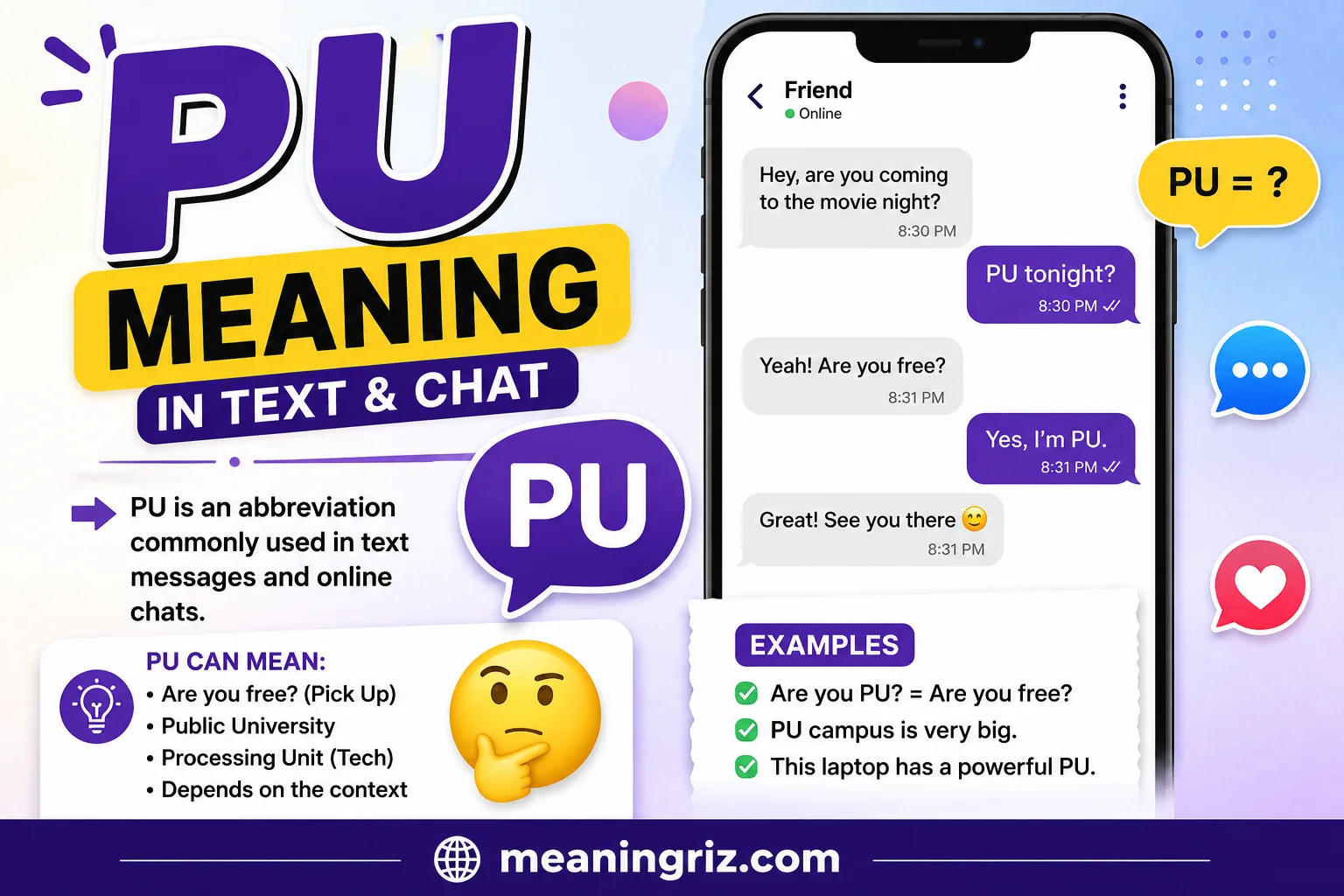
What Does PU Mean in Text?
PU most commonly means “Pop Up” — a casual way of asking someone to message them or reach out. When someone posts “pu” on their Snapchat story or sends it in a DM, they’re saying: come find me in my inbox.
But that’s only the most common meaning. PU also regularly means “Pick Up” (as in, come get me or answer the phone), and in older slang it’s an exclamation — “P.U.” — for when something smells bad.
Quick answer: PU in text usually means “pop up” (message me) or “pick up” (come get me/answer). Which one it is depends on who sent it and what was happening before it.
That two-line answer covers most situations. The rest of this article explains how to tell them apart — and what to do when you still can’t.
The Three Real Meanings of PU (And How to Tell Them Apart)
1. Pop Up — “Message Me”
This is the most common meaning in 2025–2026, especially on Snapchat and Instagram. When someone says “pu,” they’re inviting you to slide into their DMs or start a conversation.
You’ll usually see it:
- On Snapchat stories (“bored, pu 😴”)
- At the end of a DM exchange that’s about to go quiet (“I’m online tonight, pu”)
- When someone wants to reconnect without making it a big deal
The vibe is low-pressure and casual. It’s an open door, not a demand. The person is saying “I’m here, reach out if you want” — which is exactly why it works socially. It puts zero obligation on you.
2. Pick Up — “Come Get Me” or “Answer the Phone”
This meaning shows up more in everyday texting between people who are already coordinating plans — usually friends, partners, or family.
You’ll usually see it:
- “pu in 10?” (Are you picking me up in 10 minutes?)
- “can you pu from school today”
- “pu the call” (rare, but it happens)
The quick way to tell this apart from “pop up”: if there’s any logistics context before it — location, time, transport — it’s almost certainly “pick up.”
3. P.U. — “That Smells / That’s Disgusting”
This one is the oldest of the three and has nothing to do with texting invitations. It’s an exclamation, usually written “P.U.” or “pew,” that people use to react to something gross or bad-smelling.
In text, you might see:
- “P.U. what is that smell 💀”
- “pu it reeks in here”
This one is easy to spot because it reads as a reaction, not a request. If the sentence before it describes something unpleasant, this is what it means.
Real Chat Examples (How PU Actually Shows Up)
“Pop Up” in a Snapchat Story
Lila posts on her story at 10pm: “nobody ever pus me anymore 🙄”
She’s not complaining about pick-ups or smells. She wants people to message her. This is the loneliness-fishing post that Snapchat was practically built for.
“Pick Up” While Making Plans
Zara: we’re leaving at 7 Zara: can your brother pu? You: yeah he said he’s fine with it
Zero ambiguity. Context makes it instantly clear.
“Pop Up” as a Flirty Invite
“free tonight, pu if you’re tryna link 👀”
This one combines “pop up” with an implied invitation to hang out. The emoji does a lot of emotional work here — without it, the same message reads more neutral.
“P.U.” as a Reaction
“opened my gym bag after two weeks bro” “P.U. 💀💀”
Classic exclamation. The conversation context removes all doubt.
Platform-by-Platform: Where You’ll See PU and What It Means There
PU on Snapchat
This is where “pop up” dominates completely. When someone posts “pu” on their Snapchat story, it almost always means “message me.” The platform’s design — stories, streaks, DMs — is built for exactly this kind of low-effort social reach-out.
PU on Instagram
Similar to Snapchat, but slightly more intentional. “Pu” on an Instagram story or in a DM typically means “pop up” — though on Instagram, it can sometimes carry a slightly warmer, more personal tone because the platform moves slower than Snapchat.
PU in Regular Texting (SMS or iMessage)
Here it swings more toward “pick up” — the logistics meaning. Text messages between people who already know each other tend to be more practical, so “pu” as a transportation or phone-call request is more common here than on social platforms.
PU on TikTok
Usually appears in comments, and almost always means “pop up” or “message me.” Sometimes used jokingly or as a bit between content creators and followers.
PU in Gaming Chats
Less common, but some players use it as short for “power up” — as in grabbing an in-game item. Entirely context-dependent and pretty niche. If you’re in a gaming lobby and someone says “pu,” this is worth considering.
When to Use PU (And When to Avoid It)
When It Works
- You’re posting a story and want low-key attention without looking desperate
- You’re texting someone you’re close with about picking you up
- You’re in a casual DM exchange and want to keep the door open without over-committing
When to Skip It
- You don’t know the person well — “pu” can feel oddly intimate or confusing from a stranger
- You need something urgently — it’s too casual for real urgency
- You’re in a work chat, group project, or any professional context — just write it out
A useful gut check: would this message make sense if the person read it out loud to a friend? If they’d have to pause and explain what “pu” means, skip the abbreviation.
Is PU Rude?
Almost never, in any of its meanings.
The “pop up” version is warm and inviting. The “pick up” version is practical and direct. Even “P.U.” as a smell reaction is usually lighthearted rather than mean.
Where it can land badly:
- Sending “pu” repeatedly with no other context can feel pushy or needy, especially if the other person hasn’t responded
- In a sensitive conversation, the abruptness of two letters with no explanation can feel dismissive
- If someone doesn’t know the slang, “pu” might read as a typo or random noise, which is more confusing than rude
The short version: PU itself isn’t a problem. How you use it is what creates or avoids awkwardness.
Why People Use PU (Psychology)
“Pop up” as a phrase does something clever socially: it frames the invitation as effortless. Saying “pu” costs you almost nothing — no full sentence, no formal ask, no real vulnerability. And because it costs so little, it puts no pressure on the recipient to respond.
That’s its social function. It’s a low-stakes signal that you’re open to connection without demanding it.
Compare that to “text me tonight” — which sounds more like a request and slightly raises the emotional stakes for both people. “Pu” sidesteps all of that. It’s the digital equivalent of leaving a door slightly ajar rather than propping it wide open.
There’s also a familiarity signal built into it. Slang like this usually only flows comfortably between people who are already close — or who want to signal that kind of closeness. When someone uses “pu” with you instead of “message me,” they’re quietly saying: we’re the kind of people who talk like this.
One real observation worth noting: people almost never say “pu” when they genuinely need something urgent. Its casual energy signals availability, not necessity. So if someone actually needs you, they’ll usually follow up with more than two letters.
A Common Mistake People Make
The most frequent misread: assuming “pu” always means “pop up” and ignoring any other meaning. This trips people up most often in logistics situations — someone texts “pu at 5” meaning “pick me up at 5,” and the recipient thinks they’re being invited to message someone, so they just reply with a thumbs up and then no one shows up anywhere.
Always read what came before the word. If there’s a time, a place, or a mention of transport in the same thread, it’s “pick up.” If it came out of nowhere on a story or in a casual DM, it’s almost certainly “pop up.”
PU vs. Similar Slang: Quick Comparison
| Term | Full Meaning | Tone | Emotional Feel | Risk of Misread | Best Platform |
|---|---|---|---|---|---|
| PU (pop up) | Message me / show up | Casual, warm | Low-pressure invite | Medium (3 meanings) | Snapchat, Instagram |
| PU (pick up) | Come get me / answer | Practical, direct | Neutral | Medium | Texting/SMS |
| HMU | Hit me up | Casual, open | Friendly invitation | Low | All platforms |
| DM me | Direct message me | Slightly more formal | Direct | Very low | Instagram, Twitter/X |
| WYA | Where you at? | Casual, curious | Check-in or interest | Low | All platforms |
| P.U. | Smell reaction | Playful, gross-out | Humorous disgust | Low | Any chat |
The key difference between PU and HMU: HMU is a clearer, more universal invitation — almost everyone knows it. PU is more platform-specific (especially Snapchat) and carries more ambiguity. If you want zero confusion, HMU or “DM me” will always land cleaner.
How to Respond to “PU” (By Tone)
Friendly Response
“Just got home, what’s up?”
Neutral / Practical Response (When It Means Pick Up)
“On my way, 10 minutes”
Playful Response
“Already here, you just didn’t check 👀”
Flirty Response (When the Context Calls for It)
“Been waiting for you to say that”
When You’re Not Sure Which Meaning It Is
“What’s good?” — Short, casual, works for both “pop up” and “pick up” contexts as an opener.
Frequently Asked Questions
What does PU mean on Snapchat?
On Snapchat, PU almost always means “pop up” — an informal way of asking someone to message them or start a conversation. It’s very common on Snapchat stories, where someone posts “pu 👀” to invite followers to slide into their DMs.
Does PU mean pick up or pop up?
Both meanings exist and are both widely used. “Pop up” (message me) is more common on social media. “Pick up” (come get me or answer the phone) is more common in everyday texting between people coordinating plans. Context is the deciding factor.
Is PU a bad word in text?
No. In its most common uses — “pop up” and “pick up” — it’s completely neutral and friendly. The only version that could seem slightly rude is the “P.U.” smell reaction, and even that is usually lighthearted rather than offensive.
What does it mean when a girl or guy texts you “pu”?
If it’s on a story or in a casual DM with no other context, it almost certainly means “message me / pop up.” If there’s logistics context (meeting up, rides, timing), it means “pick up.” In a flirty conversation, “pu” can carry a soft invitation to reach out — the tone of what came before it usually makes this obvious.
How do I reply to “pu” on Snapchat?
Just reply. The whole point of “pu” is to invite you to start or continue a conversation, so the best response is simply to engage — ask what they’re up to, share something, or keep the chat going. There’s no wrong answer as long as you respond.
Is PU still used in 2026?
Yes, particularly on Snapchat and Instagram. It’s not trending slang in the viral sense, but it’s deeply embedded in casual digital conversation — especially among teens and young adults. It’s the kind of word that doesn’t make headlines but quietly shows up in thousands of DMs every day.
The Bottom Line
PU is two letters that do three different jobs depending on where you see it. “Pop up” (message me) is the dominant meaning in 2025–2026, especially on Snapchat and Instagram. “Pick up” (come get me) lives in practical texting. And “P.U.” is the old-school reaction to something awful-smelling, which hasn’t gone anywhere either.
The trick to reading it right every time isn’t memorizing all three definitions — it’s looking at what came before the word. Context will almost always tell you which one it is in about two seconds.
DISCOVER MORE ARTICLES
GMFU Meaning in Text Explained (Usage, Tone & Real Examples)
What Does Happy Ending Mean in Text? Full Breakdown 2026
Grand Rising Meaning in Text Explained (Usage, Tone & Real Examples)
Bilateral Meaning in Text Explained (Usage, Tone & Real Examples)
Bane of My Existence Meaning in Text: Usage, Tone & Examples

I’m the person behind this website, handling both the writing and content management myself. I focus on explaining word meanings, slang, and modern expressions in simple, clear language, using real-life examples so readers can understand how these terms are actually used in everyday conversations.