You’re reading a Reddit thread, a Discord server, or maybe a group chat, and someone drops:
“iirc, the movie came out in 2019, not 2018”
You know roughly what they mean from context — something about remembering — but you’ve never stopped to think about what IIRC actually stands for, or why people use it instead of just saying “I think.”
Here’s the short version first, then the full picture.
What Does IIRC Mean?
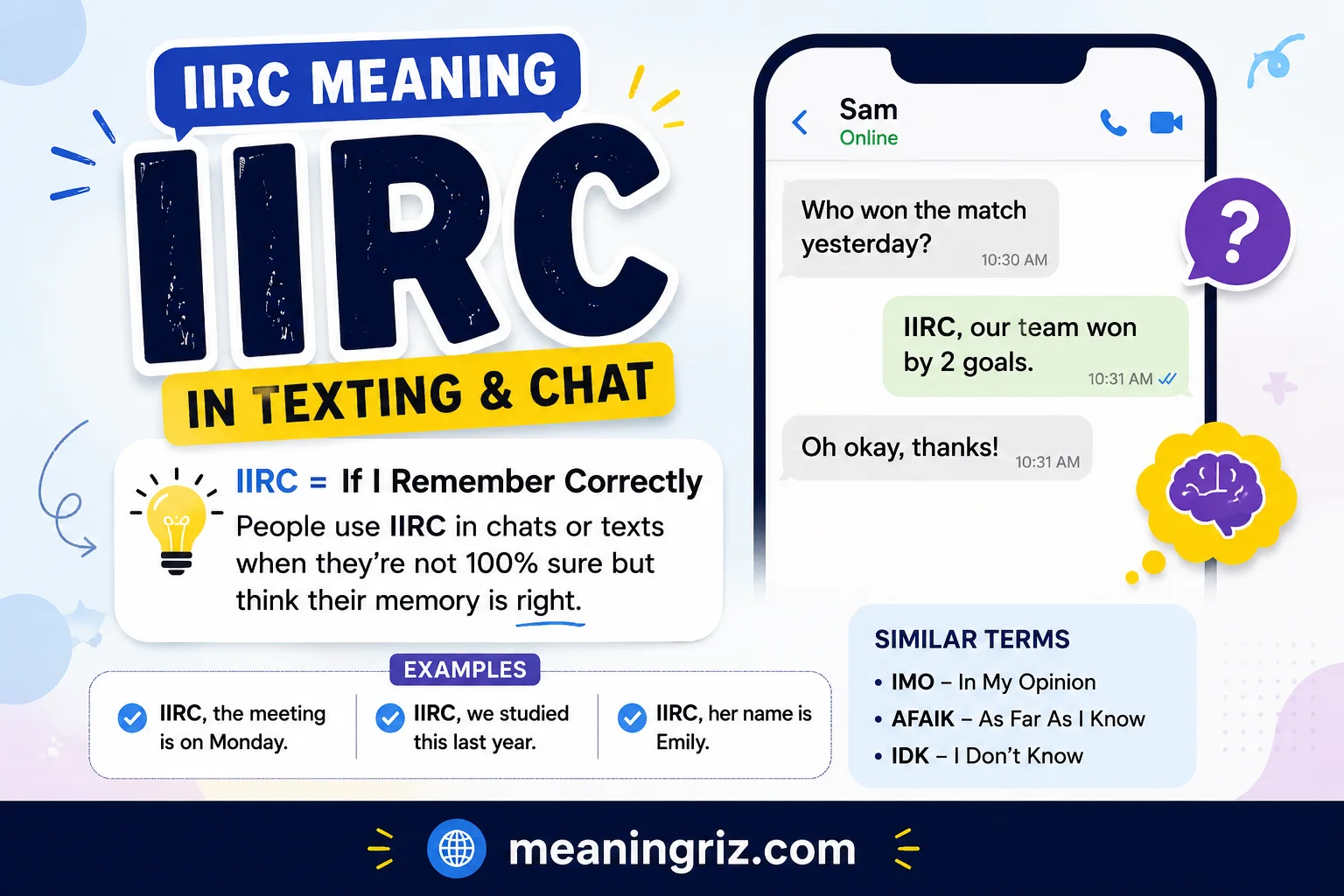
IIRC stands for “If I Recall Correctly” or “If I Remember Correctly.” It’s used when someone is sharing information from memory but isn’t fully certain it’s accurate. It signals: I believe this is right, but you can check me if I’m wrong.
Quick definition: IIRC = “If I recall correctly” — a polite hedge that softens a statement and signals the speaker isn’t 100% sure.
Both versions mean exactly the same thing. “Recall” and “remember” are interchangeable here, and people use whichever one feels more natural to them.
Where IIRC Came From
IIRC didn’t come from texting culture. It’s actually older than smartphones.
It originated in early internet forums and IRC chatrooms (Internet Relay Chat) in the late 1990s and early 2000s — back when people typed fast in real-time text conversations and abbreviations were practical, not trendy. Alongside BRB, LOL, and IMO, IIRC became a shorthand that stuck.
What made it last while many abbreviations faded is that it solves a real communication problem — how to share something you’re not 100% sure about, quickly, without sounding careless or overconfident. That problem hasn’t gone away.
The Deeper Function Nobody Talks About
Here’s what most articles miss: IIRC isn’t just about saving keystrokes. It does something socially useful.
When you say “IIRC, the deadline is Friday,” you’re doing three things at once: sharing information, admitting your uncertainty, and implicitly inviting someone to correct you. It’s a low-ego way to contribute to a conversation. You’re helping without claiming authority you don’t have.
This is why IIRC survives and thrives on platforms where accuracy actually matters — Reddit, Discord, Stack Exchange, Quora, tech forums. In those spaces, confidently stating something wrong is worse than admitting you’re not sure. IIRC gives you a socially graceful way to participate while leaving the door open for correction.
In casual texting between close friends, this matters less. But in any community where people debate facts, recall details, or share knowledge, IIRC is a genuinely useful tool.
Real-Life Usage Examples
Not the textbook kind — actual sentences people write.
Recalling a Fact You’re Not 100% Sure Of
“IIRC, you need a prescription for that in most states.” “iirc the show got cancelled after season 3” “IIRC she said she was moving in June, not July”
Recalling Something From a Past Conversation
“didn’t we already talk about this? iirc you said you were fine with it”
This use is particularly common in long group chats or threads where people scroll back and aren’t certain what was agreed.
In Online Discussions and Debates
“IIRC, the original study had a much smaller sample size than people claim”
Here IIRC does double work — it softens the correction while still making the point. It’s firm but not aggressive.
Casually Remembering Details
“iirc there’s parking behind the building, but double-check” “IIRC his birthday’s sometime in March”
These are the most everyday uses. No debate, no forum — just someone sharing a memory with an honest caveat attached.
How IIRC Is Used on Different Platforms
The meaning never changes. The vibe shifts depending on where you see it.
IIRC on Reddit
This is its natural habitat. Reddit threads are full of detailed discussions where people recall studies, dates, quotes, and past events. IIRC appears constantly because the culture rewards intellectual honesty — saying “IIRC” is better received than stating something wrong with confidence.
IIRC on Discord
Heavy in gaming servers and topic-based communities. People use it when recalling game mechanics, patch notes, or things said earlier in a long conversation. It fits the fast-paced, informal-but-informed tone of Discord.
IIRC on WhatsApp and iMessage
Less common here, and when it appears it’s usually from someone who spends a lot of time in online communities. In close-friend chats, people more often just say “I think” or “pretty sure.” IIRC in a casual text can sometimes feel a little formal or forum-brained.
IIRC on Twitter / X and Threads
Used in replies and quote-posts when correcting or adding to someone’s claim. It softens what might otherwise read as a blunt correction — “IIRC that’s not quite right” lands differently than “that’s wrong.”
IIRC on TikTok Comments
Less frequent than on text-based platforms, but it shows up in comment discussions, particularly under informational or educational content when someone wants to add context without sounding like they’re fact-checking aggressively.
When to Use IIRC — and When Not To
Use It When
- You’re sharing something from memory and genuinely aren’t certain
- You’re in a discussion where accuracy matters and you want to contribute without overclaiming
- You’re gently correcting someone but want to stay humble about it
- You’re recalling something from a past conversation, plan, or agreement
Don’t Use It When
- You’re actually sure — if you know something is correct, IIRC just adds unnecessary doubt to a true statement and can make you sound uncertain when you shouldn’t be
- You’re writing formally — emails, reports, academic work, or anything professional should use the full phrase “if I remember correctly” or avoid the hedge entirely
- The stakes are high — if someone is depending on your information for something important, a casual “iirc” isn’t the right signal
Is IIRC Rude?
No. It’s one of the more polite abbreviations in digital communication. By definition, it signals humility — you’re not claiming to be an authority, you’re sharing a memory and acknowledging it might not be perfect.
The only way it lands poorly is if it comes across as passive-aggressive. Something like:
“IIRC, I already told you this.”
That’s not really using IIRC for uncertainty about a fact. It’s weaponizing politeness as a subtle dig. The tone of the message around it matters.
Used genuinely — to share something you half-remember — it’s a respectful, low-pressure contribution to any conversation.
Why People Use This (Psychology)
There’s a reason IIRC persists while other abbreviations have faded: it taps into something real about how people communicate under social pressure.
No one wants to be wrong in public. Online spaces have memory — screenshots, scroll history, quote-replies. Being confidently incorrect in a thread is often more embarrassing than staying quiet. IIRC offers a middle path: you can contribute, share what you remember, and pre-emptively protect yourself from being fully “wrong” if the fact turns out to be off.
It’s a form of intellectual honesty signaling. People who use IIRC regularly in discussions tend to be perceived as more trustworthy, not less. You’re not bluffing. You’re showing your epistemic cards. In communities that value accuracy, that’s a social asset.
It reduces conflict. “IIRC, it was your idea” is softer than “it was your idea.” The hedge disarms defensiveness. The other person can agree, disagree, or check — without anyone’s ego taking a direct hit first.
This is the real reason IIRC has outlasted dozens of other abbreviations from its era: it solves an emotional problem, not just a typing one.
A Common Mistake People Make
The most frequent misuse is using IIRC when you’re actually certain.
If you know the meeting is at 3pm, saying “IIRC the meeting’s at 3” creates unnecessary uncertainty. People will second-guess the time, maybe check with someone else, and the extra friction came from your hedge, not from any real ambiguity. IIRC works because it’s honest. If you’re certain, be certain.
The second mistake is using it in formal writing as a shortcut. “IIRC, the contract was signed in Q3” in a professional email makes you look imprecise when you should be going back to confirm. Abbreviations don’t make vagueness professional.
IIRC vs. Similar Internet Abbreviations
People often mix IIRC up with terms that are close in feel but different in meaning.
| Term | Full Form | What It Expresses | Tone | Based On | Best Used In |
|---|---|---|---|---|---|
| IIRC | If I Recall Correctly | Uncertain memory | Humble, honest | Memory | Forums, Discord, Reddit, group chats |
| IMO | In My Opinion | Personal view | Casual, subjective | Opinion | Social media, debates, threads |
| IME | In My Experience | Personal experience | Grounded, first-person | Experience | Advice threads, communities |
| TBH | To Be Honest | Candid admission | Direct, slightly blunt | Feeling / honesty | Texting, social media |
| IDK | I Don’t Know | Total uncertainty | Neutral, open | No knowledge | Anywhere casual |
| AFAIK | As Far As I Know | Uncertain knowledge | Similar to IIRC | General knowledge | Forums, tech spaces |
The closest comparison is IIRC vs. AFAIK. They’re often used interchangeably, but there’s a subtle difference: IIRC implies you once knew this and are trying to recall it. AFAIK implies you’re sharing the best of your current knowledge, which may never have been confirmed. IIRC looks backward in time; AFAIK looks at what you currently hold to be true.
How to Respond When Someone Uses IIRC
When someone uses IIRC, they’re openly signalling uncertainty — so your response should honour that.
If They Got It Right
“Yeah, you’re correct — it was 2019.” “That’s right, iirc checks out!”
If They Got It Wrong
“Actually, I think it was 2020 — I can double-check though” “Pretty sure it’s a bit different — the study used a different methodology”
Responding with the same humility they showed keeps the exchange friendly. Hard corrections land better when they match the softness of the original message.
If You’re Also Not Sure
“iirc too honestly, probably worth checking” “I think you’re right but I’d verify before acting on it”
If You Can Confirm
“Just checked — you were right, it was March”
That last response is gold in any community. Someone flagged their uncertainty, you verified it, and now everyone has better information. This is IIRC working exactly as intended.
Frequently Asked Questions
What does IIRC mean in texting?
IIRC means “If I Recall Correctly” or “If I Remember Correctly.” It’s used to share something from memory while signalling you’re not fully certain it’s accurate.
Is IIRC formal or informal?
It’s informal. It’s fine in casual texting, online forums, and community chats. In professional emails, reports, or academic writing, write out the full phrase “if I remember correctly” — or better, verify the information before sending.
What’s the difference between IIRC and IDK?
They’re not the same. IIRC means you do have a memory of something but aren’t certain it’s accurate. IDK means you have no information at all. IIRC is a qualified answer; IDK is no answer.
What’s the difference between IIRC and AFAIK?
IIRC (“If I Recall Correctly”) refers specifically to memory — something you once knew and are trying to retrieve. AFAIK (“As Far As I Know”) refers to the limits of your current general knowledge, not necessarily something you’re actively trying to remember.
Is IIRC still used in 2026?
Yes, widely — especially on Reddit, Discord, forums, and in any text-based community where factual discussions happen. It’s less common in casual friend-group texting, where people tend to just say “I think” instead, but in knowledge-based communities it’s still a standard and trusted shorthand.
Can IIRC be used sarcastically?
Rarely, but yes. “IIRC, you said you’d handle this” can carry a sarcastic or pointed tone depending on context. The word itself isn’t sarcastic, but like any hedge, it can be used to soften a passive criticism.
The Bottom Line
IIRC means “If I Recall Correctly” — that part is simple. But what makes it actually worth understanding is what it does in a conversation: it lets you share information honestly, signal your own uncertainty, and invite correction without making the exchange feel confrontational.
It’s one of the few internet abbreviations that never stopped being useful, because the thing it solves — how to share something you half-remember without pretending you’re sure — comes up every single day in digital communication.
Once you start noticing it, you’ll see it everywhere. And once you start using it right, the people you’re talking with will trust what you say a little more — not less.
DISCOVER MORE ARTICLES
Bane of My Existence Meaning in Text: Usage, Tone & Examples
PU Meaning in Text Explained (All Meanings, Tone & Real Examples)
WYF Meaning in Text Explained (Usage, Tone & Real Examples)

I’m the person behind this website, handling both the writing and content management myself. I focus on explaining word meanings, slang, and modern expressions in simple, clear language, using real-life examples so readers can understand how these terms are actually used in everyday conversations.