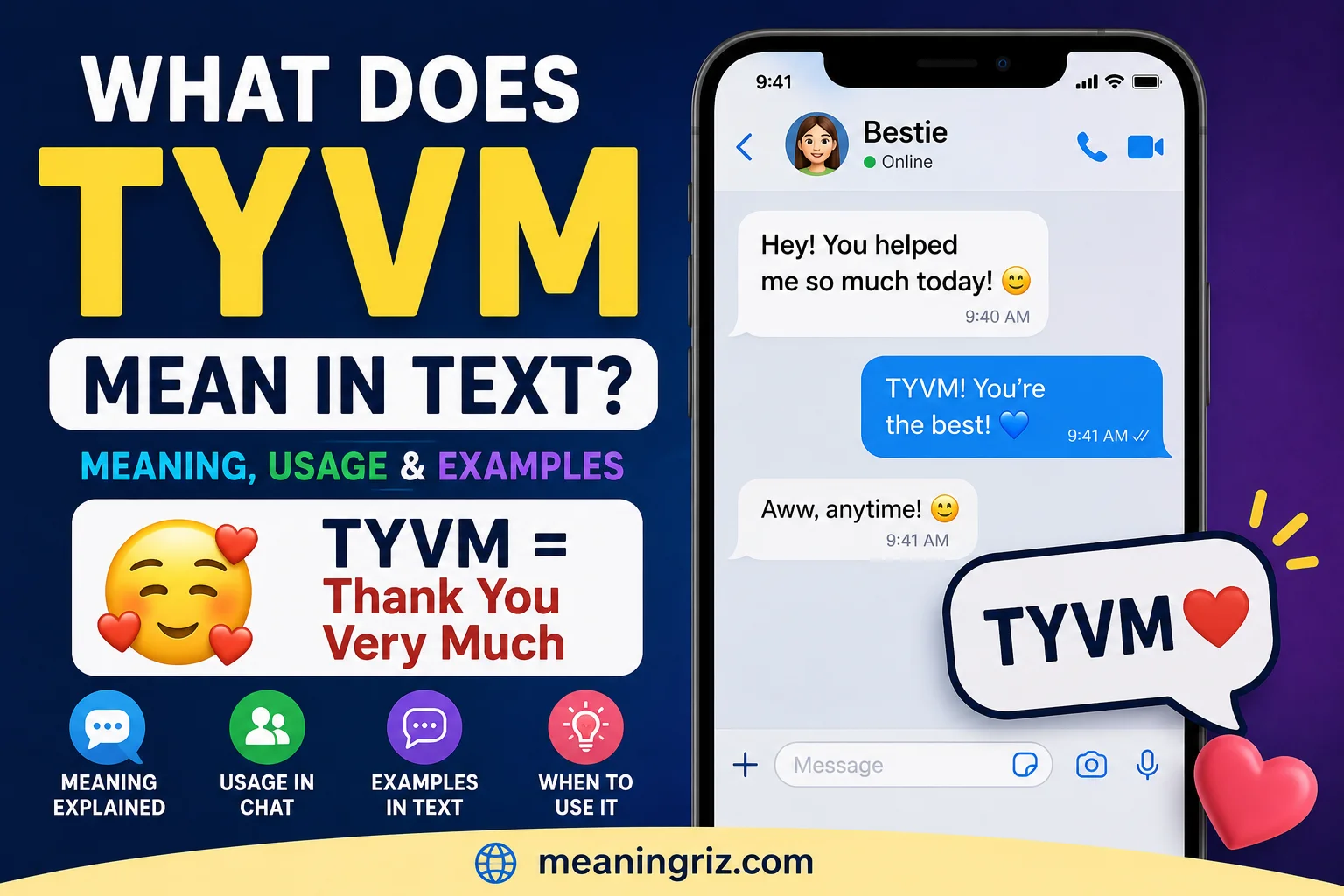
Someone helps you out, you text back “tyvm,” and you don’t think twice about it.
But then you see it in a message to you — maybe from someone you don’t know that well, or in a tone that feels a little off — and suddenly you’re wondering: is this genuine? Is this sarcastic? Is this just lazy typing?
Here’s the clear answer, plus everything that actually matters around it.
What Does TYVM Mean?
TYVM stands for “Thank You Very Much.” It’s a slightly more expressive version of “ty,” used in texting, social media, and online chats when someone wants to show a bit more appreciation than a plain “thanks.”
TYVM = “Thank you very much” — a quick, informal way to express genuine gratitude, slightly stronger in tone than “ty” but more casual than typing out the full phrase.
That’s the core meaning. The part that actually trips people up is tone — because TYVM can mean real gratitude, polite distance, or sharp sarcasm, and the three letters alone won’t tell you which.
The Simple Meaning, Without the Overthinking
TYVM is built the same way most thank-you abbreviations are: take the phrase, keep the first letter of each word, done. “Thank You Very Much” becomes four letters you can type in under a second.
It sits in a small family of gratitude shorthand that escalates in intensity:
- TY — Thank you (plain, quick)
- TYVM — Thank you very much (a step up, more deliberate)
- TYSM — Thank you so much (more emotional, more enthusiastic)
People don’t always think about this hierarchy consciously, but they use it instinctively. Typing the extra letters in TYVM signals that you took half a second longer to acknowledge someone — which, in texting, actually counts as effort.
But the Meaning Shifts Depending on Tone
This is where most explanations stop too early. TYVM on its own is neutral. What changes everything is what surrounds it.
1. Genuine gratitude. Someone helps you move, sends you a useful link, or covers your shift — “tyvm, you’re a lifesaver” reads as real, warm appreciation.
2. Polite acknowledgment. In a group chat or with someone you don’t know well, “tyvm” can just be good manners — closing the loop without making it personal.
3. Sarcasm. “Tyvm for telling me five minutes before the meeting” is not gratitude at all. It’s frustration wearing a polite mask, and the context around it makes that obvious fast.
4. Mild distance. Sometimes TYVM is used precisely because it’s a little more formal than “ty” — it can create a small, polite gap rather than closeness, especially with someone you’re not fully comfortable with yet.
Same four letters, four very different emotional jobs. Reading TYVM correctly means reading the sentence around it, not the abbreviation itself.
Real Chat Examples (How It Actually Looks)
Not the dictionary version — the version that shows up in actual conversations.
A Genuine Thank-You Between Friends
Sam: just dropped the package off for you You: tyvm!! you didn’t have to do that
A Polite Reply in a Group Chat
“tyvm for organizing this everyone, see you Saturday”
This one is closing the conversation politely, not expressing deep emotion — it’s social glue, not a big feeling.
Sarcastic TYVM
“oh tyvm for reminding me an hour late 🙃”
The emoji and timing make the sarcasm obvious. Without them, this same line could easily be read as genuine, which is exactly why tone markers matter so much in text.
Professional-Adjacent Use
“Got the files, tyvm for the quick turnaround”
Common in informal work chats — Slack, casual email threads, team group chats — where you want politeness without sounding stiff.
Platform-by-Platform: Does TYVM Change Meaning?
The definition doesn’t shift across platforms. What shifts is how often it’s used and what it tends to signal.
TYVM on WhatsApp
Common in personal and family chats, usually genuine. People use it after receiving help, gifts, or favors — straightforward gratitude with no hidden layer.
TYVM on Instagram
Shows up a lot in comments and DMs after compliments or shoutouts. Often paired with emojis (🙏❤️) to make the warmth obvious, since text alone can feel flat in a quick reply.
TYVM on TikTok
Frequently used in comment replies — creators thanking followers for support, or commenters thanking each other for tips. Tends to be light and quick, rarely sarcastic here.
TYVM in Gaming Chats
Very common after a teammate helps out — a clutch save, a useful item, good callouts. Short, genuine, and functional: it keeps the game moving without breaking focus.
TYVM in Texting (SMS/iMessage)
The most likely place to see sarcastic TYVM, because personal texting carries more emotional weight and history between two people, which makes sarcasm easier to read correctly.
When to Use TYVM (And When Not To)
When It’s Fine to Use
- Thanking a friend, family member, or coworker for something specific
- Replying to a compliment, gift, or favor on social media
- Casual group chats, gaming, or informal work messages
When to Avoid It
- Formal emails, cover letters, or first messages to someone senior or unfamiliar
- Situations where sincerity really needs to come through clearly (a heartfelt thank-you deserves full words)
- Any moment where sarcasm could be misread as genuine and cause real confusion
A simple rule: if the moment deserves real warmth, type the actual words. TYVM is great for quick, casual gratitude — but it can flatten something that deserves more weight if used on autopilot.
Is TYVM Rude?
Not by default — but it has two ways of landing wrong.
It can feel a little hollow if it’s used as a reflex, sent the same way to every “thanks” without any real attention behind it, almost like a stock reply rather than an actual reaction.
It can also feel sharp when it’s sarcastic, especially in writing where the lack of tone of voice makes the line between “thank you” and “thanks for nothing” thinner than people realize.
Used genuinely, with the right context around it, TYVM reads as perfectly polite and even a little warmer than a flat “ty.”
Why People Use This (Psychology)
There’s a small but real reason TYVM gets chosen over plain “ty” in certain moments.
Adding letters signals added effort. In texting, the length of a reply often gets read as a proxy for how much someone cares. “Ty” can feel rushed; “tyvm” feels like the person paused for a beat longer, which makes the gratitude feel slightly more deliberate even though it’s only one extra syllable’s worth of typing.
It softens situations where gratitude needs to feel safe to express. People sometimes reach for TYVM instead of a longer, more emotional thank-you because it lets them express real appreciation without feeling overly vulnerable — it’s warm, but it has a built-in exit if the moment gets too sincere.
Sarcastic TYVM works because politeness markers make frustration sharper. Saying “thanks for nothing” sounds blunt. Saying “tyvm” in a clearly frustrating moment borrows the shape of politeness and weaponizes it — the gap between the polite wording and the obviously annoyed context is what creates the sting. This is a pattern worth noticing: the more polite the phrasing, the sharper the sarcasm lands when the context doesn’t match.
One real observation from how people actually text: genuine TYVM almost always shows up with something else — an emoji, an exclamation mark, extra context about what they’re thankful for. Bare, flat “tyvm” with nothing else around it, especially as a reply to something that took real effort, is one of the more common signals that the gratitude is thinner than it looks.
A Common Mistake People Make
The most frequent misread is assuming TYVM is automatically warmer than “ty” just because it’s longer. Length doesn’t guarantee sincerity — tone, timing, and what came before the message matter far more. A flat “tyvm” with no punctuation after someone went out of their way can actually feel more dismissive than a simple “thank you so much, really.”
TYVM vs. Similar Gratitude Slang
People mix these up constantly because they all express thanks, but the intensity and tone differ.
| Term | Meaning | Typical Tone | Emotional Undertone | Risk of Misreading | Best Used In |
|---|---|---|---|---|---|
| TY | Thank you | Quick, casual | Light, low-effort | Low | Fast replies, casual chats |
| TYVM | Thank you very much | Polite, slightly more deliberate | Genuine or sarcastic, depending on context | Medium — sarcasm can be missed | Friends, group chats, informal work messages |
| TYSM | Thank you so much | Warm, enthusiastic | Strong, emotional appreciation | Low | Close friends, heartfelt moments |
| THX | Thanks | Very casual, almost reflexive | Neutral, low warmth | Low | Quick acknowledgments |
| TUVM | Thank you very much (variant) | Same as TYVM | Same as TYVM | Medium | Regional or personal typing habit |
The key difference worth remembering: TYVM sits in the middle of the gratitude scale — more deliberate than “ty,” less emotionally intense than “tysm.” That middle position is exactly why it’s flexible enough to be genuine, polite, or sarcastic depending on what surrounds it.
How to Respond to “TYVM” (By Tone)
Friendly Reply
“Anytime! Glad it helped 😊”
Neutral / Practical Reply
“No problem, let me know if you need anything else”
Playful Reply
“Tyvm noted, I expect a parade in my honor 👑”
Smart / Confident Reply
“Of course — that’s what I’m here for”
The pattern across all of these: a good reply usually mirrors the warmth level of the original message rather than escalating or flattening it. If someone sends a heartfelt “tyvm,” a dry “np” can feel like a mismatch, even if that’s not the intent.
Frequently Asked Questions
What Does TYVM Mean in a Text Message?
TYVM means “Thank you very much.” It’s a slightly more expressive version of “ty,” used to show appreciation quickly in texting, DMs, and group chats.
Is TYVM the Same as TYSM?
Not exactly. TYVM means “thank you very much,” while TYSM means “thank you so much.” TYSM tends to carry more emotional intensity, while TYVM sits a bit more in the polite-but-casual middle ground.
Can TYVM Be Sarcastic?
Yes. When someone is clearly frustrated and replies with “tyvm” — especially with an emoji like 🙃 or in a context where help clearly wasn’t actually helpful — it usually means the opposite of genuine thanks.
Is TYVM Appropriate for Work Messages?
It works fine in casual work chats like Slack or team group messages. For formal emails or messages to senior colleagues you don’t know well, spelling out “thank you very much” reads as more professional.
Does TYVM Mean Something Different on Social Media?
The meaning stays the same everywhere. What changes is the likely intent — on Instagram and TikTok it’s usually light and genuine, while in personal texting it has a higher chance of being sarcastic given the closer relationship context.
Why Do People Add “VM” Instead of Just Saying “TY”?
The extra letters signal a touch more effort and warmth than a plain “ty.” It’s a small way of making a quick thank-you feel slightly more deliberate without typing out the full sentence.
The Bottom Line
TYVM means “thank you very much” — simple on the surface. What actually matters is reading the moment around it: was there an emoji, a context, a tone that confirms it’s genuine, or is the politeness covering some real frustration? Once you start noticing what surrounds the abbreviation instead of just the abbreviation itself, TYVM becomes easy to read correctly every time.
DISCOVER MORE ARTICLES
FWIW Meaning in Chat, Texting & Social Media
GMFU Meaning in Text Explained (Usage, Tone & Real Examples)
TB Meaning in Text Explained (Usage, Tone & Examples)
What Does HN Mean in Text? (Meaning, Tone & Real Examples)
GTG Meaning in Text Explained (Usage, Tone & Real Examples)