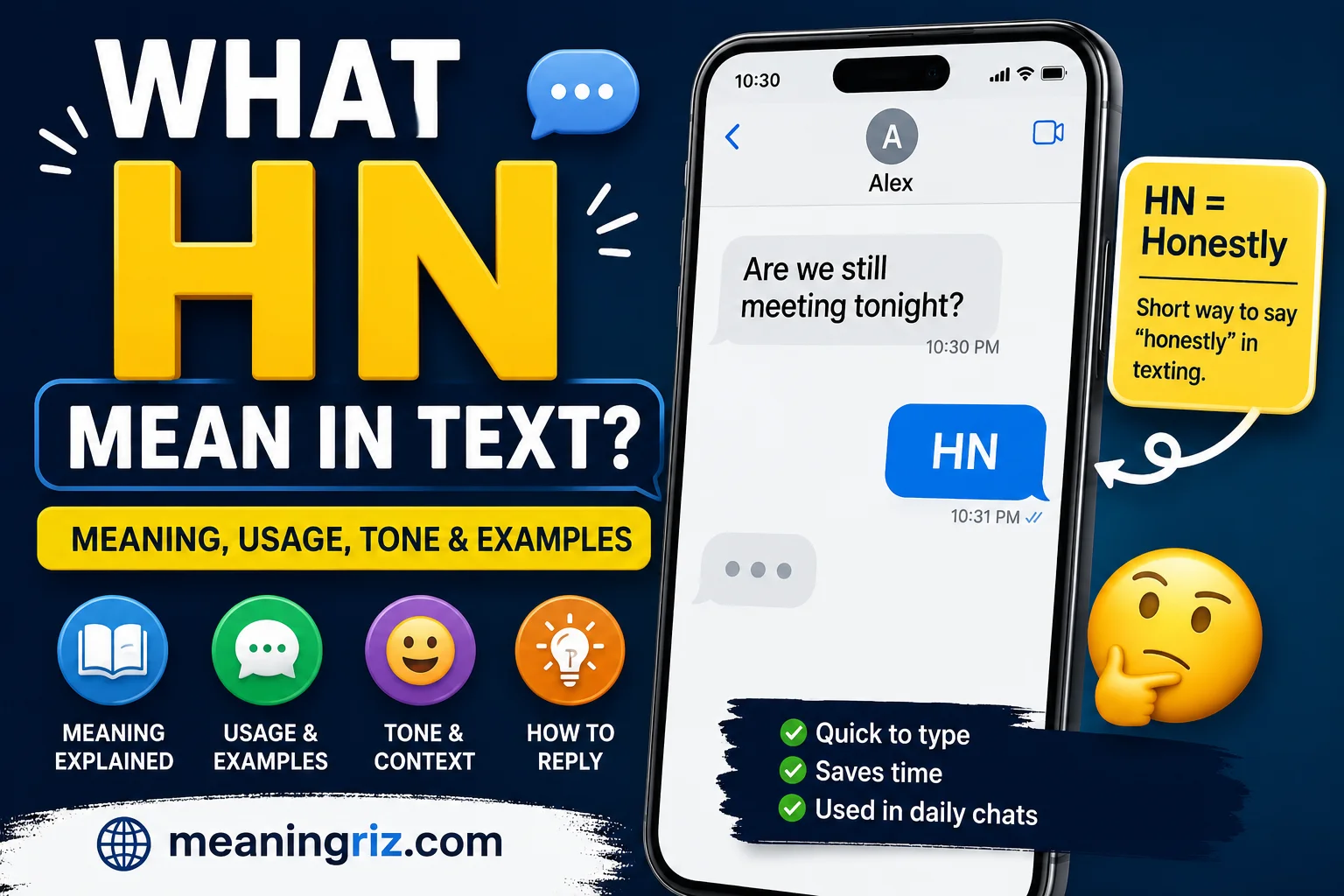
You’re scrolling through a chat, someone asks you something, and the reply comes back:
“hn”
That’s it. No punctuation, no emoji, nothing else. And now you’re sitting there wondering — was that a yes? A no? Did they even mean to send that?
You’re not overthinking it for nothing. HN is one of those rare texting abbreviations that genuinely means different things to different people, and getting it wrong can flip the entire meaning of a conversation.
What Does HN Mean?
HN most commonly means “Hell No” — a strong, casual way of refusing or rejecting something. But it has a second major meaning too: in South Asian texting (Hindi/Urdu), HN often means “Haan,” which means “yes.” A third, softer use treats it as a quick version of “hmm” — a thinking or hesitation sound.
That’s three possible meanings from two letters. Which one applies depends entirely on who sent it, what was asked, and what kind of conversation you’re already having.
The Core Meaning, Without the Confusion
If you only remember one thing from this article, remember this: HN is almost never neutral. It’s either a firm “no,” a casual “yes,” or a verbal shrug — and you can usually tell which one within a second of rereading the message before it.
Here’s the breakdown of where each meaning comes from and who tends to use it.
HN as “Hell No”
This is the most common meaning in English-speaking texting culture, especially among teens and young adults in the US, UK, Canada, and Australia. It’s used to reject an idea fast, often with a bit of attitude or humor.
“Can you cover my shift at 6am?” “hn bro, I just got to sleep”
HN as “Haan” (Yes)
In South Asian texting culture — particularly in Hindi and Urdu-influenced chats — “HN” is shorthand for “Haan,” which simply means “yes” or “okay.” This usage is completely unrelated to the English “Hell No” meaning, and it’s just as common within that context.
“Are you coming to the wedding?” “hn, I’ll be there by 6”
HN as “Hmm” (Thinking or Hesitation)
A quieter, less dramatic use. Here, HN works like a typed version of pausing out loud — showing you’re thinking, unsure, or not ready to give a full answer yet.
“Do you want to go skydiving this weekend?” “hn… maybe”
How to Tell Which Meaning Someone Means
This is the part most explanations skip, and it’s the one that actually matters when you’re staring at a message trying to decide how to feel about it.
Look at What Was Asked
If the question was a yes/no question and the reply feels abrupt or sarcastic, it’s probably “Hell No.” If the question was something simple like a plan or invitation and the reply feels relaxed, it’s more likely “Haan” (yes) — especially if the sender’s texting style leans South Asian or you’ve seen them use “haan” spelled out before.
Look at the Punctuation and Emojis
“hn 😭” or “hn lol” almost always leans toward “Hell No,” delivered with humor. A plain “hn” with no emoji, especially followed by trailing dots like “hn…” usually signals hesitation rather than a hard refusal.
Look at the Relationship and Past Texting Habits
If someone has used “haan” or other Hindi/Urdu slang with you before, “HN” from them is very likely “yes.” If someone’s texting style is mostly English slang and sarcasm, “HN” is almost certainly “Hell No.”
Real Chat Examples (How It Actually Looks)
Friend Group, Casual Rejection
Alex: movie night tonight? Sam: hn, I’m exhausted
Here it’s a relaxed “hell no” — not anger, just a tired decline.
Reacting to Something Shocking
“She said she’s never heard of Beyoncé.” “hn 😭 how?!”
This isn’t really refusal at all — it’s a reaction of disbelief, using “hell no” as an exclamation rather than a literal answer.
South Asian Family or Friend Chat
“Are you free for dinner tonight?” “hn, what time?”
Here “hn” clearly means “yes,” confirmed by the natural follow-up question asking for details.
Hesitant or Thinking Response
“Should I text him back?” “hn… I don’t know, maybe wait”
The trailing “hn” plus the unsure follow-up makes it clear this is hesitation, not a firm answer either way.
HN Across Different Platforms
The core meanings don’t change by platform, but the likely meaning shifts slightly depending on where you see it.
HN on WhatsApp
WhatsApp is heavily used across South Asia for everyday family and friend chats, so “HN” here leans more often toward “Haan” (yes) than the English “Hell No,” especially in group chats with relatives.
HN on Snapchat
Snapchat’s fast, reaction-heavy style makes “HN” lean toward “Hell No,” often paired with emojis for comedic effect rather than a genuine refusal.
HN on Instagram DMs and Comments
Common as a quick, expressive reaction to a post or message — almost always the “Hell No” meaning here, used for emphasis rather than literal disagreement.
HN in Gaming Chats
Gamers often use “hn” as a fast acknowledgment during quick-paced team communication, closer to the “hmm” or “noted” meaning than either of the other two.
When to Use HN (And When Not To)
When It’s Fine to Use
- Texting close friends who already understand your slang style
- Reacting to something surprising or funny
- Casual group chats where short replies are normal
When to Avoid It
- Messaging a boss, teacher, or anyone in a formal context — the ambiguity alone makes it risky
- Talking to someone unfamiliar with either meaning, where it could easily be misread
- Serious or emotional conversations where a real answer matters more than speed
A simple rule that holds up well: if a misunderstanding here would actually matter, skip the abbreviation and type the real word. HN saves three letters but risks the entire message.
Is HN Rude?
Not inherently — but it can come across that way more easily than most slang, simply because the ambiguity itself can feel dismissive.
It can feel cold when used as a flat refusal with no explanation, especially if the other person was hoping for more than a two-letter answer.
It can feel confusing rather than rude when the reader doesn’t share the same cultural context — someone expecting “yes” and reading “Hell No” instead (or the reverse) can walk away from the conversation with the exact opposite impression of what was meant.
It’s rarely rude between people who already share the same texting habits, since both sides already know which meaning applies before the message even arrives.
Why People Use This (Psychology)
There’s something worth noticing underneath all three meanings of “HN”: each version trades clarity for speed, but the kind of clarity being traded away is different every time.
“Hell No” compresses emotion, not information. The sender already knows their answer; they’re just choosing the fastest, most expressive way to deliver it. Typing “no” feels flat. Typing “HN” carries attitude in two letters.
“Haan” (yes) compresses effort, not emotion. This version isn’t about expressiveness at all — it’s just the natural texting shorthand for a word people already say constantly in spoken conversation. There’s no hidden tone shift; it’s simply faster typing.
“Hmm” compresses uncertainty into something postable. This is the most emotionally honest version. Real hesitation doesn’t always have words yet, and “hn” lets someone respond without committing to a position before they’re ready to.
One observation that holds up across all three versions: the shorter someone’s reply, the more the reader fills in the missing tone themselves — usually based on their own mood, not the sender’s. This is exactly why HN causes more mix-ups than slang that has only one meaning. The reader isn’t just guessing the word; they’re guessing the entire emotional register of the message.
A Common Mistake People Make
The biggest misread is assuming HN always carries the same meaning as the last time you saw it, even when the conversation, platform, or person is completely different. Someone who uses “HN” to mean “Haan” in one chat won’t suddenly switch meanings because you’re used to the “Hell No” version — and assuming otherwise is how genuinely simple yes-or-no questions turn into actual misunderstandings.
HN vs. Similar Texting Slang
| Term | Meaning | Typical Tone | Emotional Undertone | Risk of Misreading | Best Used In |
|---|---|---|---|---|---|
| HN | Hell No / Haan (yes) / Hmm | Varies sharply by context | Refusal, agreement, or hesitation | Very high — three possible meanings | Close friends, shared texting context |
| NAH | No | Casual, relaxed | Mild refusal | Low | Friends, casual chats |
| HAAN (spelled out) | Yes | Friendly, clear | Agreement | Very low | South Asian texting, any clarity-first chat |
| IDK | I don’t know | Neutral to uncertain | Genuine uncertainty | Low | Casual conversations needing an honest answer |
| SMH | Shaking my head | Disapproving, exasperated | Disappointment or disbelief | Medium | Reacting to something frustrating |
The key difference worth remembering: most slang abbreviations carry one meaning with a flexible tone. HN carries multiple meanings with a flexible tone — which is exactly why it causes more confusion than almost anything else on this list.
How to Respond to “HN” (By Tone)
Friendly Reply (If You Think It Means Yes)
“Awesome, see you there!”
Neutral Reply (If You’re Not Sure Which Meaning They Meant)
“Wait, is that a yes or no? 😂”
Playful Reply (If It Clearly Means “Hell No”)
“Lol fair enough, another time then”
Smart / Confident Reply (To Match Hesitation)
“Take your time, no rush”
Asking for clarification isn’t awkward here — it’s actually the smartest move, since this is one of the few abbreviations where guessing wrong genuinely changes the outcome of the conversation.
Frequently Asked Questions
What Does HN Mean in a Text From a Girl or Guy?
The meaning doesn’t change based on gender — it depends on the sender’s cultural and texting background, not who they are. The same person will use “HN” consistently to mean whichever version fits their usual style, regardless of who they’re texting.
Is HN the Same as “Hell No” Spelled Out?
Usually, yes, when used in English-speaking casual chats. But because “HN” also commonly means “Haan” (yes) in South Asian texting, the abbreviated version isn’t always interchangeable with the full phrase “Hell No.”
Why Does HN Mean Both Yes and No?
Because the abbreviation developed independently in two different language contexts — “Hell No” in English slang, and “Haan” (yes) in Hindi/Urdu texting — and both versions spread through messaging apps without either one replacing the other.
Is It Okay to Just Send “HN” Without Explaining?
It depends entirely on whether the other person shares your texting context. Between close friends with a shared slang style, it’s perfectly normal. With someone new or unfamiliar with either meaning, it’s safer to spell out your answer.
Does HN Mean Something Different on Snapchat or WhatsApp?
The two core meanings stay the same everywhere, but the odds shift by platform — WhatsApp usage leans more toward “Haan” (yes) in South Asian chats, while Snapchat usage leans more toward “Hell No” in Western casual chats.
Can HN Be Used in a Professional Setting?
It’s best avoided. Beyond being too casual for work conversations, the genuine risk of being misread as the opposite of what you meant makes it a bad fit anywhere clarity actually matters.
The Bottom Line
HN isn’t a simple two-letter word — it’s really three different short replies wearing the same disguise. Once you start checking the question being asked, the punctuation around it, and the sender’s usual texting style, you’ll know almost instantly whether you just got a firm “no,” a casual “yes,” or someone still thinking it over.
DISCOVER MORE ARTICLES
FWIW Meaning in Chat, Texting & Social Media
WYA Meaning in Text Explained (Usage, Tone & Real Examples)
GMFU Meaning in Text Explained (Usage, Tone & Real Examples)
TB Meaning in Text Explained (Usage, Tone & Examples)

I’m the person behind this website, handling both the writing and content management myself. I focus on explaining word meanings, slang, and modern expressions in simple, clear language, using real-life examples so readers can understand how these terms are actually used in everyday conversations.