You open a message and it just says:
“tb?”
No follow-up, no emoji, nothing else. Now you’re sitting there trying to figure out if your friend wants you to text them back, or if they’re about to post an old photo with a caption you won’t understand for ten more seconds.
Here’s the short answer, then the full picture.
What Does TB Mean?
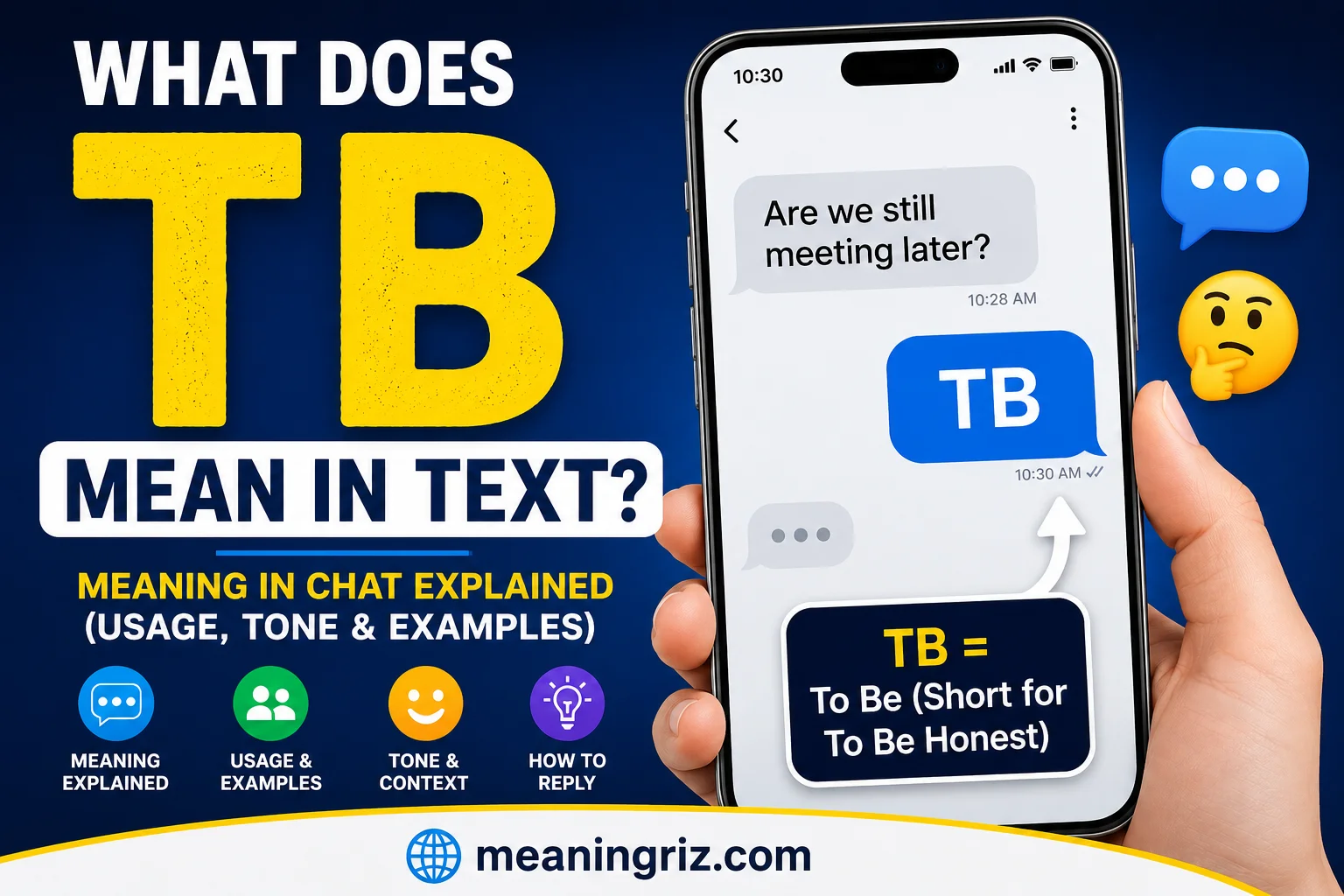
TB has two common meanings, and they’re almost opposites in how they’re used. In direct messages, TB usually means “Text Back” — a quick nudge to reply. On social media, especially Instagram and Facebook captions, TB usually means “Throwback” — a nostalgic look at an old photo or memory.
The letters never change. The meaning depends entirely on where you see them.
The Featured Snippet Version
TB = “Text Back” (in DMs and chats) or “Throwback” (in social media captions). The correct meaning depends on the platform and the sentence around it — not the letters themselves.
That’s the part most guides bury under a list of ten possible meanings. In real life, you only need to know two, and the context tells you which one instantly.
Why TB Has Two Completely Different Meanings
This isn’t actually confusing once you see the pattern. TB grew out of two separate texting habits that happened to land on the same abbreviation.
“Text Back” comes from private messaging. When someone’s waiting on a reply, typing “please text me back” feels slow. “TB” does the same job in two letters.
“Throwback” comes from social media culture. Posting an old photo with “TB to…” became a habit on Instagram years ago, and it never really left — it just became shorthand that doesn’t need a specific day attached to it, unlike TBT (Throwback Thursday).
So the split isn’t random. It’s two different communities using the same shortcut for two different reasons, and both stuck around.
TB as “Text Back”
This version shows up in one-on-one chats, group texts, and DMs — basically anywhere someone is waiting on you to reply.
What It Sounds Like in Real Chats
A friend following up:
“Hey, sent you something earlier — tb when you can”
A slightly impatient version:
“tb???”
Extra punctuation here usually means they’ve been waiting a while, not that anything is wrong.
A soft reminder, not a demand:
“no rush, just tb whenever”
What It Actually Feels Like to Receive
A plain “tb” with nothing else can feel a little flat, almost like a chore notification. It’s not meant to be cold — it’s just efficient. The tone almost always comes from whatever was said right before it, not the abbreviation itself.
TB as “Throwback”
This version lives almost entirely in captions and social posts, not private chats.
What It Sounds Like in Real Posts
A simple caption:
“tb to summer 🌞”
Paired with a specific memory:
“tb to this trip, miss this so much 😩”
Used playfully, not seriously:
“tb to when I thought I could sing 😂”
Why People Post It
Sharing an old photo with “tb” is a low-effort way to bring up a memory without writing a whole caption explaining it. The photo does the emotional work; the two letters just signal “this is from the past, not today.”
Platform-by-Platform: Where Each Meaning Shows Up
TB on Instagram
Almost always “Throwback.” Instagram’s caption culture made this the dominant meaning here, especially on posts and Stories featuring old photos.
TB on Facebook
Same as Instagram — overwhelmingly “Throwback,” often attached to memories, anniversaries, or old photos resurfacing in someone’s feed.
TB on Snapchat
Can go either way, but leans toward “Text Back” in direct chats, since Snapchat is built more around private messaging than public captions.
TB on WhatsApp
Almost always “Text Back.” WhatsApp is a private messaging app first, so the caption-style “Throwback” use rarely shows up here.
TB on TikTok
Mostly “Throwback” in captions and comments, often tied to nostalgic sounds or old-photo trends, though it occasionally appears as “Text Back” in comment replies.
TB in Regular Texting (SMS/iMessage)
Almost always “Text Back.” There’s no caption format in a regular text thread, so the nostalgic meaning rarely applies here.
When to Use TB (And When Not To)
When It’s Fine to Use
- You’re nudging a friend who hasn’t replied yet
- You’re captioning an old photo on social media
- The person you’re texting already uses casual slang with you
When to Avoid It
- You’re messaging a boss, client, or anyone in a formal context — “please get back to me when you can” reads far better
- The conversation is the first message to someone new
- You actually need an urgent reply — a plain “tb” can get lost or ignored precisely because it feels low-pressure
A simple way to check yourself: if the situation genuinely matters, type the full sentence. Slang is for situations where a slow reply wouldn’t be a real problem.
Is TB Rude?
Not inherently, but it can land wrong depending on how it’s sent.
A bare “tb” with no greeting and no explanation can feel demanding, especially from someone you don’t text often — there’s no warmth in it, just an instruction.
Repeated “tb” messages without a response in between can start to feel like pressure, even if that’s not the intent. The repetition is what shifts the tone, not the word itself.
Between people who already text casually, it almost never reads as rude. It’s just shorthand for something you’d say anyway.
Why People Use This (Psychology)
There’s more going on here than just saving keystrokes.
“Text Back” works as a low-effort way to ask for attention without sounding needy. Spelling out “please reply to me” feels like admitting you’re waiting. “TB” keeps the same request but makes it sound casual instead of urgent, which protects the sender from feeling too exposed if the reply takes a while.
“Throwback” gives people permission to be nostalgic without seeming overly sentimental. Posting an old photo with a full paragraph about how much you miss that time can feel like too much. “TB” lets the photo carry the emotion while the caption stays light, which makes vulnerability easier to share publicly.
Both versions reduce the social risk of being ignored. A short message feels less personal if it goes unanswered. This is part of why two-letter abbreviations like TB became so common in the first place — they lower the emotional stakes of reaching out, whether that’s asking for a reply or sharing a memory.
One real observation worth noticing: people rarely send “tb” to someone they’re not already comfortable with. The slang itself is a small signal of familiarity — strangers and new contacts almost always get the full sentence instead.
A Common Mistake People Make
The biggest mix-up is reading “tb” the wrong way based on habit instead of context. Someone used to seeing it as “Throwback” on Instagram might misread a “tb” text from a friend as nostalgic, when it’s actually just a reminder to reply — and vice versa. Always check where the message showed up before deciding what it means.
TB vs. Similar Texting Slang
| Term | Meaning | Typical Tone | Emotional Undertone | Risk of Misreading | Best Used In |
|---|---|---|---|---|---|
| TB | Text Back / Throwback | Casual, can be a nudge or nostalgic | Mild urgency or nostalgia | High — meaning fully depends on context | DMs (Text Back) or captions (Throwback) |
| TBT | Throwback Thursday | Playful, nostalgic | Nostalgia, lighthearted | Low | Captions, specifically on Thursdays |
| PTB | Please Text Back | More direct version of TB | Slight urgency | Low | When a plain “tb” feels too soft |
| BRB | Be Right Back | Practical, neutral | None — purely logistical | Low | Mid-conversation pauses |
| OTW | On the Way | Reassuring, practical | Confidence | Low | Replying to someone waiting |
The key difference worth remembering: TBT is locked to a day and a meaning — TB is flexible and depends entirely on where it shows up. That flexibility is exactly why it causes more confusion than its more specific cousin.
How to Respond to “TB” (By Tone)
Friendly Reply
“Omg yes replying now, sorry!”
Neutral / Practical Reply
“Saw it, will reply properly tonight”
Playful Reply
“Tb to me forgetting to text back lol, here I am”
Smart / Confident Reply
“Got it. Give me a sec, worth the wait 😉”
If “tb” was used as “Throwback” on a post instead, the natural response is simpler — react to the memory itself: “this photo is everything” or “I miss this so much” both work better than treating it like a question that needs answering.
Frequently Asked Questions
What Does TB Mean in a Text From a Guy or Girl?
The meaning doesn’t change based on who sends it — it’s still either “Text Back” or “Throwback” depending on context. Gender has no effect on which meaning applies; the platform and surrounding message do.
Is TB the Same as TBT?
Not quite. TBT (Throwback Thursday) is specific to that day and almost always nostalgic. TB is more flexible — it can mean the same nostalgic thing any day of the week, or mean “Text Back” entirely depending on where it’s used.
Is It Rude to Send Just “TB” With Nothing Else?
It can feel a little blunt, especially to someone you don’t text often. Adding even a few words — “hey, tb when free” — softens it considerably without losing the quick, casual tone.
Does TB Mean Something Different on Instagram Than in Texting?
Yes, and this is the most common confusion. On Instagram and Facebook, TB almost always means “Throwback.” In private chats and DMs, it almost always means “Text Back.” Same letters, different worlds.
Can TB Be Used in a Professional Setting?
It’s better avoided. “Please get back to me when you can” reads as polite and clear, while “tb” can come across as too casual or even confusing if a colleague isn’t familiar with the slang.
Does TB Ever Mean Anything Other Than Text Back or Throwback?
Occasionally. In gaming, it can mean “Take Back” (undoing a move). In tech contexts, it stands for terabyte. In medical conversations, it refers to tuberculosis. These uses are rare in everyday texting and almost never apply in a casual chat or caption.
The Bottom Line
TB isn’t one word with one meaning — it’s two common meanings wearing the same two letters. In a DM, it’s almost always asking for a reply. In a caption, it’s almost always pointing back at a memory. Once you notice which world the message showed up in, the confusion disappears completely.
DISCOVER MORE ARTICLES
What Does PMO Mean in Text? (Usage, Tone & Examples)
What Does LCL Stand for in Chat? Explained Simply
FWIW Meaning in Chat, Texting & Social Media
WYA Meaning in Text Explained (Usage, Tone & Real Examples)
GMFU Meaning in Text Explained (Usage, Tone & Real Examples)
What Does NRN Mean in Text? (Meaning, Usage & Examples)

I’m the person behind this website, handling both the writing and content management myself. I focus on explaining word meanings, slang, and modern expressions in simple, clear language, using real-life examples so readers can understand how these terms are actually used in everyday conversations.