You’re scrolling through a chat and someone drops: “ngl I fwy with you.”
No explanation. No context clue. Just three letters that look like a typo at first glance — until you realize it’s actually a real word in someone’s text vocabulary, and you have no idea what they just said about you.
Here’s the quick answer, then we’ll get into the parts that actually matter.
What Does FWY Mean?
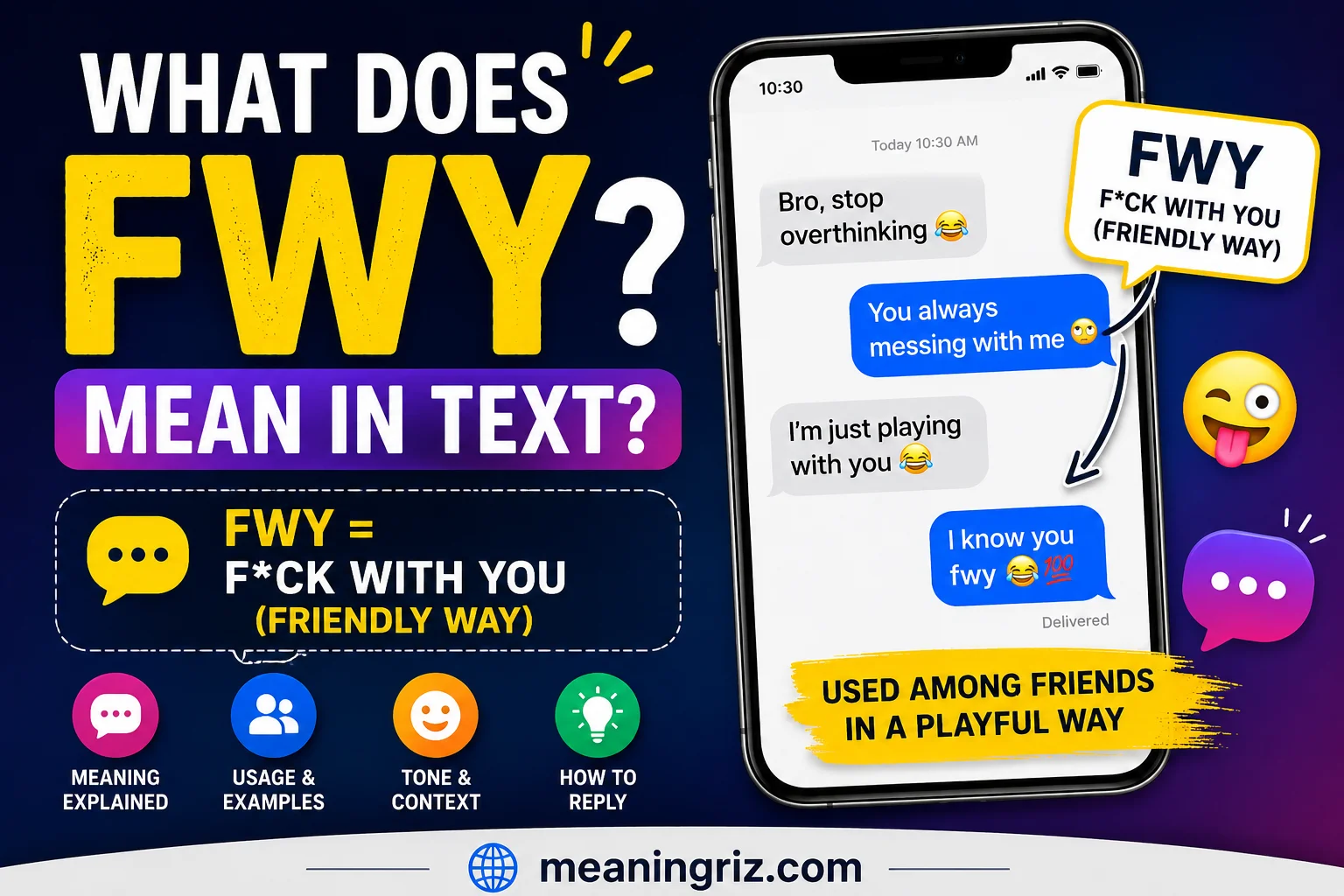
FWY usually stands for “f*ck with you,” a slang phrase that means you like, respect, or vibe with someone — not anything aggressive. It can also mean “just joking” or “messing with you,” depending on how it’s used in the sentence.
FWY = “I like/respect you” or “I’m joking with you” — the meaning depends almost entirely on the sentence around it, not the abbreviation itself.
That second part is the one most explanations rush past, and it’s the actual reason this term confuses people. FWY isn’t one fixed meaning — it’s a short form that bends depending on the words next to it.
The Honest Answer: FWY Has More Than One Meaning
Most guides act like FWY has a single definition. It doesn’t, and pretending otherwise is exactly why people stay confused after reading them. Here’s what it actually breaks down to:
Meaning 1: “I Like/Respect You” (Most Common)
This comes from the longer phrase “f*ck with you,” used the way people say “I’m into you” or “I vibe with you.” It’s a compliment, not an insult.
“Bro you always give good advice, I really fwy”
Meaning 2: “Just Joking” or “Messing With You”
Same letters, completely different job in the sentence. Here it’s short for “f*cking with you” in the sense of teasing or kidding around — closer to “jk.”
“Relax, I was just fwy 😂”
Meaning 3: A Negative, When Paired With “Don’t”
Flip it with a negative and the meaning flips too. “I don’t fwy with that” means you dislike, disapprove of, or want nothing to do with something.
“I don’t fwy with fake people”
Meaning 4: Literally “Freeway”
In driving or traffic contexts — especially in parts of the US like California — “fwy” is just a written shortcut for “freeway.” No emotional meaning at all.
“Traffic’s backed up on the 15 fwy”
The first three meanings all trace back to the same root phrase. The fourth one is a completely separate, literal abbreviation that happens to share the same letters. Which one you’re looking at depends entirely on the sentence it’s sitting in.
Real Chat Examples (How It Actually Looks)
Reading it in isolation is what trips people up. Reading it in a real exchange usually makes it obvious within one line.
A Compliment Between Friends
A: You always know what to say, fr B: Appreciate it, I fwy too
Clearing Up a Joke
A: You scared me earlier 😭 B: Relax, I was just fwy lol
Showing Disapproval
A: She’s been talking behind your back again B: I don’t fwy with that energy anymore
A Casual Compliment on Looks or Style
A: That fit is fire 🔥 B: Thanks, I see you. I fwy
The Literal Traffic Version
“Stuck on the 405 fwy, gonna be late”
Notice the pattern: in the slang versions, FWY always shows up attached to a feeling — liking someone, joking, or rejecting something. In the traffic version, it’s just sitting next to a road number. That contrast alone tells you which meaning you’re dealing with.
FWY on Different Platforms
The slang meaning stays consistent across apps. What shifts is how casual or emotionally loaded it tends to feel.
FWY on TikTok
Very common in comments and captions, often used loosely to show appreciation or agreement with a video or creator. Tends to be lighter here than in a one-on-one DM.
FWY on Instagram and Snapchat
Shows up most in DMs and close-friend story replies. In these one-on-one spaces, it carries more weight — it’s closer to a genuine compliment than a throwaway comment.
FWY in Regular Texting
This is where the “joking” meaning shows up most, usually right after a message that could’ve been read the wrong way, as a quick way to soften it.
FWY in Traffic or Navigation Contexts
Almost exclusively the literal “freeway” meaning. You’ll see this in local traffic updates, map directions, or commute conversations — context makes it obvious immediately.
When to Use FWY (And When Not To)
When It’s Fine to Use
- Texting close friends who already use casual slang
- Giving a genuine, low-key compliment without sounding overly emotional
- Clarifying that a previous message was a joke
When to Avoid It
- With anyone you don’t know well — the multiple meanings make it easy to misread
- In professional, family, or formal conversations
- When you actually need to be taken seriously, since the slang tone undercuts that
A useful rule: if the message could be read three different ways by someone unfamiliar with the term, that’s a sign to spell out what you mean instead.
Is FWY Rude?
Not inherently, but it sits closer to that line than most slang.
It can sound aggressive out of context because the root phrase it’s built from is a swear word, even though the slang use has drifted far from anything hostile.
It can come across as dismissive in the negative form — “I don’t fwy with you” said directly to someone is a clear, blunt way of cutting them off, and it’s meant to land that way.
It’s almost always harmless in the positive form between people who already talk casually, where it functions more like “I’m cool with you” than anything sharper.
Why People Use This (Psychology)
There’s a reason this specific phrase caught on instead of just saying “I like you” or “I respect you” directly.
Swear-based slang lowers emotional exposure. Saying “I fwy with you” feels tougher and more guarded than saying “I really like you as a person,” even though they mean almost the same thing. It lets people express warmth without sounding soft, which matters a lot in peer groups where vulnerability feels risky.
The ambiguity is partly the point. Because FWY can mean affection, joking, or rejection depending on phrasing, it gives the sender room to back out of a feeling if it’s not received well. “I fwy with you” is easier to laugh off as a joke than “I have feelings for you” ever could be.
It signals insider knowledge. Terms with multiple, context-dependent meanings act as a small filter — if you understand all three uses without needing an explanation, you’re already inside the conversational group that uses it naturally.
One real observation worth noting: people rarely use FWY with someone they’re trying to impress in a formal sense. It shows up almost exclusively in relationships where the stakes already feel low enough to risk being misread — which is itself a quiet signal about how casual that relationship actually is.
A Common Mistake People Make
The biggest misread is treating FWY as always being the swear-based slang version, even in contexts where it’s clearly the literal “freeway” abbreviation — or the reverse, taking a casual compliment as something aggressive because of the root word it comes from. The fix is the same every time: read the sentence around it before reacting to the word itself.
FWY vs. Similar Texting Slang
People often confuse FWY with terms that sound similar or get used in the same kinds of messages.
| Term | Meaning | Typical Tone | Emotional Undertone | Risk of Misreading | Best Used In |
|---|---|---|---|---|---|
| FWY | Like/respect you, or joking with you | Casual, can sound blunt | Affection, teasing, or mild rejection | High — multiple meanings | Close friends, casual chats |
| FW | Shorter version of “f*ck with” | Casual | Same as FWY, less specific | High — same ambiguity | Same as FWY |
| JK | Just kidding | Light, clear | Reassurance | Low | Clearing up a joke |
| IDGAF | I don’t give a f*ck | Blunt, dismissive | Indifference or detachment | Medium | Expressing not caring |
| NJ | Not joking | Direct, clarifying | Sincerity | Low | Confirming something is real |
The key difference worth remembering: FWY carries emotional weight that shifts with context, while JK and NJ are unambiguous on their own. That’s exactly why FWY needs more reading-between-the-lines than most slang shortcuts.
How to Respond to “FWY” (By Tone)
Friendly Reply
“Aw I fwy too, you’re a good one”
Neutral / Practical Reply
“Appreciate that, means a lot”
Playful Reply
“Oh you fwy me now? Took you long enough 😏”
Smart / Confident Reply
“I know. I make it easy to fwy with me”
The common thread: a good reply mirrors the warmth of the original message rather than overanalyzing it. Asking “wait what do you mean by that” usually isn’t necessary unless the context genuinely leaves it unclear — and in most real chats, the meaning is obvious from what was said right before it.
Frequently Asked Questions
What Does FWY Mean in a Text From a Girl or Guy?
The meaning doesn’t change based on who sends it — it’s still rooted in “f*ck with you,” meaning like, respect, or vibe with. From someone you’re dating, it often reads as a genuine compliment. From a friend, it’s usually casual appreciation or banter.
Is FWY the Same as FW?
They come from the same root phrase and carry the same range of meanings. FW is just the shorter version, often used the exact same way — “I fw you” and “I fwy” mean essentially the same thing in most chats.
Is FWY Rude or Offensive?
Not by default. The root word is a swear, but the slang use has shifted toward meaning “I like/respect you.” It can sound harsher in the negative form (“I don’t fwy with you”), where it’s meant to be a clear, blunt statement.
Does FWY Always Mean the Swear-Based Slang?
No. In traffic, navigation, or commute conversations — especially in parts of the US — “fwy” is simply short for “freeway” and has nothing to do with the slang meaning at all.
Can FWY Be Used in a Professional Setting?
No. It’s built from informal, swear-rooted slang and carries multiple meanings even in casual use, which makes it a poor fit for any formal or professional conversation.
Why Does FWY Have So Many Different Meanings?
Because it’s derived from a flexible spoken phrase (“f*ck with”) that already had several uses in casual English — liking someone, joking around, or interfering with something — before it ever got shortened for texting. The abbreviation kept all of that flexibility intact.
The Bottom Line
FWY doesn’t have one fixed meaning — it shifts between “I like/respect you,” “I’m joking,” “I don’t approve,” and even the literal word “freeway,” depending entirely on the sentence around it. Once you stop trying to memorize a single definition and start reading the message it’s attached to, the confusion disappears almost immediately.
DISCOVER MORE ARTICLES
FWIW Meaning in Chat, Texting & Social Media
GMFU Meaning in Text Explained (Usage, Tone & Real Examples)
TB Meaning in Text Explained (Usage, Tone & Examples)
What Does HN Mean in Text? (Meaning, Tone & Real Examples)

I’m the person behind this website, handling both the writing and content management myself. I focus on explaining word meanings, slang, and modern expressions in simple, clear language, using real-life examples so readers can understand how these terms are actually used in everyday conversations.