You’re scrolling through TikTok or reading someone’s bio, and you see it: WLW. Maybe it’s in a hashtag. Maybe someone just texted it to you. Maybe you typed it into a search bar because you weren’t sure if you already knew what it meant — or whether it might apply to you.
Either way, here’s the clear, honest answer.
What Does WLW Mean?
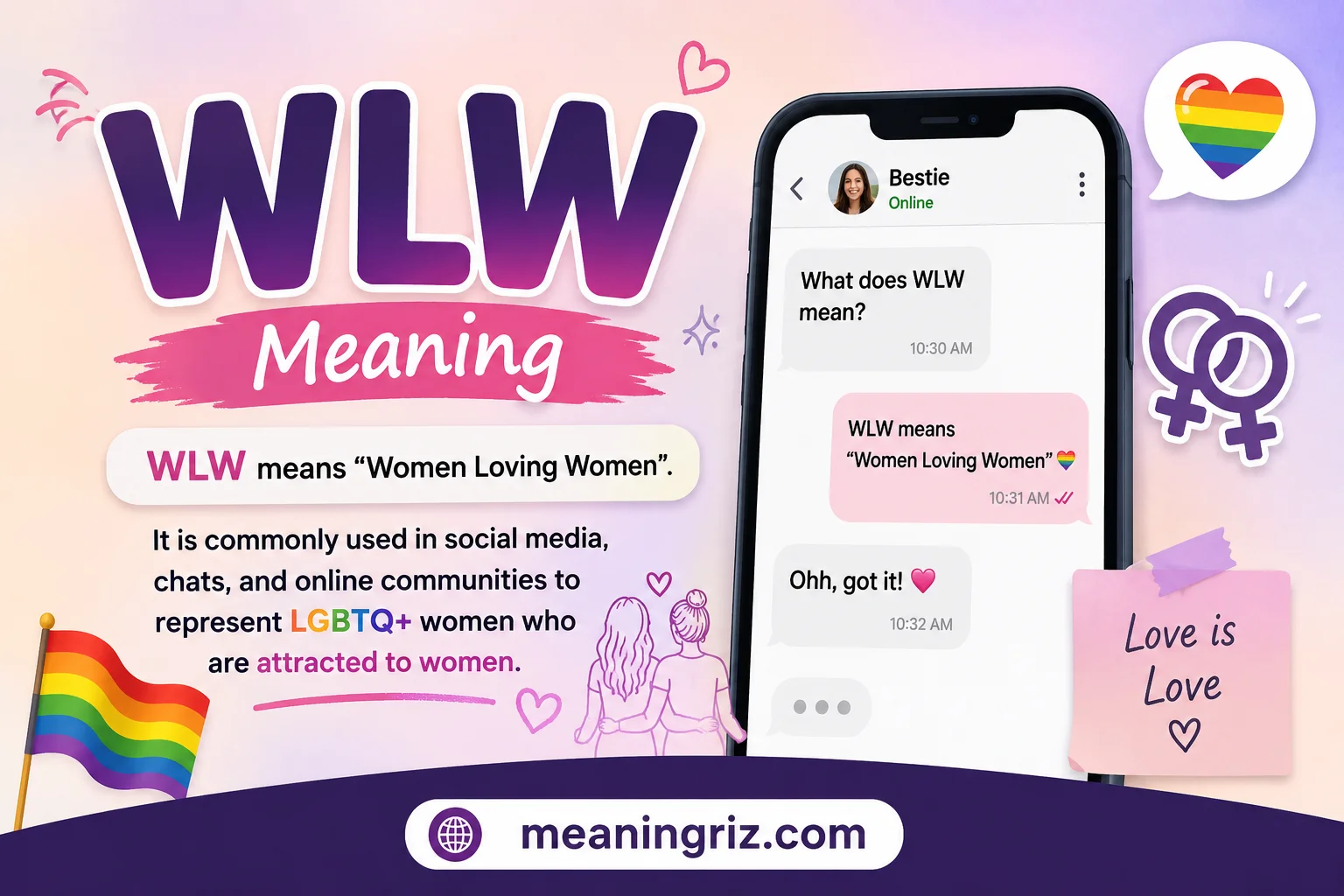
WLW stands for “Women Loving Women.” It’s an umbrella term used to describe women — and woman-aligned people — who are romantically, emotionally, or physically attracted to other women.
That’s the short version. But WLW does more than just label an orientation. It carries community, visibility, and identity inside three letters — and the way people use it varies depending on platform, relationship, and context.
Featured Snippet Answer: WLW means “Women Loving Women.” It’s an inclusive, identity-affirming term used in LGBTQ+ spaces, social media bios, texting, and online communities to describe women who are attracted to other women. It covers lesbians, bisexual women, pansexual women, and queer women under one broad, respectful label.
Where WLW Came From
Origins in Online LGBTQ+ Communities
WLW didn’t come from a textbook or a formal organization. It grew quietly in early online LGBTQ+ communities — especially on Tumblr around 2012–2014 — where people were looking for language that felt less rigid than the labels already available.
Terms like “lesbian” and “bisexual” are specific, which is exactly why many people find them useful. But some people were still figuring out their identity, or they didn’t fully identify with any one label, or they simply wanted a softer entry point into the conversation. WLW gave them that space.
How It Spread to Mainstream Platforms
From Tumblr, the term moved to Twitter, then Instagram, then TikTok — where it exploded. <cite index=”7-1″>Searches for WLW spiked significantly as the term spread on TikTok, where it partially replaced “gay and lesbian” as common terminology among Gen Z users.</cite>
By 2025–2026, WLW has reached the point where it appears in dating app bios without explanation, gets used in media criticism, and shows up in everything from fan fiction tags to academic discussions. That kind of journey — niche community to mainstream vocabulary — doesn’t happen without the term earning it.
The Three Ways WLW Is Actually Used
This is where most guides stop being useful. They tell you what WLW means but not how people actually use it. There are three distinct uses worth knowing:
WLW as an Identity Label
The most personal use. When someone includes WLW in their own bio, caption, or self-description, they’re telling you something about who they are. It’s not a diagnosis or a formal category — it’s a self-chosen signal.
Example:
“finally comfortable calling myself wlw 🏳️🌈”
This usage feels personal and sometimes even quiet. Posting it publicly for the first time can feel like a small but significant moment for a lot of people — more on that below.
WLW as a Content Descriptor
Completely separate from personal identity. When someone says “this movie has WLW representation” or tags a post with #WLW, they’re describing the content, not themselves. Allies, critics, and fans all use it this way.
Example:
“looking for wlw book recommendations” “this show needs better wlw storylines”
You don’t have to be WLW to use it this way, and most people understand that implicitly.
WLW as a Community Signal
The third use sits between the first two. It’s less about labeling yourself and more about finding your people. Someone who drops “wlw? 👀” in a comment section or uses a WLW hashtag is often testing the room — seeing who responds, who relates, who belongs to the same space.
Example:
“this playlist has wlw energy and i’m not okay”
That kind of post isn’t a formal declaration. It’s an invitation.
What WLW Actually Includes (And What It Doesn’t)
Who WLW Refers To
WLW is intentionally broad. It includes:
- Lesbians — women exclusively attracted to women
- Bisexual women — attracted to women and other genders
- Pansexual women — attracted regardless of gender
- Queer women — who use “queer” as their primary label
- Woman-aligned non-binary people — who connect with womanhood and love women
<cite index=”6-1″>Unlike labels that focus strictly on sexual orientation, WLW emphasizes connection and attraction between women, without forcing someone into a rigid identity box.</cite>
What WLW Is Not
WLW is not a replacement for “lesbian” or “bisexual.” Those are specific, meaningful identities. WLW sits above them as an umbrella — it includes them, not erases them.
It’s also not inherently about gender identity. WLW describes attraction, not how someone identifies their gender. Someone can be a transgender woman and WLW. Someone can be non-binary and WLW, if they feel that fits their experience.
Real-Life Usage Examples (How It Actually Looks in Conversation)
In a Personal Text Between Friends
Priya: wait are you wlw? Sam: yeah, figured it out like last year. you? Priya: honestly still figuring it out lol
This is one of the most common texting contexts — a gentle, low-stakes way to ask about orientation without making the conversation feel clinical or heavy.
In a Social Media Caption
“finally watching a show where the wlw couple gets a happy ending 😭💜”
This is the content-descriptor use. The person posting it may or may not be WLW themselves — they’re commenting on representation.
In a Dating App Bio
“wlw | she/her | looking for something real”
Short, clear, and signals community membership and orientation in one word. This use has become extremely common on apps like HER, Hinge, and Bumble.
In a Fan or Media Discussion
“we NEED more wlw storylines in mainstream TV, not just side characters”
Advocacy use. Calling for visibility and representation without requiring anyone to disclose their own identity.
WLW Across Different Platforms
WLW on TikTok
TikTok is where WLW really found its mainstream audience. The hashtag #WLW has accumulated billions of views across couple edits, coming-out videos, memes, and community content. It’s used both by creators sharing their own experiences and by fans cataloguing fictional WLW characters or storylines they love.
The tone on TikTok tends to be celebratory, playful, and community-focused.
WLW on Instagram
On Instagram, WLW shows up most often in bios and hashtags. It functions as a filtering mechanism — helping WLW users find each other’s accounts, communities, and content. #WLWCouple and #WLW together have made Instagram one of the main spaces for WLW relationship content and visibility.
WLW on Snapchat
Because Snapchat is more private and personal, WLW on Snapchat tends to appear in direct conversations rather than public posts. <cite index=”8-1″>On Snapchat, people often use WLW to gently test interest or ask someone’s orientation</cite>, since the more intimate format lends itself to personal conversations rather than public declarations.
WLW on Dating Apps
Possibly the most practical platform use. WLW in a dating bio is a direct, efficient signal. It tells other users your orientation without requiring a paragraph of explanation. Apps like HER are built specifically for WLW users, and the term is well understood as an orientation marker across most major apps.
WLW in Texting
In personal texts, WLW tends to be used in conversations about identity — asking about someone else’s, sharing your own, or discussing representation. The tone is usually casual and personal, occasionally nervous or tentative when it’s someone using the word about themselves for the first time.
When to Use WLW — and When to Be Careful
When It’s the Right Word
- Describing someone’s identity when they’ve already used the term themselves
- Referring to content, media, or representation involving women who love women
- Using it as a community hashtag or in LGBTQ+ spaces where it’s understood
- Self-describing if it fits how you understand your own orientation
When to Be More Careful
- Don’t label someone as WLW without them using it first — identity terms are self-chosen
- Don’t use it flippantly or as a joke in contexts where it might feel dismissive
- In professional or academic settings, “women who love women” or specific terms (lesbian, bisexual) are usually more appropriate than the abbreviation
- Be aware that some people prefer other labels — not everyone in the WLW umbrella likes the term itself
The clearest rule: use WLW to describe content, representation, and community freely. Use it to describe a specific person only if they’ve already applied it to themselves.
Why People Use WLW (Psychology)
It Reduces the Weight of Identity
Specific labels carry history — decades of activism, pain, pride, and cultural baggage that’s mostly positive, but can still feel heavy. WLW is newer and lighter. For someone still exploring their identity, it can be an easier first step than claiming “lesbian” or “bisexual” — not because those words are wrong, but because WLW doesn’t feel as permanent or as defining in the early stages.
It Signals Community Without a Full Announcement
Dropping WLW in a bio or hashtag is a low-risk way of saying “I’m part of this community” to people who will recognize it, while remaining fairly invisible to people who don’t know the term. That’s not secrecy — it’s a natural feature of in-group language that lets people control how much they disclose, and to whom.
The First-Time Use Is Often Emotionally Significant
This is the part most guides skip entirely. For many people, the first time they type or post WLW about themselves feels like a real moment. <cite index=”2-1″>A girl quietly uses WLW in her bio for the first time — it feels like a small step, but emotionally it represents clarity and confidence in who she is.</cite>
That emotional weight is worth understanding. The same three letters that one person uses casually to tag a TikTok might be a genuinely significant act of self-definition for someone else in the same comment section.
A Common Mistake People Make
The most common error is treating WLW as strictly synonymous with “lesbian.” It’s not — it’s broader by design.
<cite index=”6-1″>WLW is not limited to lesbians. It is an inclusive term that describes attraction. The abbreviation is newer, but the experience it describes is not.</cite>
Using WLW and lesbian interchangeably can feel dismissive to bisexual, pansexual, and queer women who identify with WLW but not with the word “lesbian.” The terms exist at different levels of specificity — knowing the difference shows real understanding.
WLW vs. Similar Identity Terms
People encounter several overlapping terms in LGBTQ+ spaces, and it helps to know how they relate.
| Term | Meaning | Scope | Tone | Typical Use |
|---|---|---|---|---|
| WLW | Women Loving Women | Broad umbrella | Casual, affirming | Social media, bios, texting, community spaces |
| Lesbian | Woman exclusively attracted to women | Specific identity | Personal, proud | Self-identification, formal discussions |
| Sapphic | Women/non-binary attraction to women | Broad, poetic | Soft, literary | Fandom, creative spaces, some bios |
| Bisexual | Attraction to own and other genders | Specific identity | Personal, proud | Self-identification |
| Queer | Non-heterosexual, broadly defined | Broad umbrella | Reclaimed, political | Self-identification, academic |
| MLM | Men Loving Men | Parallel to WLW | Casual, affirming | Social media, community spaces |
The key distinction: WLW and sapphic are community terms. Lesbian and bisexual are identity labels. People use them in different contexts for different reasons, and many people use several at once without contradiction.
How to Respond When Someone Uses WLW
If Someone Mentions It About Themselves
Just receive it naturally. You don’t need to make a big moment of it or ask a lot of follow-up questions unless they invite that. “Oh nice, same” or “I appreciate you sharing that” or continuing the conversation normally are all fine. What most people want in that moment is for it to land quietly and without drama.
If You’re Not Sure How to Use It Yourself
If you’re genuinely unsure whether WLW applies to you, that’s okay — that’s actually a normal part of figuring out your identity. You don’t need to claim the term before you’re ready, and you don’t need to have everything figured out before it’s “allowed.” Many people describe the WLW community as intentionally low-pressure for exactly this reason.
If Someone Uses It in a Text and You Don’t Know What It Means
It’s completely fine to ask: “I’m not totally familiar with that term — can you explain?” Most people are happy to, and asking is always better than guessing.
Frequently Asked Questions
Is WLW Only for Lesbians?
No. WLW is an umbrella term that includes lesbians, bisexual women, pansexual women, queer women, and woman-aligned non-binary people. All lesbians are WLW, but not all WLW are lesbians. The term is specifically designed to be broader than any one label.
Can Non-Binary People Use WLW?
Yes, if they feel it fits their experience. <cite index=”8-1″>Non-binary people can use WLW if they connect with womanhood and love women.</cite> Identity language is self-chosen, and the WLW community generally welcomes anyone who feels the term resonates with them.
What Is the Difference Between WLW and Sapphic?
Both are umbrella terms for women who love women. “Sapphic” has a slightly more poetic, literary feel — it comes from the ancient Greek poet Sappho — and tends to show up more in fandom, creative, and aesthetic spaces. WLW is more common in everyday texting, social media bios, and LGBTQ+ community discussions. Many people use both interchangeably.
Is It Okay for Allies to Use WLW?
Yes, when referring to content, representation, or the community in general. An ally saying “I’m looking for WLW recommendations” or “this show has good WLW representation” is completely fine. What allies should avoid is applying the term to specific people who haven’t used it for themselves.
Is WLW Offensive or Inappropriate?
<cite index=”4-1″>WLW is not offensive. It is a respectful and widely accepted identity term in LGBTQ+ spaces.</cite> It’s informal, so it’s not suited for formal or academic writing, but in everyday digital communication it’s consistently used in a positive and inclusive way.
What Does “WLW Energy” or “WLW-Coded” Mean?
These are extensions of the content-descriptor use. “WLW energy” means something gives off a vibe associated with women-loving-women experiences — emotional closeness, romantic tension, sapphic aesthetics. “WLW-coded” means a character or relationship reads as WLW even if it’s not officially confirmed. Both are common in fan communities.
The Bottom Line
WLW is three letters doing a lot of quiet work. At its simplest, it means Women Loving Women. At its most meaningful, it’s a word that helps real people find community, describe their identity on their own terms, and locate content and representation that reflects their lives.
You’ll see it in bios, captions, comment sections, texts, and hashtags. Sometimes it’s casual. Sometimes it carries real weight for the person using it. Either way, understanding what it means — and using it with care — is a straightforward way to communicate more clearly and respectfully in 2026’s digital landscape.
DISCOVER MORE ARTICLES
Bane of My Existence Meaning in Text: Usage, Tone & Examples
PU Meaning in Text Explained (All Meanings, Tone & Real Examples)
WYF Meaning in Text Explained (Usage, Tone & Real Examples)
IIRC Meaning Explained: What It Means, How It’s Used & Why It Works