You’re scrolling through a comment section, or maybe your friend just texted you something that ended with “lol the tism,” and you paused.
“Tism?”
It looks like a typo at first. It’s not. And once you know what it actually stands for, the next question is usually the real one: is this okay to say, or is it something you shouldn’t repeat?
Here’s the clear answer, plus everything around it that actually matters.
What Does TISM Mean?
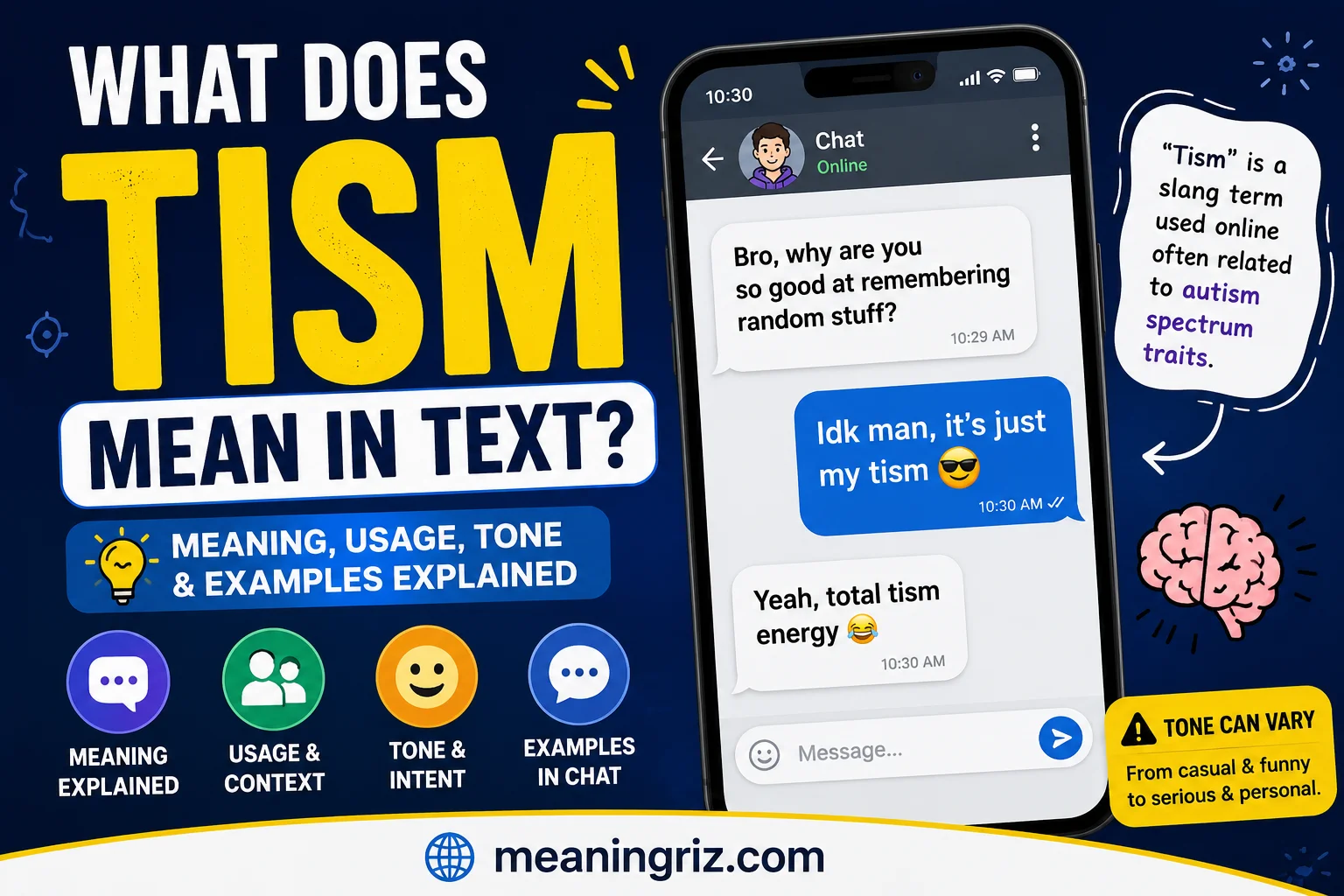
TISM is internet slang short for “autism.” It’s most often used by autistic people themselves, casually and self-referentially, to describe a trait, habit, or moment that connects to their neurodivergence — usually with humor rather than clinical language.
That’s the core meaning. But how it lands depends heavily on who is saying it and why, which is the part this guide is going to walk through properly.
The Simple Meaning, Explained Plainly
At its root, “tism” is just a shortened, casual way of saying “autism.” Nothing more complicated than that.
It started showing up in online autism and neurodivergent communities — forums, Reddit threads, TikTok comment sections — as a way to talk about autism without it feeling heavy or clinical every single time.
So in plain terms:
TISM = short for “autism” — slang used mostly by autistic people, in a casual or humorous way, to talk about traits or experiences tied to being autistic.
That’s the direct answer. Now here’s where it gets more nuanced, because this word carries more weight than most texting slang.
Why This Term Is Different From Typical Slang
Most slang words are just shortcuts for convenience. “Tism” is a little different, because it’s tied to a real, lived identity — not a joke concept invented for memes.
When autistic people use it about themselves, it’s usually:
Self-aware. Someone naming a pattern in their own behavior, almost like an inside joke with themselves.
Community-building. A way of signaling “I get it” to other neurodivergent people without a long explanation.
Tension-relieving. Turning something that’s sometimes been talked about in cold or stigmatizing ways into something lighter to carry.
That context matters more than the word itself. The same three letters can feel completely different depending on who’s typing them.
Real Chat Examples (How It Actually Shows Up)
Here’s what this looks like in actual conversations, not just a dictionary definition.
Someone Describing Their Own Behavior
A: “why did you reorganize your entire bookshelf by color at midnight” B: “ngl that’s just the tism”
This is the most common version — lighthearted, self-directed, no one else involved.
In a Group Chat Among Friends Who Understand the Context
“sorry I went on a 10 minute tangent about trains again, tism moment 😭”
Used to soften a habit the person already knows about themselves, shared with people who already understand and accept it.
On TikTok or Instagram Comments
“the way I info-dumped about this for 20 minutes… the tism is strong today”
Often paired with humor, usually from creators who are openly autistic talking to an audience that relates.
What It Usually Doesn’t Look Like
“lol you’re so tism” (said about someone else, casually, by someone who isn’t part of the conversation)
This version is where things get uncomfortable fast — more on that below.
Platform Differences: Where TISM Shows Up
The meaning stays the same everywhere. The tone shifts slightly depending on where you see it.
TISM on TikTok
This is where the term is most visible right now. Autistic creators use it heavily in captions and comments, often alongside hashtags about neurodivergence, usually as self-description rather than commentary on someone else.
TISM on Instagram
Shows up in comments and DMs between people who already share context — often after a relatable post or meme about autistic traits.
TISM on Snapchat or in Texting
Less common, but still appears between close friends who already talk openly about neurodivergence, usually in a casual, low-stakes way.
TISM in Gaming Chats or Discord
Sometimes appears at the end of usernames or gamer tags as a personal identifier, similar to how people might mention other parts of their identity.
When It’s Okay to Use — And When It’s Not
This is the part most slang guides skip entirely, and it’s the most important section here.
Generally Fine
- Describing your own traits, if you’re autistic or self-identify as neurodivergent
- Used inside a community or friend group where everyone already understands the context
- Light, self-aware humor about your own habits or patterns
Not Okay
- Using it to describe someone else without their context or consent
- Using it as an insult or to mock someone’s behavior
- Using it in professional, academic, or formal settings
- Using it if you’re not sure how the other person would feel about it
A good rule here: this word works as self-description, not as something you say about other people. That single distinction is the difference between language that builds community and language that hurts someone.
Is It Rude to Use TISM?
It depends almost entirely on direction and intent, more than with most slang.
When autistic people use it about themselves, it’s rarely rude. It’s usually closer to an inside joke — familiar, lighthearted, and rooted in real experience.
When it’s used about someone else, especially without knowing their identity or consent, it can come across as mocking, even if that wasn’t the intent. The line between “relatable” and “making fun of” disappears fast when the word is pointed outward instead of inward.
If you’re not autistic yourself and you’re unsure whether to use the term at all, the safer move is simply not to — there’s no real downside to just saying “autism” instead.
Why People Use This Word (The Real Reason)
There’s a deeper reason this term spread the way it did, and it’s worth sitting with for a second.
Naming something casually makes it easier to live with. For a lot of autistic people, growing up often meant hearing their traits described in clinical, distant, or even negative language. Turning that into something they can joke about themselves is a way of taking the weight off.
It signals belonging without needing to explain. Saying “tism moment” to another autistic person skips the part where you’d normally have to justify or explain a behavior — the other person just gets it immediately. That shortcut is the entire point.
Humor here is doing real emotional work. This isn’t just a joke for the sake of being funny. It’s often a way of saying “I’m allowed to find this funny, on my own terms” — which is a meaningfully different thing than someone else finding it funny for them.
One observation worth noting: the same word said by an autistic person about themselves and an outsider saying it about them can look identical in text, but mean completely opposite things. The words don’t carry the meaning here — the relationship and direction do.
A Common Mistake People Make
The most common misstep is assuming that because a word is used casually within a community, it’s automatically fine to use the same way from outside it. Self-referential language and language used about someone else operate under completely different rules, even when the exact phrase is identical. Borrowing in-group language without being part of that group — or without the other person’s context — is where good intentions can still land badly.
TISM vs. Other Identity-Related Slang
People sometimes confuse this term with other casual shorthand, so here’s how it compares.
| Term | Meaning | Typical Tone | Who Usually Uses It | Risk of Misuse | Best Context |
|---|---|---|---|---|---|
| Tism | Short for autism | Casual, self-aware | Autistic/neurodivergent people, self-referentially | High if used about others | Self-description, supportive communities |
| ND | Neurodivergent | Neutral, descriptive | Broad neurodivergent community | Low | General conversation, advocacy spaces |
| Stim/stimming | Self-regulating behavior | Neutral to affectionate | Autistic community | Low | Describing specific behaviors |
| Special interest | A deep, focused passion | Positive, neutral | Autistic community, broader audiences | Low | Describing hobbies or hyperfocus |
| “On the spectrum” | Informal way of saying autistic | Varies — casual to dismissive | General public | Medium | Best avoided as a vague stand-in for “autistic” |
The key difference: most of these terms are descriptive and low-risk in almost any context. “Tism” carries more weight because its safety depends entirely on who’s speaking and who they’re speaking about.
How to Respond If Someone Uses It About Themselves
If a friend says something like “sorry, tism moment” about their own behavior, here’s how different tones might respond.
Supportive Reply
“No need to apologize, I love that about you”
Casual / Relating Reply
“Same energy honestly, I do this too”
Light Humor Reply
“Iconic tism behavior, never change”
Simple Acknowledgment
“Got it, no worries at all”
The common thread: a good response doesn’t make a bigger deal of it than the person did themselves. Matching their tone — rather than over-explaining or under-reacting — usually lands best.
Frequently Asked Questions
What Does TISM Mean in a Text?
TISM is internet slang short for “autism,” typically used casually and self-referentially by autistic people to describe a trait or moment connected to their neurodivergence.
Is TISM an Offensive Word?
It depends on context. Used by autistic people about themselves, it’s generally not offensive. Used by someone else to describe or mock another person, it can come across as disrespectful, even unintentionally.
Can I Use TISM if I’m Not Autistic?
It’s best to avoid using it casually about yourself or others if you’re not part of that community. There’s no real downside to just saying “autism” instead.
Why Do People Shorten “Autism” to “Tism”?
Mostly for the same reason any slang catches on — it feels lighter, more casual, and easier to use in everyday conversation than a clinical-sounding term, especially in humor or community contexts.
Is TISM the Same as Saying Someone Is “On the Spectrum”?
Not exactly. “Tism” is informal slang typically used self-referentially, while “on the spectrum” is a more general (and sometimes vague) public phrase that isn’t always used the same way within the autistic community itself.
Does TISM Mean Something Different on TikTok Than in Regular Texting?
The core meaning stays the same everywhere. TikTok is simply where the term is most visible right now, largely because of openly autistic creators using it in captions and comments.
The Bottom Line
TISM means “autism,” used as casual shorthand — most often by autistic people themselves, as a way to describe their own traits with humor instead of clinical distance. The meaning is simple. The responsibility around how it’s used is what actually matters here. Said about yourself, with context, it’s usually warm and self-aware. Said about someone else without that same context, it can land very differently — so when in doubt, it’s always safer to just say “autism.”
DISCOVER MORE ARTICLES
FWIW Meaning in Chat, Texting & Social Media
GMFU Meaning in Text Explained (Usage, Tone & Real Examples)
TB Meaning in Text Explained (Usage, Tone & Examples)