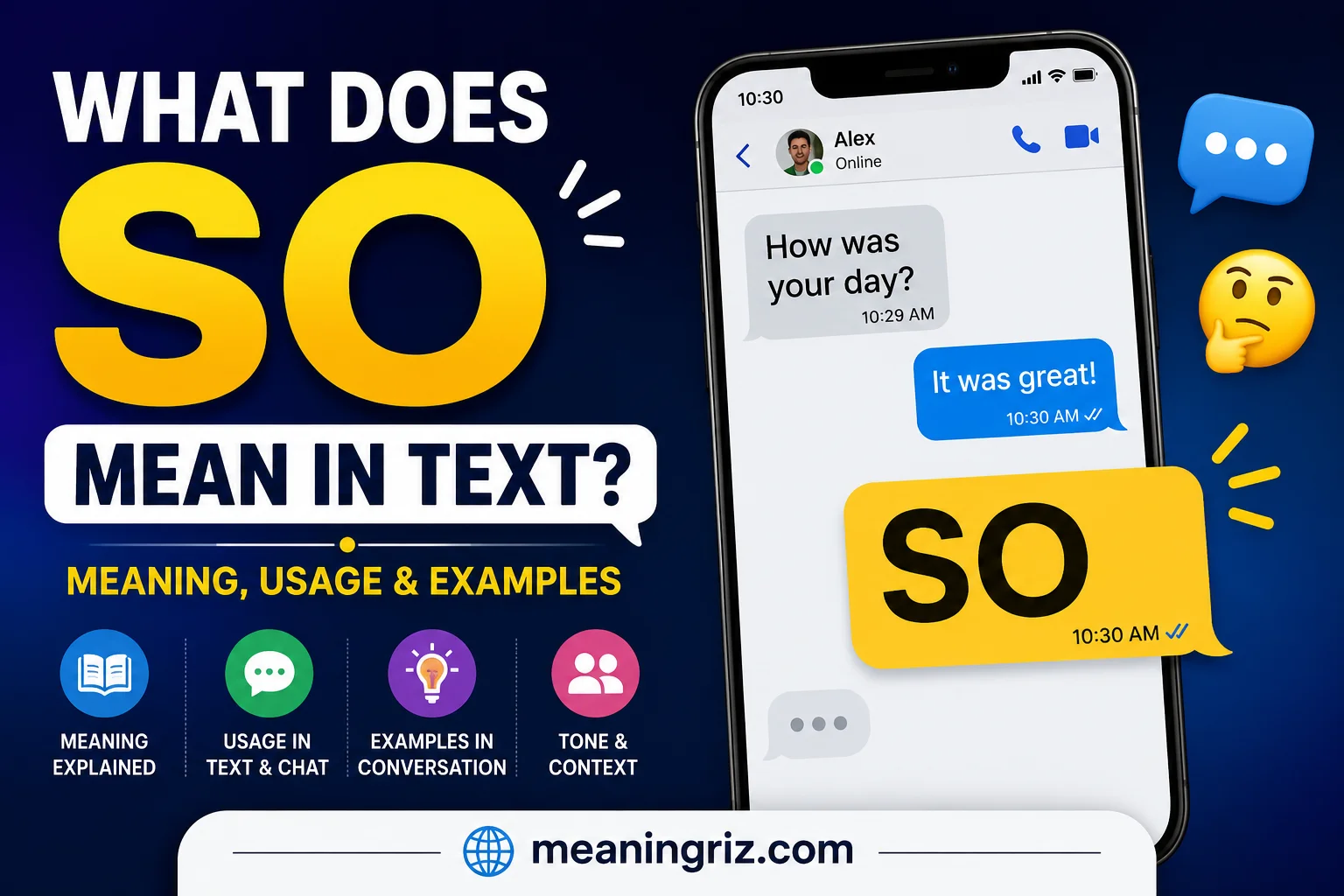
You’re scrolling through a chat and someone replies with just:
“So?”
No explanation. No emoji. Just one word sitting there, and now you’re not sure if they’re annoyed, confused, or just being casual.
Here’s the thing about “so” — it’s one of the most overworked words in texting, and that’s exactly why it’s so easy to misread.
What Does “So” Mean in Text?
“So” in text usually works as a connector, an emphasis word, or a way to start a new thought. It can mean “therefore,” “to a great extent,” or even “what now?” — and the meaning shifts almost entirely based on tone, punctuation, and what came before it.
That’s the simple version. But “so” rarely shows up alone. It’s almost always doing a specific job in the sentence, and figuring out which job is the actual skill here.
The Core Meaning, Without the Confusion
“So” is one of the oldest words in English. It comes from Old English swā, and it originally just meant “in this way” or “to this extent.”
In normal writing, it does one simple job: connecting ideas or showing a result.
“I was tired, so I went to bed early.”
That’s the textbook use — cause and effect, plain and clear.
But texting stripped “so” out of that structure. People started using it on its own, without the rest of the sentence, and that’s when it picked up all its extra emotional weight.
Why “So” Means Different Things Depending on Context
This is the part most explanations rush past. “So” isn’t one word with one meaning — it’s a small word that borrows its meaning from whatever surrounds it.
As emphasis — makes a feeling stronger.
“I’m so tired.” “This is so good.”
As a transition — moves the conversation to a new topic.
“So, what’s the plan for tonight?”
As hesitation or suspense — signals something is coming.
“So… we need to talk.”
As dismissiveness — shuts down a point.
“So? Why does that matter?”
As a soft opener — eases into a request or update.
“So yeah, that’s basically what happened.”
Same three letters, five completely different emotional jobs. The word itself never changes — the delivery does.
Real Chat Examples (How It Actually Shows Up)
When Someone’s Building Up to Something
“so… i have to tell you something”
This almost always signals nerves. The person isn’t ready to say the main thing yet, and “so” is buying them a second to get there.
When Someone’s Brushing You Off
You: “I really think you should’ve called first.” Them: “So?”
This is short, flat, and meant to end the conversation, not continue it. One word, but it lands like a wall going up.
When Someone’s Excited
“I’m SO excited for this weekend omg”
Capital letters and repetition here aren’t an accident — they’re doing the same job tone of voice would do out loud.
When Someone’s Wrapping Up a Story
“so yeah, that’s basically how the whole thing went down”
This is “so” as a soft landing — a way to close out a message without it feeling abrupt.
When Someone’s Changing the Subject
“anyway so what time are we leaving tomorrow”
Here it’s just a pivot word, doing the job a comma or “anyway” would do in speech.
Platform-Based Differences
The meaning of “so” doesn’t really change by app — but the speed and tone people expect from it does shift depending on where it shows up.
“So” in Texting (SMS/iMessage)
Tends to be the most personal and direct. Because texting is usually one-on-one, a flat “so?” here often carries more emotional charge than the same word elsewhere.
“So” on Instagram or Twitter/X Comments
Often used as exaggerated emphasis — “so real,” “so done,” “so over it” — as a way to react quickly without writing a full sentence.
“So” on TikTok Captions and Comments
Frequently stretched out (“sooo”) for comedic or dramatic effect, especially in reaction comments to something surprising or relatable.
“So” in Group Chats
Usually functions as a transition word to redirect a busy conversation — “so anyway,” “so back to the original question” — helping pull focus back to one topic.
When to Use “So” (And When to Be Careful)
When It Works Well
- Starting a new topic naturally in a chat
- Softening a story or update before sending it
- Adding genuine emphasis to how you feel about something
When It Can Backfire
- Replying with just “so?” to something someone shared with you — it can read as dismissive even if you didn’t mean it that way
- Using it to open a heavy conversation without any warning (“so we need to talk” with nothing else can spike anxiety on the other end)
- Relying on it instead of actually answering a question, which can come across as avoidant
A useful gut check: if “so” is your entire reply, picture how it would sound said out loud in that exact tone. If it sounds cold in your head, it’ll probably read cold on screen too.
Is “So” Rude?
Not inherently. But it’s one of the easiest words to accidentally sound rude with, because it’s so short that it leaves almost no room for tone.
It tends to read as dismissive when it’s a standalone reply to something the other person clearly put effort into. “So?” after someone explains why they’re upset can feel like you don’t care, even if you’re just processing.
It tends to read as fine — even warm — when it’s used to open up a longer message, because the words that follow immediately soften it.
The punctuation matters more than people realize. “So?” feels confrontational. “So…” feels hesitant or thoughtful. “So!” feels upbeat. Same word, three completely different moods, just from punctuation.
Why People Use This Word So Much (Psychology)
There’s a reason “so” survives in texting even though it’s vague — and it’s not just laziness.
It buys time without going silent. Typing “so…” while you figure out how to phrase something hard is faster than leaving someone on read, and it signals “I’m here, just thinking” instead of nothing at all.
It softens directness. A flat statement like “We need to talk” feels heavier than “So, we need to talk.” The word adds just enough casualness to make a hard sentence easier to send and easier to receive.
It mimics how people actually talk. In real speech, almost nobody starts serious conversations with zero warm-up. “So” recreates that natural pause in text, which is part of why it feels more human than jumping straight to the point.
One real observation worth noting: people often use “so” more when they’re nervous about a message, not less. A long pre-amble starting with “so” is frequently a sign the next sentence took some courage to send.
A Common Mistake People Make
The biggest misread is treating a short “so?” as automatically hostile. In a lot of cases, it’s not attitude — it’s genuine confusion or a request for more detail, especially from someone who texts in short bursts naturally. Before assuming tone, it helps to think about how that person texts normally, not just how this one message reads in isolation.
“So” vs. Similar Texting Words
People often confuse “so” with words that look similar in function but carry different weight.
| Term | Meaning | Typical Tone | Emotional Undertone | Risk of Misreading | Best Used In |
|---|---|---|---|---|---|
| So | Connector, emphasis, or transition | Flexible — neutral to sharp | Depends heavily on punctuation | High — easy to misread as cold | Almost any casual or serious chat |
| Anyway | Topic shift or closing a point | Casual, slightly dismissive | Mild impatience or redirection | Medium | Wrapping up a tangent |
| Well | Hesitation or soft disagreement | Cautious, thoughtful | Uncertainty or reluctance | Medium | Easing into a correction |
| Like | Filler or approximate emphasis | Very casual | Low — rarely emotionally loaded | Low | Casual storytelling |
| Therefore | Formal cause-and-effect connector | Formal, structured | Neutral | Low | Written or professional contexts |
The key difference: “so” carries far more emotional risk than its formal cousins because it’s used informally so often that the absence of extra words around it becomes meaningful on its own.
How to Respond When Someone Texts Just “So?”
Friendly Reply
“Haha what do you mean, so what?”
Neutral / Clarifying Reply
“So… what exactly?”
Playful Reply
“So nothing, I just like saying so 😄”
Direct Reply
“I think you already know what I mean by that.”
The pattern that works best across all of these: ask for clarification instead of guessing at tone. A one-word message like “so?” almost always means there’s more behind it — the fastest way to find out is just asking, not assuming.
Important Side Note: “SO” as an Abbreviation
If you searched this because you saw “SO” written in capital letters in a caption or bio, that’s a completely different thing — not the everyday word “so” at all.
SO (capitalized) usually stands for “Significant Other” — a gender-neutral way to refer to a romantic partner without specifying boyfriend, girlfriend, husband, or wife. It shows up most in social captions: “Dinner with my SO tonight” or “Bring your SO to game night.”
You might also see “s/o” with a slash, which can mean either “significant other” or “shout out” depending on context — a shout-out version usually shows up as public praise or credit (“big s/o to everyone who helped”).
And separately, you may have come across “s o” written with a space between the letters — that’s a 2026 stylistic trend where people stretch the word “so” for dramatic or sarcastic emphasis in comments, similar to writing “soooo.” It’s mostly seen in TikTok and Discord reaction comments, not regular texting.
Three different things, three different meanings, all hiding behind nearly the same letters.
Frequently Asked Questions
What Does It Mean When Someone Texts Just “So”?
On its own, it usually means they’re waiting for more information, reacting to something you said, or building up to a bigger point. The exact meaning depends on what was said right before it.
Is “So?” Rude in a Text?
It can come across that way, especially as a standalone reply, but it’s often not meant as rude. Short replies lose tone easily over text, so context matters more than the word itself.
What Does “SO” Mean on Social Media?
When capitalized, “SO” typically means “Significant Other” — a neutral way to refer to a partner without naming their gender or relationship title.
Why Do People Text “So…” With Three Dots?
The dots usually signal hesitation or suspense — a sign that something more serious or emotional is coming after it.
Is “So” the Same as “S/O”?
No. Lowercase “so” is the everyday word used for emphasis or transition. “S/O” with a slash is shorthand for either “significant other” or “shout out,” depending on context.
Why Does “So” Feel Different in Every Text?
Because it has almost no fixed meaning on its own — it borrows its tone entirely from punctuation, capitalization, and the words around it, which makes it one of the most context-dependent words in texting.
The Bottom Line
“So” means very little by itself and almost everything in context. It can soften a hard message, sharpen a dismissive one, or just keep a conversation moving — and the only real way to know which job it’s doing is to look at what’s around it, not the word alone. Once you start reading it that way, the confusion mostly disappears.
DISCOVER MORE ARTICLES
FWIW Meaning in Chat, Texting & Social Media
GMFU Meaning in Text Explained (Usage, Tone & Real Examples)
TB Meaning in Text Explained (Usage, Tone & Examples)
What Does TISM Mean in Text? (Meaning, Tone & Real Examples)