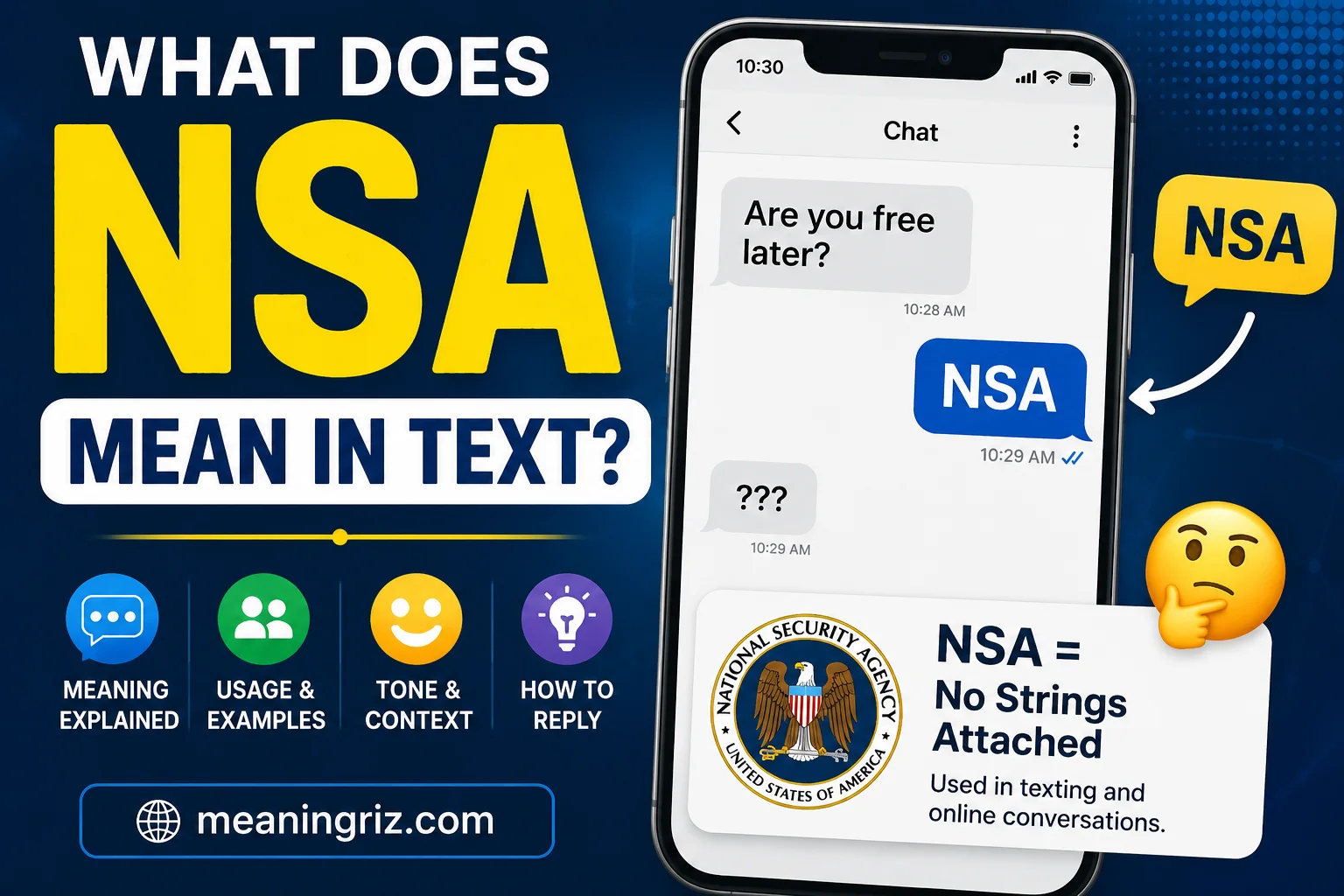
Someone sends you a message: “looking for something NSA, you interested?”
And suddenly you’re not sure if they’re talking about dating, government surveillance, or something else entirely. You don’t want to ask and look clueless, but you also don’t want to assume the wrong thing.
Here’s the answer, plain and simple.
What Does NSA Mean in Text?
NSA stands for “No Strings Attached.” In texting and dating conversations, it describes a casual relationship or interaction with no emotional commitment, no expectations, and no obligation to turn it into something serious.
That’s the quick definition. But how it actually plays out in a real conversation — and what it says about the person using it — takes a bit more unpacking. Let’s get into it.
The Simple Meaning, Without the Overthinking
NSA is shorthand for a setup where two people spend time together, often romantically or physically, without trying to build anything long-term out of it.
No check-ins the next morning. No meeting the family. No conversation about “where this is going.” Each interaction stands on its own, with nothing implied about the future.
NSA = “No Strings Attached” — a casual connection or arrangement with no emotional commitment, no long-term expectations, and no obligation beyond the moment.
That’s the core idea. Everything else is just context.
Wait — Doesn’t NSA Mean the National Security Agency?
Yes, technically. NSA is also the abbreviation for the National Security Agency, the U.S. government intelligence organization.
In texting, though, this almost never comes up unless the conversation is specifically about politics, government, surveillance, or the news. If someone texts you “NSA” out of nowhere, especially in a dating app or DM, they are not talking about a federal agency.
Context decides everything here. “Did you see that NSA story on the news?” is government talk. “I’m down for something NSA” is not.
How the Meaning Shifts Depending on Context
NSA isn’t always used the exact same way. The tone and intent behind it can shift depending on the situation:
1. A dating app signal. Someone states upfront in their bio or opening messages that they’re only looking for something casual. This is the clearest, most direct use of the term.
2. A boundary-setting message. Two people have been talking and one wants to clarify expectations before things go further. “I’m cool with this being NSA” is a way of avoiding confusion later.
3. A casual mention between friends. Someone tells a friend about a date or hookup and adds “it’s just NSA” to explain there’s no emotional weight behind it.
4. A joke or meme reference. Sometimes people throw the term around lightly, almost ironically, especially in group chats where nobody is being literal.
The word stays the same. What changes is how seriously it’s meant — and that depends entirely on who’s saying it and where the conversation already stands.
Real Chat Examples (How It Actually Looks)
Here’s what NSA actually looks like showing up in real conversations, not just a textbook definition.
On a Dating App Bio
“Not looking for anything serious right now. NSA only, please respect that.”
This is the most direct version — setting the expectation before the conversation even starts.
Between Two People Getting to Know Each Other
Alex: so just to be clear, what are you looking for? Sam: honestly just NSA, nothing serious Alex: yeah that works for me too
This is a boundary being stated plainly, which is actually the healthiest way the term gets used.
Between Friends, Explaining a Situation
“Met someone last weekend, it was fun. We’re keeping it NSA though, no pressure on either side.”
Here it’s less about setting a rule and more about explaining the vibe of a connection to someone else.
In a Group Chat, Used Loosely
“bro just wants NSA energy in his life rn 😭”
This version isn’t really about a literal arrangement — it’s closer to a joke about someone’s general mood or attitude toward relationships.
Platform-by-Platform: Does NSA Change Meaning?
The definition doesn’t change much across platforms, but how often it shows up — and how bluntly it’s used — does shift depending on where you see it.
NSA on Dating Apps (Tinder, Bumble, Hinge)
This is where the term is used most directly. People often state it plainly in their bio to filter out anyone looking for something serious.
NSA on Instagram or Snapchat DMs
Usually appears mid-conversation rather than upfront, often after some flirting has already happened and someone wants to clarify intentions.
NSA on TikTok
Mostly used in comments or captions discussing dating culture and relationship trends, often in a more general or joking sense rather than describing a real, specific situation.
NSA on Discord or Gaming Chats
Occasionally used outside of dating entirely, to describe a casual social dynamic between people in a server with no real expectations attached.
NSA in Regular Texting
Tends to come up after an in-person conversation has already happened, used as a quick way to confirm what was discussed.
When to Use NSA (And When Not To)
When It’s Fine to Use
- Both people are clearly on the same page about wanting something casual
- You’re setting a boundary early, before things get confusing later
- You’re explaining a casual situation to a friend who already understands the context
When to Avoid It
- You’re not actually sure how the other person feels — assuming NSA without checking can hurt someone who wanted more
- The conversation is in a professional, family, or formal setting
- You’ve already developed real emotional attachment, since saying NSA at that point usually isn’t honest
A simple way to check yourself: if saying “NSA” out loud to this person would make either of you flinch, that’s usually a sign the label doesn’t actually match what’s happening.
Is NSA Rude?
Not inherently. On its own, NSA is just a term — it’s the way it’s used that determines whether it feels respectful or careless.
It can feel cold if it’s dropped into a conversation with no warmth or explanation, especially with someone who was hoping for more. A blunt one-word “NSA” with zero context can land harder than intended.
It can feel disrespectful if someone says NSA but then acts emotionally invested anyway, because that mismatch creates confusion instead of clarity, which defeats the entire purpose of using the term.
It’s generally not rude when both people are aligned and the term is used to create clarity rather than distance. In that case, it’s actually a more honest move than staying vague.
Why People Use This (Psychology)
There’s more going on under the surface here than just describing a type of relationship.
Naming it removes the guesswork. A lot of relationship confusion comes from unclear expectations. Saying “NSA” upfront, even if it feels blunt, actually reduces the chance of someone getting hurt by assuming there’s more going on than there is.
It protects against vulnerability. Committing to something serious requires emotional risk. Framing a connection as NSA lets someone enjoy closeness without fully opening up — which can be a genuine choice, or sometimes a way of avoiding harder feelings underneath.
It reflects where someone is in their life, not just their personality. People often shift between wanting something serious and wanting something NSA depending on what’s happening elsewhere in their life — work stress, recent breakups, or just not having the bandwidth for a relationship right now. It says more about timing than it does about character.
One real observation worth noting: the people most comfortable saying “NSA” out loud are usually the ones who’ve already had a relationship go sideways from unclear expectations. The directness isn’t coldness — it’s often a learned response to past miscommunication.
A Common Mistake People Make
The biggest misread is assuming NSA means the same thing to both people automatically, without actually confirming it. One person might think NSA means “no labels, but still texting daily,” while the other means “purely occasional, no real connection at all.” The term sounds clear, but it still needs an actual conversation behind it to mean the same thing to everyone involved.
NSA vs. Similar Texting & Dating Slang
People often confuse NSA with other casual-relationship terms that sound similar but carry different expectations.
| Term | Meaning | Typical Tone | Emotional Undertone | Risk of Misreading | Best Used In |
|---|---|---|---|---|---|
| NSA | No Strings Attached | Direct, neutral | Detachment, low commitment | Medium — assumes the other person agrees | Dating apps, casual relationships |
| FWB | Friends With Benefits | Familiar, casual | Comfort, some emotional closeness | Medium — friendship can blur the lines | Existing friendships that turn physical |
| ONS | One Night Stand | Blunt, situational | Low attachment, single occurrence | Low — usually understood as one-time | Describing a single past encounter |
| DTR | Define The Relationship | Serious, direct | Uncertainty, need for clarity | Low | When someone wants to move past NSA into something defined |
| TS | Talking Stage | Cautious, early | Curiosity, mild uncertainty | Medium — unclear if it’ll stay casual | Early conversations before anything is defined |
The key difference worth remembering: NSA usually means no friendship layer attached, while FWB keeps the friendship intact alongside the physical part. People mix these up constantly because both avoid commitment, but the emotional closeness involved is genuinely different.
How to Respond to “NSA” (By Tone)
Friendly Reply
“Yeah that works for me, as long as we’re both on the same page”
Neutral / Practical Reply
“Cool, just wanted to know where things stood”
Playful Reply
“NSA huh? Bold of you to assume I wasn’t already thinking that 😏”
Smart / Confident Reply
“I’m fine with that, just be honest if that changes for either of us”
The pattern across all of these: a good reply doesn’t just accept or reject the label — it usually opens the door for honesty later, since these arrangements work best when either person can speak up if their feelings shift.
Frequently Asked Questions
What Does NSA Mean From a Girl or Guy?
The meaning doesn’t change based on who’s saying it — it’s still “no strings attached.” What can differ is how directly each person feels comfortable stating it, but the underlying intent is the same for everyone.
Is NSA the Same as FWB?
No. NSA typically means no friendship layer involved — just a casual connection with no strings. FWB keeps an existing friendship alongside the physical relationship, which usually means more emotional closeness than NSA implies.
Is It Rude to Ask Someone for NSA?
Not if it’s stated clearly and respectfully. It becomes a problem only if it’s assumed without checking, or used to avoid an honest conversation the other person clearly wants to have.
Does NSA Always Mean Something Physical?
Not necessarily. NSA most often implies a casual romantic or physical connection, but some people use it more loosely to mean any low-commitment interaction, even one that’s mostly just spending time together.
Can NSA Turn Into Something Serious?
Yes, it sometimes does, but that requires both people to openly redefine the relationship. Assuming it will naturally evolve without talking about it is one of the most common ways these situations go wrong.
Is NSA Used Outside of Dating Contexts?
Rarely, but occasionally. In gaming or group chat communities, people sometimes use it loosely to describe casual social involvement with no real obligations, though dating remains its most common use.
The Bottom Line
NSA means “no strings attached” — a casual connection with no commitment expected on either side. The part that actually matters isn’t the definition itself, but whether both people genuinely mean the same thing by it. The term works best when it’s used to create clarity, not to avoid an honest conversation that needs to happen anyway.
DISCOVER MORE ARTICLES
FWIW Meaning in Chat, Texting & Social Media
GMFU Meaning in Text Explained (Usage, Tone & Real Examples)
TB Meaning in Text Explained (Usage, Tone & Examples)
FWY Meaning in Text Explained (Usage, Tone & Real Examples)

I’m the person behind this website, handling both the writing and content management myself. I focus on explaining word meanings, slang, and modern expressions in simple, clear language, using real-life examples so readers can understand how these terms are actually used in everyday conversations.