You send someone a quick update. Maybe it’s “got home safe” or “meeting moved to 4.” Then you add three letters at the end: NRN.
They reply with “??” because they have no idea what that means — and now you have to explain it instead of just sending the update.
So here’s the explanation, in plain terms, so you never have to type it out again.
What Does NRN Mean?
NRN most commonly stands for “No Reply Necessary” (sometimes written as “No Reply Needed” or “No Response Necessary”). It’s added to the end of a message to let the other person know they don’t have to respond — you’re just sharing information.
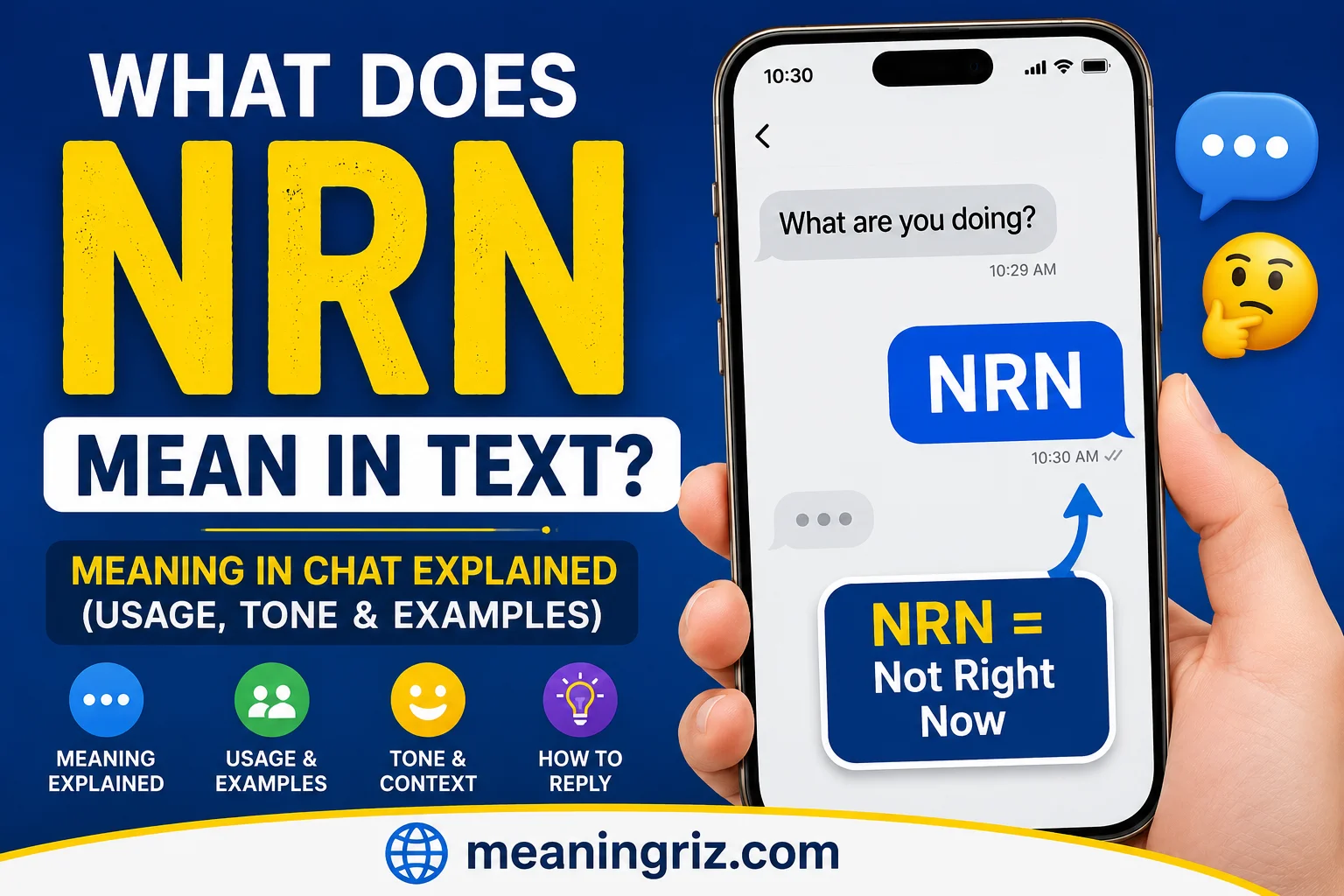
There’s also a second, less common meaning: “Not Right Now.” This version shows up when someone is declining or postponing something, not closing out a message. We’ll cover both, because mixing them up is the most common mistake people make with this one.
Quick answer: NRN usually means “No Reply Necessary” — a polite way to end a message without expecting a response. Less often, it means “Not Right Now,” used to put something off.
The Core Meaning, Explained Simply
NRN exists for one simple reason: not every message needs an answer, and texting doesn’t always make that obvious.
When you send someone a normal text, there’s an unspoken pressure to reply — even if it’s just “ok” or a thumbs-up emoji. NRN removes that pressure on purpose. It tells the other person: I’m just letting you know something. You don’t owe me a response.
It works the same way “FYI” does, but it goes one step further — FYI tells you the message is informational, while NRN actually tells you what to do with it (nothing).
Why Two Different Meanings Exist
This is the part most guides skip, and it’s actually the most useful thing to understand.
“No Reply Necessary” is the dominant, most widely recognized meaning. It’s used at the end of a message, almost always after the actual information has already been shared.
“Not Right Now” is older internet slang, more common in instant messenger and gaming contexts, and it’s used as a response to something — usually turning down a request or invitation for the moment.
You can usually tell which one is meant by where it sits in the conversation:
- If NRN comes after a statement of fact → it almost certainly means “No Reply Necessary.”
- If NRN comes as a reply to a question or request → it likely means “Not Right Now.”
Real Chat Examples
Seeing both versions side by side makes the difference click immediately.
“No Reply Necessary” in Action
Sam: Made it home safe. NRN Sam: Just wanted you to know 🙂
Manager: Team meeting moved to Monday 10am. NRN Employee: 👍
Friend: Left your charger on your desk. NRN
In every one of these, the sender is closing the loop, not opening a conversation.
“Not Right Now” in Action
Jordan: wanna hop on a call? You: nrn, kinda swamped
Friend: can you send that file? You: nrn, will do it tonight
Here, NRN is doing a completely different job — it’s softening a “no” or a “not yet” rather than ending an update.
Where You’ll See NRN Used
In texting (SMS/iMessage): Almost always the “No Reply Necessary” version — people use it to share quick updates without starting a back-and-forth.
On WhatsApp and Messenger: Common in family groups and friend chats for the same reason — sharing logistics, locations, or plans without needing a reply chain.
In work chats (Slack, Teams, email-adjacent messaging): Used informally to flag that an update doesn’t need acknowledgment. Still best avoided in formal emails, where spelling it out reads more professional.
In gaming chats and older instant messenger culture: This is where “Not Right Now” shows up more, usually declining an invite to join, play, or talk without sounding harsh.
On social media DMs: Mostly “No Reply Necessary,” often after sending a link, photo, or quick note that doesn’t need a response.
When to Use NRN (And When Not To)
When It Works Well
- You’re sharing a simple update, fact, or piece of info
- You want to be considerate of someone’s time
- The relationship is casual enough that shorthand feels natural
- You’re closing out a message, not opening a new topic
When to Skip It
- You’re writing a formal email — spell it out instead (“no response needed”)
- The message includes something emotional, serious, or sensitive
- You’re talking to someone who may not know texting abbreviations
- You actually do want some kind of acknowledgment, even a small one
A useful gut check: if you’d feel a little uneasy getting total silence back, don’t add NRN. It removes the social obligation to reply — including the obligation to say “ok, got it.”
Is NRN Rude?
Generally, no. It’s built to be the opposite of rude — it’s meant to take pressure off the other person, not put pressure on.
Where it can land wrong is when it’s attached to something that actually mattered emotionally. Telling someone “I’m really upset about what happened. NRN” sends a mixed signal — the words say “I need to share this” while NRN says “but don’t engage with me about it,” and that contradiction can feel colder than intended.
It can also confuse anyone unfamiliar with texting shorthand, especially older relatives or coworkers, who might wonder if you’re annoyed or being short with them.
Why People Use This (Psychology)
There’s something quietly considerate happening underneath this abbreviation, beyond just saving keystrokes.
It manages the unspoken weight of texting. Every message carries a small expectation of response, even casual ones. NRN is one of the few pieces of slang that exists purely to lift that expectation, rather than add tone, emotion, or urgency.
It protects the sender’s time too. People assume NRN is only about being polite to the recipient, but it also quietly tells the sender’s own brain “this doesn’t need a follow-up check,” which is its own small relief in a constantly-pinging inbox.
It reflects a shift toward lower-pressure communication. As more daily life moves into chat threads, people have started building in small social exits — phrases that let a conversation end naturally without it feeling abrupt or dismissive. NRN is one of those exits.
One real observation from how people actually use it: NRN tends to show up most in messages that are slightly more than pure information but not quite worth a full conversation — “made it home,” “left your stuff at the door,” “saw your text, all good.” It’s the texting equivalent of a small wave instead of a handshake.
A Common Mistake People Make
The biggest mix-up is using “No Reply Necessary” NRN in a moment that actually called for “Not Right Now,” or vice versa — without realizing the receiver might read it the other way. Since both meanings exist, dropping NRN into an ambiguous spot in the conversation (not clearly after info, not clearly as a reply to a request) can leave the other person guessing which one you meant. When in doubt, the position in the conversation should make it obvious — if it doesn’t, it’s worth spelling it out.
NRN vs. Similar Texting Slang
| Term | Meaning | Typical Tone | Emotional Undertone | Risk of Misreading | Best Used In |
|---|---|---|---|---|---|
| NRN | No Reply Necessary / Not Right Now | Polite, low-pressure | Considerate or mildly declining | Medium — two meanings exist | Closing updates, softening a “no” |
| FYI | For Your Information | Neutral, informative | Practical | Low | Sharing facts, no reply implied either way |
| NTS | Note to Self | Neutral | Reflective, internal | Low | Personal reminders, not addressed to others |
| JIC | Just In Case | Cautious, helpful | Reassuring | Low | Backup info, contingency plans |
| NVM | Never Mind | Casual, dismissive | Can feel abrupt or closed-off | Medium — tone depends on punctuation | Withdrawing a question or comment |
The key difference worth remembering: FYI shares information neutrally and leaves the reply optional by implication. NRN removes that ambiguity completely by stating outright that no reply is expected.
How to Respond to “NRN” (By Tone)
Friendly Reply
“Got it, thanks for letting me know!”
Neutral / Practical Reply
“Noted 👍”
Playful Reply
“Replying anyway, deal with it 😄”
Smart / Confident Reply
“Appreciate the heads up — no notes.”
The pattern here: even though NRN technically frees you from replying, a short acknowledgment usually feels warmer and costs almost nothing. Total silence can occasionally feel like the message vanished into nothing, even when that was technically the point.
Frequently Asked Questions
What Does NRN Mean in a Text Message?
NRN most often means “No Reply Necessary” — a way of telling someone they don’t need to respond to your message. It can sometimes mean “Not Right Now” when used as a reply to a request.
Is NRN Rude or Impolite?
No, it’s generally meant to be considerate, not rude. It only feels off when it’s attached to an emotional or serious message, where the contradiction between sharing something heavy and asking for no response can feel mismatched.
Can I Use NRN in a Work Email?
It’s better to spell it out as “no response needed” in formal emails. NRN works fine in informal work chats like Slack or Teams, but it can look unclear or too casual in official correspondence.
Should I Still Reply if Someone Sends NRN?
You don’t have to, but a short “got it” or an emoji is a nice, low-effort way to close the loop without writing a full response.
Does NRN Always Mean the Same Thing?
No — that’s the part most people miss. It usually means “No Reply Necessary,” but in older internet slang and gaming chats, it can mean “Not Right Now.” Context and position in the conversation usually make it clear which one is meant.
Is NRN Common on Social Media and Apps Like WhatsApp?
Yes, it shows up in WhatsApp, Messenger, Instagram DMs, and group chats — almost always as “No Reply Necessary” in those settings, since it’s typically used for quick updates rather than declining requests.
The Bottom Line
NRN means “No Reply Necessary” most of the time — a small, considerate way to share something without expecting a response. Less often, it means “Not Right Now,” softening a decline instead. Once you notice where it lands in a conversation — right after information versus right after a request — the meaning becomes obvious every time you see it.
DISCOVER MORE ARTICLES
What Does PMO Mean in Text? (Usage, Tone & Examples)
What Does LCL Stand for in Chat? Explained Simply
FWIW Meaning in Chat, Texting & Social Media
WYA Meaning in Text Explained (Usage, Tone & Real Examples)
GMFU Meaning in Text Explained (Usage, Tone & Real Examples)