You’re scrolling through a group chat, someone shares something wild, and the next reply is just:
“STFU 😭”
No anger emoji. No fight. Just that. And now you’re wondering — is this person mad, shocked, or just joking around?
Here’s the short answer, then we’ll get into the part that actually matters: how to read it correctly.
What Does STFU Mean?
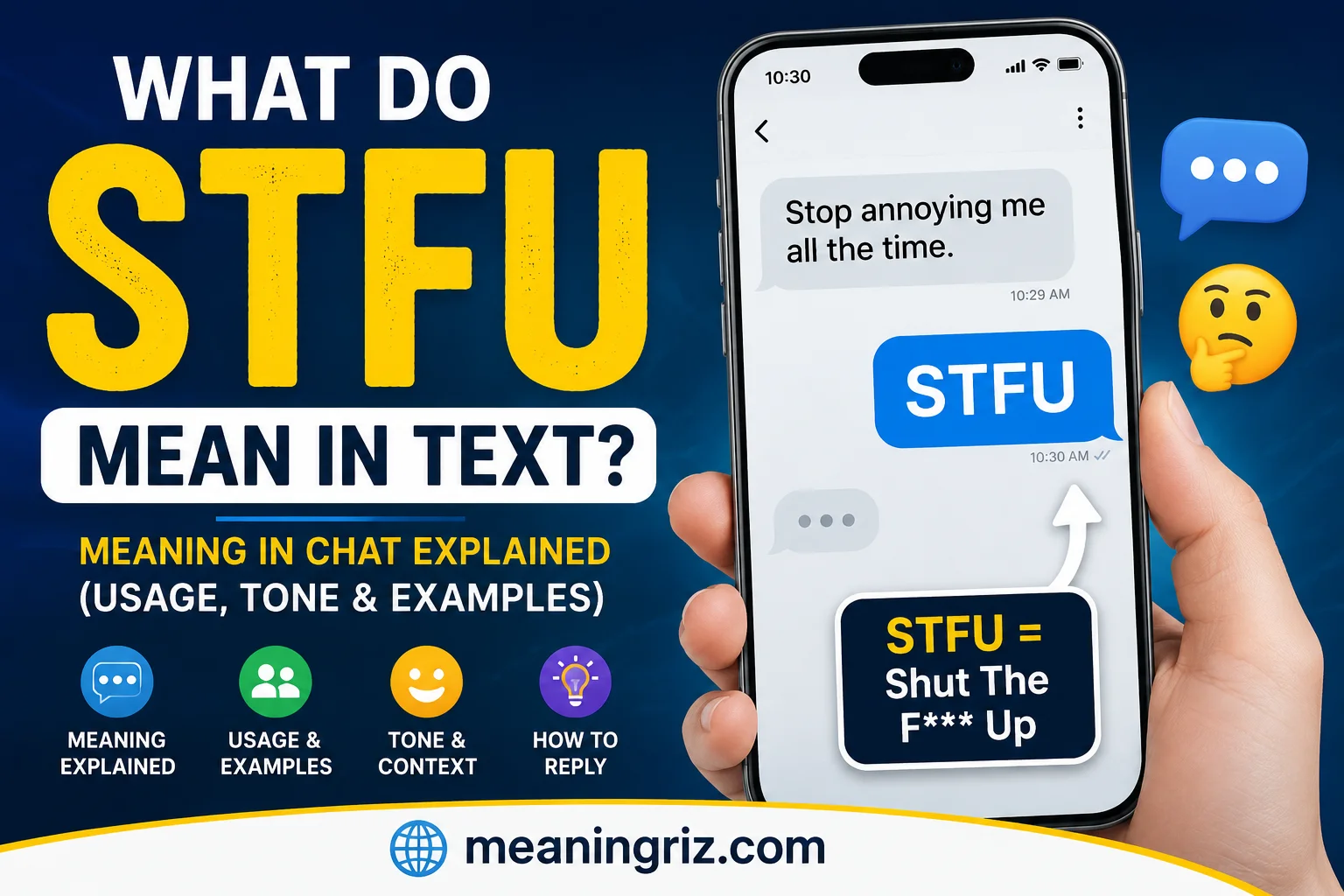
STFU stands for “shut the f* up.”** It’s a strong, blunt phrase used to tell someone to stop talking — but online, it’s just as often used to express shock, disbelief, or excitement rather than actual anger.
That’s the literal translation. The real skill is knowing which version someone means, because the same four letters can sound like an insult or a compliment depending on who sent it.
The Simple Meaning, Without the Confusion
At face value, STFU is a command: stop talking, be quiet. It’s the texting shorthand of a phrase people have said out loud for decades, just compressed into letters for speed.
It started in early internet forums and chatrooms in the late 1990s and 2000s, where it was used bluntly — often to shut down trolls or people being annoying in a thread. Gaming communities picked it up next, and from there it spread into everyday texting and social media.
So in plain English:
STFU = “Shut the f* up”** — a strong slang phrase used to tell someone to stop talking, though online it’s frequently used to express shock or excitement instead of anger.
That’s the literal definition. But almost nobody texting “stfu” today is using it the way it reads on paper — and that gap is exactly why people get confused by it.
But the Meaning Shifts Depending on Context
This is where most explanations stop too early. STFU rarely means what it literally says. The same word carries at least four very different meanings:
1. Genuine anger or frustration. Someone is actually telling you to stop talking, usually in a heated moment. This is the rarest use in casual texting, but it’s the one people worry about most.
2. Shock or disbelief. “STFU, you got the job?!” This has nothing to do with anger — it means “no way” or “I can’t believe it.”
3. Playful teasing. Between close friends, it’s often a joking jab, almost affectionate in tone. “Stfu, you’re not even that funny 😂” reads as banter, not conflict.
4. Excitement or hype. In comment sections and group chats, “STFU THAT’S SO GOOD” is pure enthusiasm, often paired with caps lock and exclamation points to push the energy higher, not the anger.
Same four letters, four completely different emotional temperatures. The literal meaning barely matters once you understand how it’s actually used.
Real Chat Examples (How It Actually Looks)
Not the dictionary version — the version that actually shows up in your notifications.
Reacting to Big News
Sam: I got into the program!! You: STFU 😭 congratulations omg
Here it means pure shock and happiness. Nobody is being told to be quiet.
Playful Teasing Between Friends
Friend: I think pineapple on pizza is actually good You: stfu, no it’s not 😤
Light, joking disagreement. The tone is closer to “oh come on” than an actual insult.
Genuine Frustration
“Can you just STFU for one second, I’m trying to think”
This one is closer to the literal meaning — a real request, sometimes annoyed, sometimes sharp, depending on punctuation and caps.
Comment Section Hype
“STFU THIS EDIT IS INSANE 🔥🔥”
All caps here usually means excitement, not anger — it’s a volume increase, not a tone shift toward hostility.
Platform-by-Platform: Does STFU Change Meaning?
The core meaning stays the same everywhere. What shifts is how likely it is to be playful versus genuinely hostile.
STFU on TikTok
Almost always reactive and positive — used in comments to express shock at something impressive, funny, or unexpected. Rarely meant as an insult here.
STFU on Discord
Common in gaming chats during fast-paced moments. It can be playful banter between teammates or a sharper reaction during a heated match, depending on the server’s culture and how well people know each other.
STFU on Instagram
Frequently shows up in comments and story replies as a reaction to surprising posts, often paired with laughing or shocked-face emojis to keep the tone light.
STFU in Group Chats
Tends to be the most context-dependent. Among close friends, it’s usually a joke. In a tense group conversation, it can land as a genuine request to stop.
STFU in One-on-One Texting
The most likely place for it to carry real weight, especially without emojis or punctuation softening it. Without an audience, there’s less incentive to perform humor, so it leans closer to literal.
When to Use STFU (And When Not To)
When It’s Generally Fine
- Reacting to shocking, funny, or impressive news from close friends
- Joking around in a relationship where this kind of banter is already normal
- Hype reactions in comment sections or gaming chats with people you know
When to Avoid It
- Messaging anyone in a professional, academic, or formal context
- Talking to someone you don’t know well or have no joking rapport with
- During an actual argument, where it’s likely to be read as literal and escalate things
- Texting someone who doesn’t use or like profanity, even casually
A simple rule that holds up almost every time: if the tone could be misread and the relationship can’t absorb that risk, don’t send it.
Is STFU Rude?
It depends entirely on context, but it’s worth being honest about the baseline: STFU contains profanity, so it carries more weight than something like “lol” or “omg” even when it’s meant playfully.
It’s rarely rude between close friends who already joke this way — the shared history makes the tone obvious to both people.
It can land as genuinely rude or aggressive with someone you don’t know well, in a professional setting, or during a real disagreement, because there’s no established context to soften it.
It’s almost never appropriate directed at someone older, in authority, or in a setting where profanity itself would be inappropriate — the issue there isn’t just tone, it’s the language itself.
Why People Use This (Psychology)
There’s a reason this specific phrase, despite the profanity, became one of the most common reactions online instead of fading out as “too harsh.”
Strong language signals strong emotion efficiently. When you want to convey real shock or excitement fast, a mild word doesn’t do the job. STFU works because the intensity of the phrase mirrors the intensity of the reaction, even when the literal meaning isn’t intended at all.
It functions as a trust signal between friends. Using a phrase that would sound aggressive to a stranger, but lands as funny between you, is itself a way of saying “we know each other well enough that this can’t be misread.” People often save their strongest slang for their closest relationships precisely because the risk of misunderstanding is lowest there.
It lets people express enthusiasm without sounding naive. “STFU that’s amazing” hits differently than “wow that’s amazing” — it reads as more genuine, less performative, almost reluctant-sounding excitement, which can feel more believable than an enthusiastic response that sounds too eager.
One real observation worth noting: the punctuation and capitalization around STFU often matter more than the word itself. “stfu” in lowercase with no punctuation usually reads soft and casual. “STFU.” with a period reads sharp and final. Same word, very different temperature, based entirely on formatting choices people make almost unconsciously.
A Common Mistake People Make
The biggest misread goes both directions. Some people assume STFU is always rude and panic or get defensive when a friend sends it playfully. Others assume it’s always harmless and use it with someone who either doesn’t share that context or genuinely finds the language uncomfortable. Both mistakes come from treating the word as fixed instead of reading the relationship and moment it showed up in.
STFU vs. Similar Texting Slang
People often group STFU with other reaction slang, but the intensity and intent behind each one are different.
| Term | Meaning | Typical Tone | Emotional Undertone | Risk of Misreading | Best Used In |
|---|---|---|---|---|---|
| STFU | Shut the f*** up | Strong, blunt | Shock, excitement, or genuine frustration | High — contains profanity, easily misread | Close friends, comment reactions, casual hype |
| WTF | What the f*** | Strong, blunt | Confusion, shock, disbelief | Medium | Reacting to confusing or wild situations |
| SHUT UP | Be quiet | Softer, more polite | Disbelief or mild annoyance | Low | Casual friend conversations, no profanity needed |
| GTFO | Get the f*** out | Very strong, blunt | Shock or disbelief, sometimes anger | High | Close friends only, reacting to big news |
| STG | Swear to God | Moderate, emphatic | Sincerity or mock seriousness | Low | Emphasizing a point casually |
The key difference worth remembering: STFU and similar profanity-based reactions carry more emotional intensity but also more risk. “Shut up” can do almost the same job with far less chance of being misunderstood by someone outside your usual texting circle.
How to Respond to “STFU” (By Tone)
Friendly Reply
“Right?? I couldn’t believe it either 😂”
Neutral / Practical Reply
“Haha yeah it’s pretty wild”
Playful Reply
“Excuse me?? Say that to my face 😤”
Smart / Confident Reply
“I know, I’m just that good 😎”
The pattern here: most “STFU” reactions are looking for matching energy, not an explanation. Treating it as a joke when it’s clearly meant as one keeps the exchange light, while a flat or overly serious reply can make a playful moment feel awkward.
Frequently Asked Questions
What Does STFU Mean in a Text From a Girl or Guy?
The meaning doesn’t change based on gender — it’s still “shut the f*** up.” What shifts is the same as always: relationship and tone. From a close friend, it’s usually shock or banter. From someone you don’t know well, take it more literally.
Is STFU Always Rude?
No. Among friends, it’s frequently used to express shock, excitement, or playful teasing rather than genuine anger. It can be rude in formal settings, with strangers, or during an actual disagreement.
Is It Okay to Use STFU at Work or in Professional Messages?
No. It contains profanity and is considered too casual and potentially offensive for any work, school, or formal communication, even if meant as a joke.
What’s the Difference Between STFU and Shut Up?
“Shut up” is softer and more universally understood as casual or mildly annoyed. STFU is stronger because it includes profanity, which raises both the intensity and the risk of being misread.
Why Do People Use STFU to Express Excitement Instead of Anger?
Because strong language conveys strong emotion quickly. Saying “STFU that’s amazing” feels more genuine and intense than a milder phrase, even though the literal words sound aggressive.
How Do I Know If Someone Means STFU Seriously or Jokingly?
Look at the surrounding context: emojis, punctuation, capitalization, and what was just said. A laughing emoji or exclamation usually signals a joke. A period, no emoji, and a tense conversation usually signals it’s literal.
The Bottom Line
STFU literally means “shut the f*** up,” but in real texting and online conversations, it’s just as often a reaction to shock, excitement, or friendly teasing as it is a genuine command. The word itself doesn’t tell you the tone — the relationship, the platform, and the punctuation around it do. Once you start reading those signals instead of just the letters, STFU stops being confusing and starts being easy to read correctly almost every time.
DISCOVER MORE ARTICLES
What Does PMO Mean in Text? (Usage, Tone & Examples)
What Does LCL Stand for in Chat? Explained Simply
FWIW Meaning in Chat, Texting & Social Media
WYA Meaning in Text Explained (Usage, Tone & Real Examples)
GMFU Meaning in Text Explained (Usage, Tone & Real Examples)