Someone just replied to your message with “IMK” and now you’re second-guessing everything.
Is that an answer? A brush-off? Are they being sarcastic or just lazy with their typing?
You’re not overthinking it — IMK genuinely trips people up because it looks like it should be obvious but isn’t. Here’s everything you actually need to know.
What Does IMK Mean? (Quick Answer)
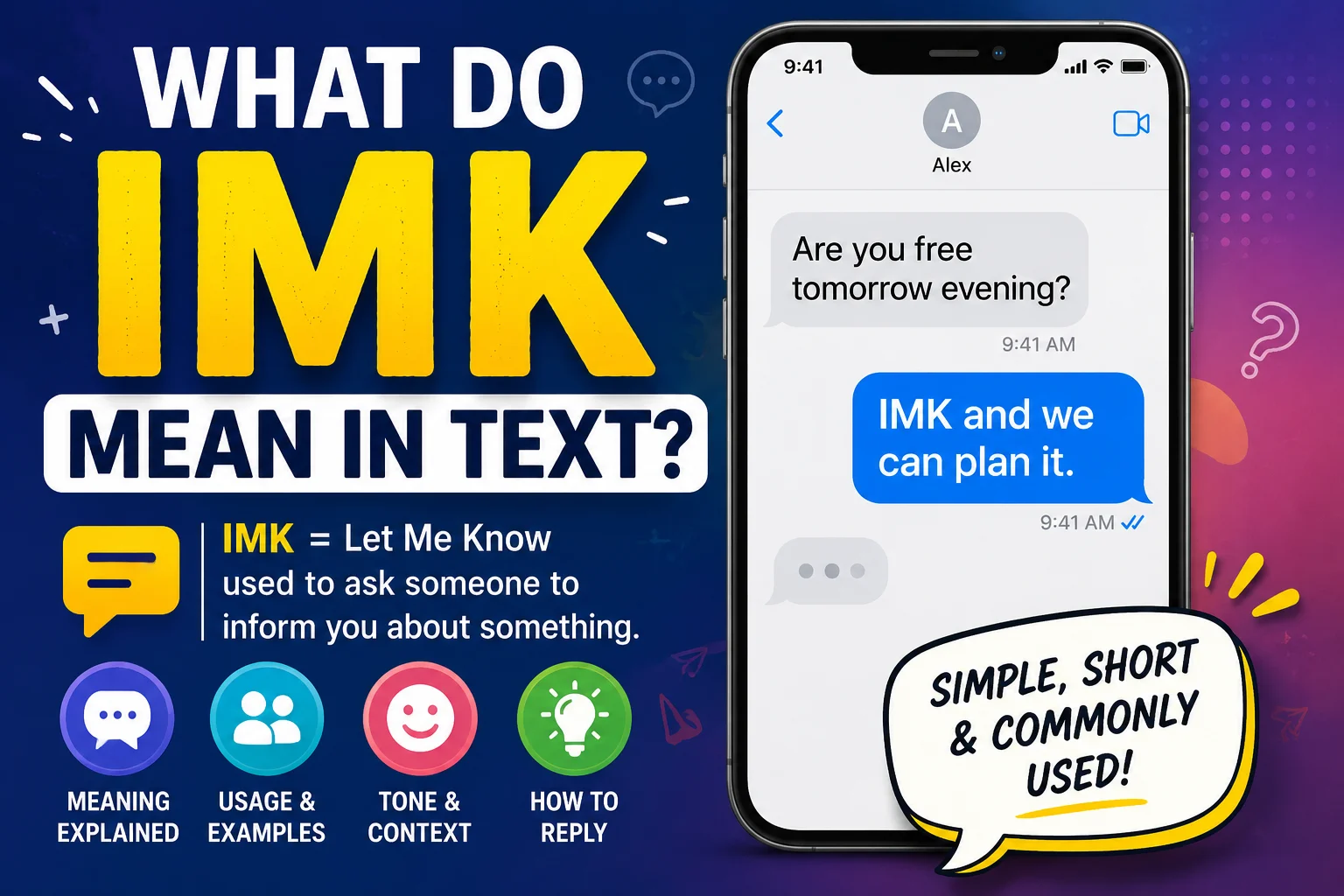
IMK stands for “In My Knowledge.” It’s a casual way of saying “based on what I know” or “as far as I’m aware” — without fully committing to the information being 100% accurate.
Think of it as a built-in disclaimer wrapped inside a short answer.
IMK = “In My Knowledge” — used to share information while signaling you’re not totally certain. A polite, humble way to answer without overpromising.
That’s the core definition. But like most texting slang, what it actually communicates in a conversation goes a bit deeper than the abbreviation itself.
The Two Meanings of IMK (Context Changes Everything)
Most people encounter IMK in one of two ways, and they’re slightly different in tone.
IMK as “In My Knowledge”
This is the most common use. Someone is answering a question but wants to flag that their answer is based on personal understanding, not guaranteed fact.
“IMK the restaurant closes at 10, but you should call first.”
The message is: I think this is right, but I’m not swearing by it. It’s useful, humble, and honest — all at once.
IMK as “I Might Know”
Less common, but you’ll see it in more playful or flirty conversations. Here, IMK is used to tease — to hint that the person has an answer but wants you to engage more before they give it.
“IMK who told them 👀”
This version isn’t really about knowledge at all. It’s about holding something back in a way that keeps the conversation going. The tone is coy, not informational.
The difference between these two uses usually comes down to punctuation, emoji, and the energy of the conversation before it. A plain “IMK” tends to be informational. An “IMK 👀” or “imk…” is almost always playful.
Why People Use IMK Instead of Just Answering
This is the part most articles completely skip, and it’s actually the most interesting piece of the puzzle.
When someone uses IMK, they’re doing something subtle but socially smart: they’re protecting both themselves and you.
Saying “the show starts at 8” and being wrong feels bad. Saying “IDK” can feel unhelpful. IMK lands right in between — it gives you information while quietly saying “don’t quote me on this.” That middle ground is genuinely useful in text conversations where you don’t have time to verify things and you don’t want to seem either ignorant or overconfident.
IMK became a linguistic safety net for exactly this reason. It lets people be helpful without being accountable for being wrong. In a world where misinformation spreads fast and people get called out publicly, that kind of built-in hedge has real social value — even in casual chats.
One real thing you’ll notice in actual conversations: people use IMK most when they care enough to help but aren’t sure enough to commit. Someone who genuinely doesn’t know says IDK. Someone who knows for sure just answers. IMK lives in the honest middle.
Real Chat Examples (How It Actually Looks)
Between Friends, Answering a Quick Question
Jake: “Is the game on tonight?” Sam: “IMK yeah, check the ESPN app tho”
This is the most everyday version — helpful, casual, slightly uncertain. Sam’s not blowing Jake off, he’s giving his best answer with a honest caveat built in.
In a Group Chat, Sharing Info Nobody’s Sure About
“IMK the deadline was moved to Friday but someone should confirm”
This works really well in group chats where nobody wants to be the person who confidently says something wrong in front of everyone. IMK gives the group something to work with while spreading the accountability around.
In a Flirty or Playful Exchange
“imk who’s been asking about you 👀”
Here IMK isn’t even about knowledge — it’s a teaser. The person is deliberately being vague to create curiosity. If you see IMK with emoji or trailing dots, expect this kind of tone.
Texting Someone You’ve Just Met
“IMK there’s a good pizza place near there, not 100% sure tho”
Useful, friendly, and humble. A good way to be helpful without sounding like you’re showing off.
Platform-by-Platform: Where You’ll See IMK and How It’s Used
IMK on Snapchat
On Snapchat, IMK tends to pop up in quick back-and-forth streaks. The tone is almost always casual and the “I Might Know” version shows up more here, often paired with streaks and story replies. It’s low-pressure communication.
IMK on Instagram DMs
Instagram DMs tend to run a little warmer and more social. IMK in DMs often comes up when someone’s sharing info about an event, a person, or something they’re not fully sure about. The flirty or teasing version also appears here, especially in DM exchanges that have some spark to them.
IMK on WhatsApp
WhatsApp conversations tend to be more practical — logistics, family groups, coordinating plans. IMK here is almost always the “In My Knowledge” version. Someone’s answering a real question and acknowledging they might not have the full picture.
IMK in Discord or Gaming Chats
Gaming communities use IMK a lot when sharing tips, patch notes, or strategy — things that change frequently and where nobody wants to be pinned down as wrong. “IMK that respawn time changed in the last update” is a very natural use here.
IMK in Text Messages (SMS/iMessage)
Straightforward and practical. In plain texting between people who already know each other, IMK is a quick, honest way to answer without sounding uncertain or dismissive.
When to Use IMK (And When to Skip It)
When It Works Well
- You have an answer but you’re not 100% sure it’s accurate
- You want to be helpful without being misleading
- You’re in a casual group chat where full certainty isn’t expected
- The conversation is relaxed and informal
When to Avoid It
- Professional emails or work messages. It reads as vague and uncommitted in a business setting. Use “as far as I’m aware” or “to the best of my knowledge” instead — same idea, professional tone.
- Serious or high-stakes topics. Health, money, legal stuff. If accuracy really matters, don’t hedge — either verify it or say you’ll find out.
- When talking to someone who’s already frustrated. An uncertain answer when someone needs clarity can feel like a brush-off, even if that’s not the intent.
A good rule of thumb: IMK belongs in conversations where being slightly wrong is low-risk. The moment the stakes go up, swap it for a full phrase or a commitment to actually check.
Is IMK Rude?
No — not in normal use. IMK is fundamentally a polite term. It’s the opposite of being arrogant or overconfident. It shows enough self-awareness to admit you might not have the full picture.
The only time it can read as dismissive is when someone asks something genuinely important and gets a vague “IMK” with nothing else. That can feel like the person couldn’t be bothered to actually find out. Context and effort matter — adding something like “IMK, but I’ll check” completely changes the tone.
Why People Use This (Psychology)
There’s something deeper going on with IMK that most people don’t consciously notice.
Hedging language is a form of social intelligence. In face-to-face conversation, you have tone of voice, facial expressions, and body language to soften a statement. In text, you have nothing but the words themselves. That’s why phrases like IMK exist — they do the work that tone of voice would do in person.
When someone says IMK, they’re also signaling something about the relationship: I trust you enough to give you my best guess, but I respect you enough not to pretend it’s more than that. That’s a surprisingly considerate move, especially in fast texting environments where people often just blast off answers without thinking.
There’s also an element of digital humility at play. In online spaces where being wrong can be screenshotted, shared, and used against you, people have become more careful about how they frame information. IMK is partly a product of that culture — a way of sharing knowledge while keeping a small escape hatch open.
The deeper emotional truth: when someone uses IMK with you, they’re usually trying to help. They just want you to know the help comes with limitations. That’s worth appreciating, not rolling your eyes at.
A Common Mistake People Make With IMK
The most common mistake is assuming IMK means the person doesn’t really know anything. They do. IMK doesn’t mean “I have no idea” — that’s IDK. IMK means “I have partial or unverified knowledge and I’m sharing it honestly.”
Treating an IMK answer as useless and going off to find information elsewhere, when the IMK answer was actually correct, is something that happens all the time. The hedge makes people doubt the answer more than they should.
The fix: take IMK answers seriously as a starting point. They’re often right — just not guaranteed.
IMK vs. Similar Texting Slang
IMK shares space with a few other hedging abbreviations that people sometimes mix up. Here’s how they actually differ:
| Term | Full Meaning | Tone | Certainty Level | Emotional Undertone | Best Context |
|---|---|---|---|---|---|
| IMK | In My Knowledge | Casual, humble | Partial — “I think so” | Helpful, honest | Informal texting, group chats |
| IDK | I Don’t Know | Casual, neutral | None — “no idea” | Neutral, sometimes lazy | Casual chats |
| AFAIK | As Far As I Know | Semi-formal | Moderate — “probably right” | Careful, trustworthy | Work Slack, semi-formal chats |
| IMHO | In My Humble Opinion | Casual to semi-formal | Opinion, not fact | Thoughtful, slightly careful | Social media, discussions |
| TBH | To Be Honest | Casual, direct | Variable — depends on sentence | Raw, open | Personal conversations |
| IK | I Know | Casual, confident | High — “definitely” | Assured, sometimes blunt | Quick confirmations |
The clearest distinction worth remembering: IMK is about knowledge with uncertainty. IDK is the absence of knowledge. IK is knowledge with confidence. They sit on a certainty spectrum, and IMK sits right in the honest middle.
How to Respond to IMK
When They’re Sharing Information
Them: “IMK the party starts at 9” Friendly response: “Got it, I’ll double-check the time just in case!” Practical response: “Thanks, I’ll confirm with Maya” Casual response: “works for me either way”
When They’re Being Playful or Teasing
Them: “imk who texted you last night 👀” Playful response: “okay so spill 😂” Confident response: “You clearly know, just tell me” Chill response: “lmao okay I see you”
When You Need More Certainty
Them: “IMK the deadline is Friday” Smart response: “Okay I’ll verify — would hate to miss it”
The pattern: when IMK is informational, acknowledge it and flag that you might verify. When it’s playful, match the energy. Don’t over-analyze a casual IMK — it’s usually just someone being helpful and honest at the same time.
Frequently Asked Questions
What Does IMK Mean in Text From a Guy or Girl?
The meaning doesn’t change based on who’s sending it. IMK means “In My Knowledge” regardless. What might shift is the intent — in flirty or playful conversations, IMK can be used teasingly (closer to “I might know, but I’m not telling you yet”). Read the conversation, not just the word.
Is IMK the Same as IDK?
No, and this is the most common confusion. IDK means “I don’t know” — the person has no information. IMK means “In My Knowledge” — the person does have information but isn’t fully certain it’s accurate. One is an absence of knowledge, the other is knowledge with a disclaimer.
Is IMK Rude or Offensive?
Not at all. It’s one of the more thoughtful texting abbreviations because it builds honesty into the answer. It only reads as dismissive in very specific situations — usually when the question was serious and the response gave nothing useful beyond “IMK.”
Can IMK Be Used in a Professional Setting?
It’s risky. In a formal email or client message, IMK can sound vague or careless. The phrase “as far as I’m aware” or “to the best of my knowledge” carries the same meaning professionally, without the slang. In casual Slack or team chat with people you know well, it’s usually fine.
Does IMK Mean the Same Thing on Snapchat, Instagram, and TikTok?
The core meaning stays consistent across platforms. The tone shifts slightly — on Snapchat and Instagram it tends to run more casual or playful, while on WhatsApp and iMessage it’s usually more straightforward and informational.
Why Do People Use IMK Instead of Just Saying “I Think”?
Speed is part of it, but not all of it. IMK carries a slightly more specific meaning than “I think” — it implies that the answer is based on actual knowledge or experience, just not verified knowledge. It’s a more honest, precise hedge than simply “I think.”
The Bottom Line
IMK means “In My Knowledge” — a small, honest signal that someone is sharing their best answer without claiming it’s guaranteed. It’s not a brush-off, not rude, and not the same as saying “I don’t know.” It’s actually one of the more considerate things someone can say in a fast-moving text conversation: here’s what I know, take it as a starting point.
When you see it, take the answer seriously. When you use it, you’re doing someone a small favour by being upfront about your certainty level. That’s a surprisingly rare thing in texting, and it’s why IMK has stuck around.
DISCOVER MORE ARTICLES
FWIW Meaning in Chat, Texting & Social Media
GMFU Meaning in Text Explained (Usage, Tone & Real Examples)
TB Meaning in Text Explained (Usage, Tone & Examples)
PMTFO Meaning in Text Explained (Usage, Tone & Examples)
I’m the person behind this website, handling both the writing and content management myself. I focus on explaining word meanings, slang, and modern expressions in simple, clear language, using real-life examples so readers can understand how these terms are actually used in everyday conversations.