Have you ever opened Snapchat or TikTok, seen someone reply with “ionk,” and immediately wondered what it meant? You’re not alone. Internet slang changes so quickly that even people who spend hours online sometimes come across abbreviations they’ve never seen before.
The good news is that IONK isn’t as complicated as it looks. Once you understand the context, you’ll start noticing it everywhere—from text messages and Instagram DMs to gaming chats and comment sections.
What Does IONK Mean in Text? (Quick Answer)
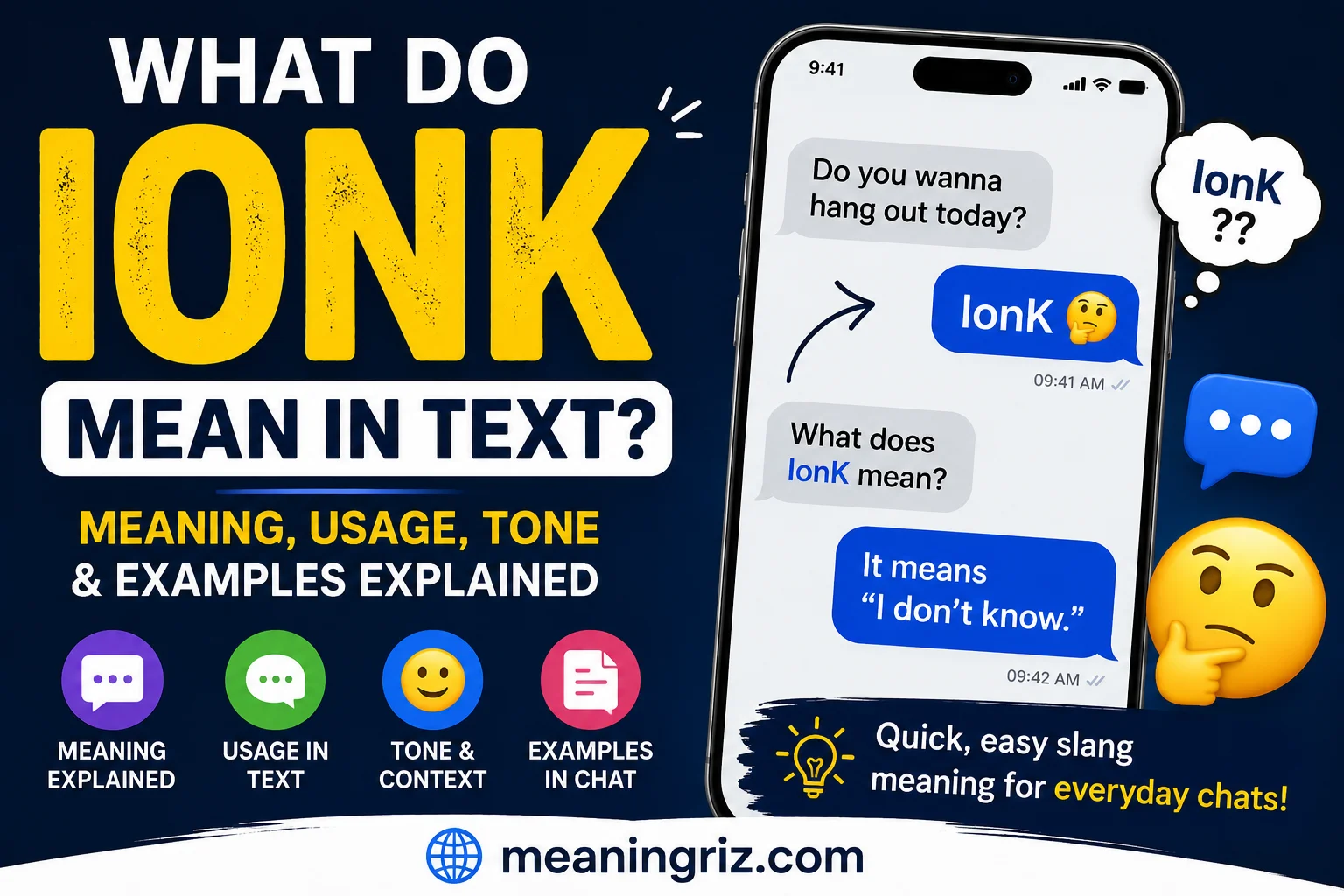
IONK usually means “I don’t know.” It’s a casual internet abbreviation people use in text messages, social media, and online chats when they don’t know the answer to something.
While IDK is still the most common abbreviation for “I don’t know,” many people—especially younger users—type ionk because it reflects the way they naturally speak and text online.
What Does IONK Mean in Text?
In most conversations, IONK simply means:
I don’t know.
That’s it.
It’s an informal slang abbreviation used when someone doesn’t have an answer, isn’t sure about something, or doesn’t want to make a guess.
For example:
Friend: Who’s driving tonight?
You: ionk.
Translation:
“I don’t know.”
Although it looks unusual at first, ionk serves exactly the same purpose as saying “I don’t know” or “IDK.”
The biggest difference is the tone.
Instead of sounding like a traditional abbreviation, ionk feels more casual, relaxed, and in line with today’s texting style.
Why Do People Type “IONK” Instead of “IDK”?
This is where many explanations stop—but the real answer is more interesting.
People don’t always type words exactly as they’re written. In fast-paced chats, they often type words the way they sound when spoken.
That’s why you’ll see slang like:
- imma
- finna
- gotta
- ion
- ionk
Rather than carefully typing “I don’t know,” many users simply type the phrase the way it naturally comes out in conversation.
Over time, that casual writing style became normal on platforms like TikTok and Snapchat.
In real conversations, most people aren’t trying to invent new slang. They’re simply texting as quickly as they speak.
What Does IONK Mean on Snapchat?
On Snapchat, IONK almost always means “I don’t know.”
Because Snapchat conversations are quick and informal, people rarely use full sentences unless they’re discussing something important.
You might see messages like:
ionk lol
ionk maybe ask Jake
ionk 😂
In every example above, the person is simply saying they don’t know the answer.
The emoji or extra words only change the mood of the message—not its meaning.
What Does IONK Mean on TikTok?
TikTok comments move incredibly fast, so users naturally shorten words wherever possible.
If someone comments:
ionk bro
they usually mean:
“I don’t know, bro.”
You’ll often find ionk alongside other popular internet slang like:
- fr
- ngl
- ts
- imo
- lowkey
- idc
These abbreviations help conversations feel quicker and more conversational.
What Does IONK Mean on Instagram?
Whether it’s in Instagram comments or direct messages, ionk carries the same meaning.
Example:
Person A: Did they break up?
Person B: ionk honestly.
Meaning:
“I honestly don’t know.”
Instagram users often mix internet slang together, so seeing ionk next to expressions like fr, lol, or tbh is completely normal.
What Does IONK Mean on WhatsApp and Text Messages?
Although IDK is still more common in regular texting, ionk is becoming easier to spot—especially among younger users.
For example:
Mom: Do you know where your brother went?
You: ionk.
Or:
Friend: When’s the movie starting?
Reply: ionk yet.
It’s short, natural, and gets the point across without sounding formal.
Is IONK Different from IDK?
Technically, no.
Both expressions communicate exactly the same idea:
“I don’t know.”
The difference is how they sound.
| Expression | How It Feels |
|---|---|
| I don’t know | Complete sentence, more formal |
| IDK | Neutral internet abbreviation |
| IONK | Relaxed, conversational, modern texting slang |
Think of it this way:
Using IDK is like writing correctly.
Using ionk is like speaking casually with friends.
Neither one is wrong—the situation simply determines which feels more natural.
How People Actually Use IONK in Everyday Chats
One thing many websites miss is that people rarely use internet slang in isolation.
Instead, they mix it naturally into conversations.
For example:
Friend: Are they dating now?
Reply: ionk but everyone keeps saying they are.
Friend: Who’s picking us up?
Reply: ionk yet. I’ll ask.
Gaming Chat
Player 1:
“When’s the update?”
Player 2:
“ionk maybe tomorrow.”
Notice something?
People almost never stop after typing ionk.
They usually add another thought that keeps the conversation moving.
That’s how real texting works.
The Tone Behind IONK
One reason internet slang is sometimes misunderstood is that tone doesn’t come from the abbreviation itself.
It comes from the surrounding message.
For example:
ionk 😂
Feels playful.
ionk honestly
Feels sincere.
ionk bro stop asking
Feels annoyed.
ionk sorry
Feels polite.
The exact same abbreviation can sound friendly, dismissive, apologetic, or humorous depending on the words around it.
This is why context matters much more than the abbreviation itself.
When Should You Use IONK?
IONK works best in casual conversations where everyone understands internet slang.
Good situations include:
- Texting friends
- Snapchat conversations
- TikTok comments
- Instagram DMs
- Discord chats
- Gaming communities
- Group chats
Using it in these situations feels completely natural.
In fact, many younger users probably won’t even notice it because it’s become part of everyday online communication.
When Should You Avoid Using IONK?
Although ionk is common online, it isn’t suitable everywhere.
Avoid using it in:
- Business emails
- Job applications
- School assignments
- Customer service messages
- Professional LinkedIn conversations
- Formal workplace communication
Instead, write:
- I don’t know.
- I’m not sure.
- Let me check.
- I’ll find out and get back to you.
Using complete sentences shows professionalism and avoids confusion.
Is IONK Rude?
Not by itself.
Most people simply use it as a quicker way of saying “I don’t know.”
However, tone changes everything.
A reply like:
ionk sorry
shows kindness.
Meanwhile:
ionk.
with no additional words can sometimes feel short if someone is asking an important question.
In real conversations, emojis, punctuation, timing, and your relationship with the other person usually have a much bigger impact than the abbreviation itself.
Common Mistakes People Make
Many people assume every unfamiliar abbreviation must have a hidden meaning.
That’s usually not the case.
With ionk, the most common mistakes are:
- Thinking it’s completely different from IDK.
- Assuming it’s rude.
- Believing it has a secret meaning on TikTok or Snapchat.
- Confusing it with ION, which often means “I don’t.”
The easiest way to understand any slang is to read the entire conversation instead of focusing on a single word.
Why People Use IONK (The Psychology Behind It)
At first glance, ionk looks like just another internet abbreviation. But there’s a reason people prefer it over typing “I don’t know.”
Online conversations are built around speed. Whether you’re replying on Snapchat, TikTok, or in a group chat, most people aren’t trying to write perfect sentences—they’re trying to keep the conversation flowing.
Typing ionk feels effortless. It signals, “I don’t know,” without making the reply feel overly formal or serious.
There’s also a social side to it. Using familiar internet slang helps people feel like they’re part of the same online culture. It’s similar to how words like lol, fr, or ngl became everyday expressions. They don’t just save time—they create a relaxed, conversational tone.
In many chats, ionk also softens uncertainty. Instead of sounding cold or distant, it often comes across as casual and honest, especially between friends.
A Real Communication Insight Most People Miss
One interesting thing about internet slang is that people rarely think about it while typing.
Nobody pauses to decide, “Should I use IDK or IONK?”
They simply type whatever feels natural in that moment.
If you spend time reading comments on TikTok or chatting with friends on Snapchat, you’ll notice that slang develops naturally within groups. People start copying expressions they see every day until they become part of their normal typing style.
That’s why two people can mean exactly the same thing but write it differently:
- IDK
- ionk
- ion know
- dunno
The meaning stays the same. The writing style changes.
A Common Mistake People Make
One of the biggest misunderstandings is assuming every abbreviation has only one fixed meaning.
Internet slang doesn’t work that way.
Context is everything.
For example, if someone replies:
ionk lol
they’re probably just admitting they don’t know.
But if someone writes:
ionk, ask Alex instead
they’re also pointing you toward someone who might have the answer.
Looking at the entire conversation—not just one word—will almost always help you understand the intended meaning.
Emotional Context: How IONK Can Feel
The words themselves are simple, but the feeling behind them can change.
Imagine these replies:
“ionk 😂”
This feels lighthearted and playful.
“ionk, sorry.”
This feels considerate and polite.
“ionk.”
Depending on the situation, it might sound neutral—or a little abrupt if someone expected a longer answer.
This is why emojis, punctuation, and the relationship between two people often matter more than the abbreviation itself.
IONK vs Similar Internet Slang
Many texting abbreviations express different emotions, even when they’re short. Here’s a quick comparison.
| Slang | Meaning | Tone | Emotion | Risk Level | Best Used In |
|---|---|---|---|---|---|
| IONK | I don’t know | Casual | Relaxed | Low | Friends, texting, social media |
| IDK | I don’t know | Neutral | Calm | Very Low | Everyday texting |
| ION | I don’t | Very casual | Informal | Medium | Internet slang conversations |
| NGL | Not gonna lie | Honest | Open | Low | Sharing opinions |
| TBH | To be honest | Friendly | Sincere | Low | Honest conversations |
| IMO | In my opinion | Neutral | Thoughtful | Very Low | Discussions and advice |
Although these abbreviations often appear together, they don’t mean the same thing. Each one helps shape the tone of a conversation in a different way.
How to Respond When Someone Says “IONK”
If someone replies with ionk, your response depends on the conversation.
Friendly Responses
- No worries!
- That’s okay.
- Thanks anyway.
- Appreciate it!
Neutral Responses
- I’ll ask someone else.
- Let me check.
- Thanks for letting me know.
- I’ll find out.
Playful Responses
- Guess we’re both clueless. 😂
- The mystery continues!
- Fair enough.
- We’ll figure it out eventually.
Smart and Confident Responses
- Thanks. I’ll do a little research.
- No problem. I’ll confirm it elsewhere.
- I appreciate the honest answer.
- I’ll check another source before deciding.
These replies help keep the conversation going without sounding awkward or forced.
Does IONK Mean the Same on Every Platform?
For the most part, yes.
Whether you see ionk on:
- Snapchat
- TikTok
- Discord
- Messenger
- Regular text messages (SMS)
…the meaning is usually the same:
“I don’t know.”
The platform doesn’t change the definition. What changes is the style of the conversation.
For example, TikTok comments are often shorter and filled with slang, while WhatsApp conversations may use more complete sentences.
Should You Start Using IONK?
If your friends already use internet slang regularly, ionk will probably feel natural.
However, you don’t need to force it.
If you normally type IDK, that’s perfectly fine too.
The goal of communication isn’t to use the trendiest slang—it’s to make sure the other person understands you.
Choosing the expression that fits your audience is always more important than following internet trends.
Frequently Asked Questions
What does IONK mean in text?
In most text messages and online conversations, IONK means “I don’t know.” It’s an informal abbreviation commonly used in chats and on social media.
Is IONK the same as IDK?
Yes, the meaning is essentially the same. The difference is that ionk feels more casual and reflects modern internet slang, while IDK is the more traditional abbreviation.
What does IONK mean on Snapchat?
On Snapchat, ionk almost always means “I don’t know.” It’s used in quick, informal conversations between friends.
What does IONK mean on TikTok?
TikTok users typically use ionk to say “I don’t know” in comments, replies, or direct messages. It’s part of the platform’s fast-moving slang culture.
Is IONK rude?
Not by itself. The abbreviation is usually neutral. Whether it sounds friendly, polite, or dismissive depends on the rest of the message and the relationship between the people chatting.
Can I use IONK in professional messages?
No. It’s best to avoid internet slang in emails, business communication, school assignments, or job-related conversations. In those situations, write “I don’t know” or “I’m not sure” instead.
Final Thoughts
If you’ve been searching for what does ionk mean in text, the answer is refreshingly simple.
In most situations, IONK means “I don’t know.” It’s an informal abbreviation used in texting, Snapchat, TikTok, Instagram, WhatsApp, Discord, and other online conversations.
What makes it different from IDK isn’t the meaning—it’s the tone. IONK reflects the relaxed, conversational style of modern internet communication, where people often type the way they speak.
Whenever you come across unfamiliar slang, remember one simple rule: read the entire conversation before deciding what a word means. Context almost always tells you more than the abbreviation itself.
As online language continues to evolve, expressions like ionk remind us that communication isn’t just about grammar—it’s about connecting with people in a way that feels natural, clear, and appropriate for the moment.
DISCOVER MORE ARTICLES
FWIW Meaning in Chat, Texting & Social Media
GMFU Meaning in Text Explained (Usage, Tone & Real Examples)
What Does IMK Mean in Text? Full Meaning, Tone & Real Examples