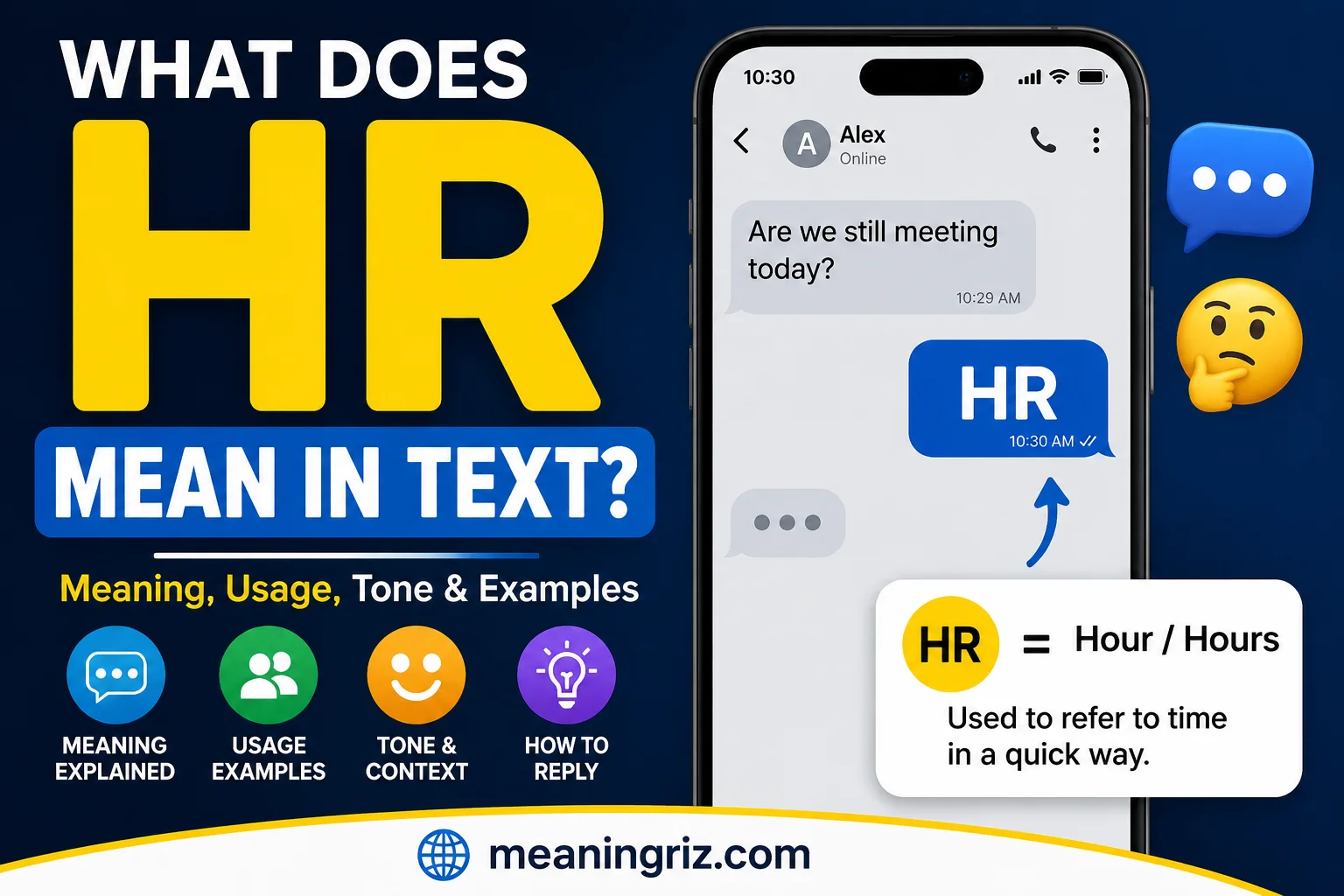
You get a text that just says “back in 1 hr” — easy, that’s obviously “hour.”
Then five minutes later, a coworker texts “got pulled into HR today” — and suddenly the same two letters mean something completely different.
That’s the whole confusion in one sentence. HR isn’t one word with one meaning. It’s two completely unrelated meanings that happen to share the same abbreviation, and you’re expected to tell them apart instantly, with zero punctuation to help you.
What Does HR Mean in Text?
HR usually means one of two things: “hour” (a unit of time) or “Human Resources” (the workplace department). Which one it means depends entirely on the sentence around it — there’s no symbol or capital letter that reliably tells you which one someone meant.
That’s the short answer. The longer, more useful answer is learning to spot which meaning applies in under a second, without having to ask “wait, which HR do you mean?”
The Two Real Meanings of HR
Most people only know one of these two meanings, which is exactly why HR causes confusion. Here’s both, in plain English.
HR = Hour
This is the time version. People drop the “ho” and just write “hr” because it’s faster to type, especially when giving an ETA or talking about duration.
“Be there in 20 min, give or take an hr lol” “Gym for 1hr then I’m free” “Flight’s delayed 2 hrs”
HR = Human Resources
This is the workplace department version — the team that handles hiring, complaints, benefits, and disciplinary stuff. In texts and DMs, it almost always shows up in a work-related conversation.
“HR wants to talk to me tomorrow 😬” “I already reported it to HR” “New HR rep starts Monday”
Two unrelated meanings, same three letters, and the only way to tell them apart is reading the rest of the sentence.
How to Tell Which Meaning Is Being Used
You don’t need to guess — there’s a pattern. If HR is next to a number, it almost always means “hour.” If HR is next to words like “talk,” “meeting,” “complaint,” “report,” or “fired,” it means “Human Resources.” Once you notice this, it becomes almost automatic.
A few more reliable clues:
Check what comes right before or after it. “2 hr,” “1hr,” “an hr” — that’s time. “to HR,” “from HR,” “HR said” — that’s the department.
Check the topic of the whole conversation. If you were already talking about plans, timing, or a schedule, HR is “hour.” If the conversation is about work, a job, or something that happened at the office, it’s “Human Resources.”
Check for a number directly attached. This is the single fastest tell. Numbers attach to time. People almost never write “HR1” or “1 Human Resources,” so a number glued to “hr” is your strongest signal.
Real Chat Examples
Seeing both side by side makes the pattern click faster than any rule does.
Texting About Time
“omw, eta 1hr” “call starts in half hr” “be back in like 2hrs, traffic is bad”
Texting About Work HR
“hr emailed me about the schedule change” “ugh hr again, third time this month” “they’re sending it to hr, it’s getting serious”
When Both Show Up in the Same Conversation
“running 1hr late, sorry” “no worries, also did you hear hr is changing the dress code policy”
Notice how the second message doesn’t even pause — native texters slide between both meanings without confusion because the surrounding words do all the work.
Platform-Based Variations
The meaning of HR doesn’t change by platform, but which meaning shows up more often does shift depending on where you’re texting.
HR on WhatsApp and SMS
Mostly used for “hour” here — running late, ETA updates, and “call you in 1hr” type messages between friends and family.
HR on Instagram and TikTok
Often “hour” too, especially in captions like “giveaway ends in 1hr” or “drop in 2hrs.” Time-based countdowns are everywhere on these platforms.
HR on LinkedIn, Slack, or Work Chats
Almost always “Human Resources” here, since the entire context of the platform is professional. “I flagged it to HR” makes sense instantly in a workplace channel.
HR in Group Chats With Coworkers
This is the trickiest spot, because both meanings show up constantly — “lunch in 1hr” and “HR sent a memo” can appear back to back in the same thread.
When to Use HR (And When to Spell It Out)
Fine to abbreviate when:
- You’re texting casually and the context already makes the meaning obvious
- You’re giving a quick time estimate (“back in 1hr”)
- You’re talking to a coworker who already knows what’s going on at the office
Better to spell it out when:
- You’re writing a formal email or message to an actual HR department
- The sentence could genuinely be read either way and you don’t want to cause confusion
- You’re talking to someone outside the situation who doesn’t have the context to fill in the blank
A simple gut-check: if you re-read your own message and pause for even a second wondering which HR you meant, your reader will pause too. That’s the moment to just type the full word.
Is It Confusing or Rude to Use HR This Way?
It’s not rude — it’s just genuinely ambiguous in a way most texting slang isn’t. Most abbreviations only have one common meaning. HR is one of the rare ones carrying two completely unrelated meanings at once, which is exactly why this question gets searched so often.
It becomes a real problem only when the surrounding context is thin. A text that just says “hr?” with nothing else is a genuine coin flip — it could be asking “what time?” or “did something happen with HR?” In a single-word message like that, the safest move is to just ask which one they mean rather than guess.
Why This Confusion Happens (Communication Insight)
There’s a reason HR causes more mix-ups than most texting abbreviations, and it’s not really about the word itself.
Most slang gets shortened from one source word. “Brb” only ever means “be right back.” HR is unusual because it’s not really slang at all — it’s two separate, pre-existing abbreviations from completely different worlds (timekeeping and corporate departments) that happen to collide into the same two letters.
Context-switching is invisible until it fails. In real conversations, people switch between meanings of HR constantly without noticing, because their brain is already tracking the topic of the conversation. The confusion only becomes visible to you when you’re reading someone else’s thread without that built-in context — which is exactly the situation that brings most people to search this term in the first place.
The ambiguity is actually a small trust signal. When someone texts you “hr” with no extra explanation and trusts you to know which meaning they mean, it’s a small sign they assume you’re already up to speed on what’s going on in their day. That’s part of why it feels more natural between close friends or coworkers than with someone you don’t talk to often.
One common mistake worth flagging: people often assume the workplace meaning is the “default” simply because it sounds more important. In actual texting data, “hour” is the far more frequent use — it just gets less attention because it’s less dramatic to talk about.
HR vs Similar Abbreviations
HR sometimes gets confused with other short workplace or time-related terms. Here’s how they actually differ.
| Term | Meaning | Typical Tone | Context It Belongs To | Risk of Misreading | Common Setting |
|---|---|---|---|---|---|
| HR | Hour / Human Resources | Neutral, depends on context | Time-tracking or workplace | High — two unrelated meanings | Texts, work chats, social captions |
| PTO | Paid time off | Neutral, practical | Workplace only | Low | Work chats, scheduling |
| ETA | Estimated time of arrival | Casual, informative | Time-tracking only | Low | Texting, group chats |
| HRT | Hormone replacement therapy | Personal, sensitive | Health context only | Low, but topic-sensitive | Health conversations |
| EOD | End of day | Practical, work-related | Workplace only | Low | Work chats, deadlines |
The standout difference: almost every term on this list has exactly one meaning. HR is the outlier with two, which is the entire reason it needs more context to read correctly than the others.
How to Respond When You’re Not Sure Which HR Someone Means
If a message is genuinely unclear, here’s how to handle it depending on the tone you want.
Friendly Clarifying Reply
“Haha wait, hour or Human Resources 😅”
Neutral Clarifying Reply
“Just to confirm — do you mean the time or the department?”
Playful Reply
“Plot twist, which HR are we doing today”
Quick Reply When Context Is Already Obvious
“Got it, see you in 1hr” (no need to clarify when the meaning is already clear from earlier messages)
Frequently Asked Questions
What Does HR Mean in a Text Message?
HR usually means either “hour” or “Human Resources.” Numbers next to it (“2hr,” “1hr”) almost always point to time, while work-related context points to the department.
Does HR Always Mean Human Resources?
No. In everyday texting between friends and family, “hour” is actually the more common meaning. “Human Resources” shows up mainly in work-related conversations.
How Do I Know if HR Means Hour or the Department?
Look at what’s right next to it. A number attached to HR almost always means “hour.” Words like “meeting,” “talked to,” or “reported to” almost always point to the workplace department.
Is HR Used the Same Way on Every Platform?
The meaning itself doesn’t change by platform, but the likely meaning shifts. Social captions and casual texts lean toward “hour.” Work chats and professional platforms lean toward “Human Resources.”
Can HR Be Used in a Formal Email?
For “hour,” it’s better to spell it out in anything formal. For the department, “HR” is actually the standard way it’s written in most companies, so it’s fine to use as-is in that context.
Why Does HR Have Two Different Meanings?
HR isn’t really one piece of slang — it’s two separate, older abbreviations (one from timekeeping, one from business) that happened to end up with the same letters. Texting just brought both into the same casual space.
The Bottom Line
HR isn’t complicated once you know there are two completely separate meanings hiding behind the same two letters. Check for a number, check the topic of the conversation, and the right meaning almost always becomes obvious in a second. When it doesn’t, asking which one someone means is a completely normal, low-stakes question — not an awkward one.
DISCOVER MORE ARTICLES
FWIW Meaning in Chat, Texting & Social Media
GMFU Meaning in Text Explained (Usage, Tone & Real Examples)
TB Meaning in Text Explained (Usage, Tone & Examples)
What Does OFCC Mean in Text? (Meaning, Tone & Real Examples)

I’m the person behind this website, handling both the writing and content management myself. I focus on explaining word meanings, slang, and modern expressions in simple, clear language, using real-life examples so readers can understand how these terms are actually used in everyday conversations.