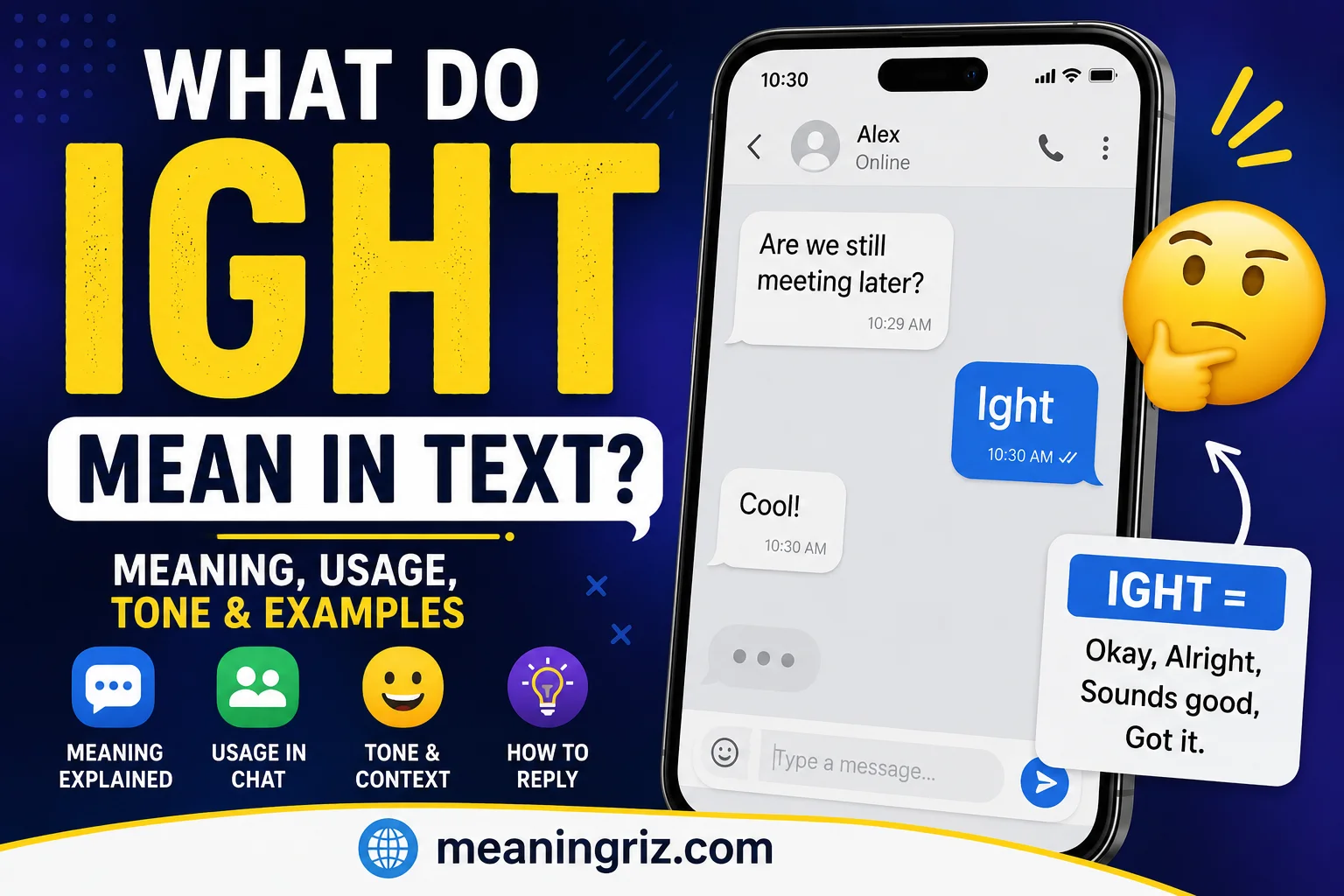
You text someone something that actually mattered to you — an apology, a plan, a question you were nervous about — and all you get back is:
“ight”
No punctuation. No emoji. Just five letters, and now you’re sitting there wondering if that’s a good “ight” or a bad one.
Here’s the answer, plain and simple, before anything else.
What Does Ight Mean?
“Ight” means “alright.” It’s a shortened, casual way of saying yes, okay, or I agree. People drop the “al-” and the “r” to type it faster, and it’s used the same way you’d use “okay” — just more relaxed and more common in texting between friends.
That’s the dictionary answer. The part that actually trips people up is figuring out which version of “okay” someone means — because “ight” can sound warm, neutral, bored, or annoyed depending on almost nothing but timing and punctuation. That’s what we’re actually going to unpack here.
The Simple Meaning, Without the Overthinking
“Ight” is just a faster way to say “alright.” That’s the whole word, at its most basic.
It comes from African American Vernacular English, where dropping the first syllable of “alright” has been common in speech for decades, long before texting existed. Texting just turned a spoken habit into a typed one.
So in plain terms:
Ight = “Alright” / “Okay” / “I agree” — a quick, casual way to confirm, accept, or acknowledge something in a text.
That’s the snippet-ready version. Short, accurate, no padding.
But the Meaning Shifts Depending on Tone
This is where most explanations stop too early. “Ight” by itself is neutral. What changes its meaning is everything around it — punctuation, timing, and what came before it in the conversation.
1. Genuine agreement. “Wanna grab food at 7?” → “ight” — this is just a normal, friendly yes. No hidden meaning.
2. Closing out a conversation. Sometimes “ight” is the last word before someone goes quiet, simply because the conversation has naturally run its course.
3. Mild annoyance or shutting things down. “Ight.” with a period, after an argument or a long explanation, often means someone’s done talking — not agreeing, just stopping.
4. Sarcasm or disbelief. “Ight… if you say so” carries a completely different weight than a plain “ight.” The added words turn agreement into doubt.
5. Low effort, not low interest. Sometimes “ight” just means someone’s busy, driving, or typing one-handed. It’s not always a feeling — sometimes it’s just a fast reply with nothing behind it.
Same five letters. Five different emotional readings. The real skill here isn’t memorizing the word — it’s noticing what surrounds it.
Real Chat Examples (How It Actually Looks)
These are the versions that actually show up in real conversations, not the textbook ones.
Between Friends, Confirming Plans
You: wanna head to the gym at 6? Friend: ight bet
This is the most common version — relaxed, friendly, zero overthinking required.
After an Apology
You: hey sorry I forgot to text back yesterday, was a rough day Them: ight no worries
Short, but warm. The “no worries” attached to it removes any coldness the bare word might have had alone.
After a Disagreement
“Ight.”
One word. A period. No emoji. This version usually means the conversation is over, and not in a happy way. Context before it almost always confirms this — if there was tension a few messages back, this is where it lands.
In a Group Chat
“ight who’s driving”
Purely functional here — no emotional weight at all. It’s just moving the conversation along.
From Someone Who’s Clearly Busy
“ight talk later”
Quick, practical, not dismissive. The “talk later” attached is doing the reassuring work that the bare word can’t do alone.
Platform-by-Platform: Does Ight Change Meaning?
The meaning itself doesn’t shift by platform. What shifts is how it’s typically used and read.
Ight on Snapchat
Snapchat conversations move fast and casually, so “ight” here is usually a quick reaction to a snap or a plan — low-stakes, low-effort by design, not a sign of anything deeper.
Ight on Instagram DMs
Often shows up after a story reply or a quick exchange. It tends to function as a polite way to wrap up a thread without it feeling abrupt.
Ight in Group Chats (iMessage/WhatsApp)
Mostly functional here — confirming logistics, agreeing on plans, or acknowledging something without slowing the group down.
Ight in Gaming Chats (Discord, in-game voice/text)
Extremely common as fast coordination — “ight I got left side” — with zero emotional undertone. Speed matters more than tone here.
Ight in One-on-One Texting (SMS/iMessage)
This is where tone matters most, because it’s the most personal context. A bare “ight” here carries more emotional weight than the exact same word in a group chat or game.
When to Use Ight (And When Not To)
When It’s Fine to Use
- Texting friends or people you’re already casual with
- Confirming plans quickly
- Reacting to something low-stakes, like a meme or a small update
When to Avoid It
- Messaging a boss, teacher, or anyone in a formal role
- Replying to something serious, emotional, or important — it can come across as dismissive even when that’s not the intent
- First conversations with someone you don’t know well yet
A useful gut-check: if the topic deserves more than one word, “ight” alone probably isn’t enough — pair it with something else, or skip it.
Is Ight Rude?
Not inherently. But it can land that way in specific situations.
It can feel cold when it’s the only reply to something that took effort to write — a long explanation, an apology, or a vulnerable message. The mismatch in effort is what reads as dismissive, not the word itself.
It can feel like a conversation-ender when it shows up right after tension, especially with a period and nothing else attached.
It’s rarely rude in fast-moving, casual exchanges, because that’s exactly the context it was built for. The same word that feels short in a serious moment feels completely normal in a quick one.
Why People Use This (Psychology)
There’s a quieter pattern behind why “ight” gets used so often, beyond just speed.
A short reply protects against over-investing in a conversation that might not need it. Typing a full sentence back can feel like assigning more importance to an exchange than it actually has. “Ight” lets someone respond without committing emotional energy either way.
It’s a low-risk way to end something without explicitly ending it. Most people don’t like saying “I’m done with this conversation” directly. A flat “ight” does that job quietly, without confrontation, which is exactly why it can feel abrupt to the person on the receiving end even though nothing was technically said.
The brevity is often about bandwidth, not feelings. This is the part most explanations miss: people frequently send a bare “ight” because they’re distracted, multitasking, or typing on the move — not because they’re upset. The message says less about their mood and more about what else is happening around them in that moment.
One real observation worth noting: the gap between someone’s usual texting style and a sudden one-word “ight” tells you more than the word itself. If someone normally sends full sentences and switches to “ight,” that shift is the actual signal — not the word.
A Common Mistake People Make
The biggest misread is assuming “ight” always carries an emotional charge. Most of the time, it doesn’t — it’s just efficient texting. Reading deep feelings into every short reply creates more anxiety than the message ever intended, and it’s worth checking the pattern of someone’s texting style before assuming a one-word reply means something is wrong.
Ight vs. Similar Texting Slang
People often confuse “ight” with words that sound similar in spirit but carry different weight.
| Term | Meaning | Typical Tone | Emotional Undertone | Risk of Misreading | Best Used In |
|---|---|---|---|---|---|
| Ight | Alright / okay | Casual, relaxed | Neutral to agreeable | Medium — can feel cold without context | Friends, casual plans, group chats |
| Aight | Alright (older spelling) | Casual, slightly more drawn out | Same as “ight” | Low | Spoken-style texting, AAVE-influenced chats |
| K | Okay | Clipped, minimal | Often reads as cold or annoyed | High | Best avoided unless relationship is very casual |
| Bet | Deal / agreed | Enthusiastic, confident | Excitement, confirmation | Low | Confirming plans with energy |
| Okay | Acknowledgment | Neutral, slightly more formal | Neutral | Low | Safe in most contexts, including semi-formal ones |
The key difference worth remembering: “ight” sits between “okay” and “k” in tone. It’s more relaxed than “okay” but warmer than the often-cold “k” — which is exactly why so many people default to it when texting friends.
How to Respond to “Ight” (By Tone)
Friendly Reply
“ight cool, see you then”
Neutral / Practical Reply
“ight, sounds good”
Playful Reply
“ight ight, I see you 👀”
Smart / Confident Reply
“ight, you know where to find me”
The pattern across all of these: adding even a few extra words turns a flat acknowledgment into a reply that keeps the conversation feeling alive, instead of letting it die on a single word.
Frequently Asked Questions
What Does “Ight” Mean From a Girl or Guy?
The meaning doesn’t change by gender — it’s still “alright.” What shifts is context: in a dating conversation, a bare “ight” with no follow-up can feel low-energy, while “ight” with a playful line attached usually signals comfort, not disinterest.
Is “Ight” the Same as “Aight”?
Yes, functionally. “Aight” is an older, slightly more drawn-out spelling of the same word. Both mean “alright,” and the choice between them is mostly personal style, not meaning.
Is It Rude to Reply With Just “Ight”?
Not by default. It depends on what it’s replying to. After something casual, it’s completely normal. After something serious or emotional, a bare “ight” can feel dismissive even if that wasn’t the intent.
Does “Ight” Mean Something Different on Snapchat or Instagram?
The core meaning stays the same everywhere. What changes is the typical context — these platforms tend to use it for quick, low-stakes reactions rather than deeper exchanges.
Can “Ight” Be Used in a Professional Setting?
No. It’s too informal for emails, work chats, or messages to teachers and employers. “Alright” or “Sounds good” reads as the same meaning without the casual edge.
Why Do People Use “Ight” Instead of Typing “Alright”?
Mostly speed and habit, but also tone — “ight” sounds more relaxed and less effortful than spelling out the full word, which fits the fast, low-pressure style of modern texting.
The Bottom Line
“Ight” means “alright” — simple as that. The real skill is in reading what’s around it: the punctuation, the timing, and whether it matches how that person usually texts. Once you stop treating every short reply as a clue to someone’s mood and start reading the pattern instead, “ight” stops being confusing and just becomes what it almost always is — a quick, easy yes.
DISCOVER MORE ARTICLES
FWIW Meaning in Chat, Texting & Social Media
GMFU Meaning in Text Explained (Usage, Tone & Real Examples)
TB Meaning in Text Explained (Usage, Tone & Examples)
What Does ONG Mean in Text? (Meaning, Tone & Real Examples)