You’re scrolling through messages and someone texts you:
“ATP I give up 😭”
Or maybe a friend fires back in a group chat:
“atp just leave it”
You kind of get the vibe — but you’re not 100% sure what ATP actually means, or why it sounds a little heavier than regular texting. That half-confused feeling is exactly why you’re here, and this article is going to clear it up completely.
What Does ATP Mean in Text?
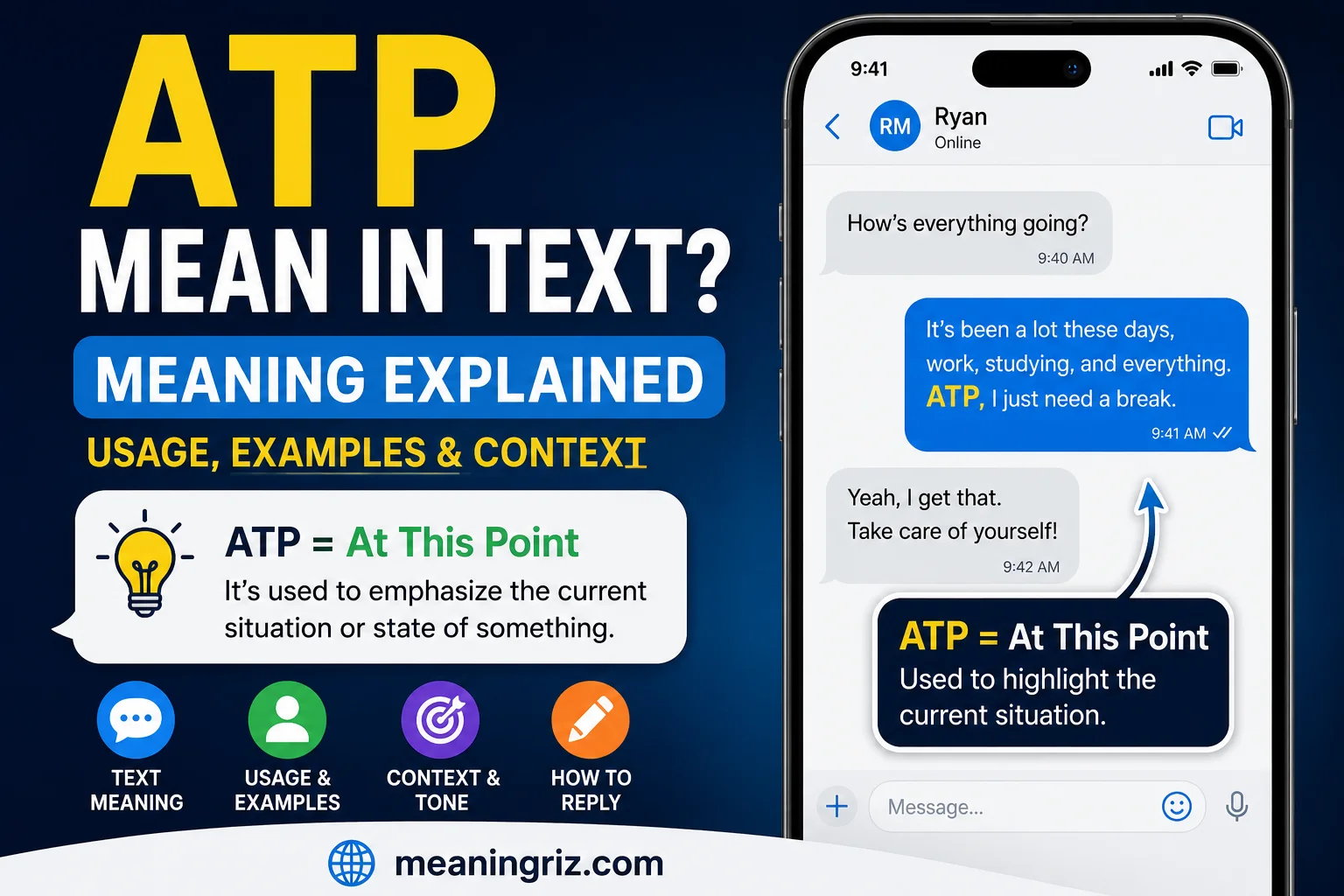
ATP most commonly stands for “At This Point” in texting, social media, and casual online conversations. It’s used to signal that a situation has reached a certain moment — usually one involving frustration, exhaustion, acceptance, or a kind of dark humor resignation.
Quick definition for featured snippet:
ATP = “At This Point” — a slang abbreviation used to express that a situation has gone far enough, reached a conclusion, or hit a stage where the speaker is done, amused, or simply stating where things stand right now.
That’s the primary meaning. But ATP has a second, completely separate meaning that shows up in a different kind of context — and mixing them up is the most common mistake people make with this word.
The Two Main Meanings of ATP in Text
Most articles give you one meaning and move on. That’s the problem — because ATP genuinely carries two distinct meanings in digital conversation, and the wrong read can completely misfire.
Meaning 1: “At This Point”
This is the dominant meaning in texting, social media captions, TikTok comments, Discord servers, and group chats. It signals emotional state more than location or time. When someone types “at this point,” they’re not talking about a physical place — they’re talking about where they’ve arrived emotionally in a situation.
Think of it as: “After everything that’s happened, this is where I’m at.”
It can be frustrated, funny, defeated, sarcastic, or weirdly calm — depending entirely on what comes after it.
Meaning 2: “Answer The Phone”
This one shows up less often but it’s real and worth knowing. When someone texts you “ATP” as a standalone message, or pairs it with “please” or a phone emoji, they almost certainly mean “answer the phone” — as in, they’re calling you and you’re not picking up.
“ATP!! I’ve been calling you 😭”
This version tends to be more urgent in tone, usually shows up when someone is actively trying to reach you, and is common on Snapchat in particular where voice/video calls are built into the app.
The rule for telling them apart is simple: if ATP comes before a statement or feeling, it’s “at this point.” If it arrives alone or with urgency and a phone context, it’s “answer the phone.”
How “At This Point” Actually Feels in Real Chats
Here’s what most explanations get wrong: they define ATP but they don’t explain the emotional arc that comes with it.
ATP isn’t just a time marker. It’s the slang equivalent of someone sighing loudly and then speaking. There’s a whole story compressed into those three letters — the implication is that something has been going on for a while, that patience has been tested, and that the person has now arrived somewhere. Where they’ve arrived changes the tone completely.
ATP as Frustration
This is the most common version. Something keeps happening — a plan keeps falling through, someone keeps doing the same thing, a situation keeps getting worse — and the person has hit a wall.
“atp i don’t even care anymore”
“ATP they really said that for the third time 💀”
The tone here isn’t explosive anger — it’s more like exhausted acceptance of something ridiculous. There’s often dark humor sitting right underneath it.
ATP as Acceptance
Sometimes ATP doesn’t carry frustration at all. It’s used to state a conclusion calmly — almost like a shrug in text form.
“atp it is what it is”
“ATP we’re just built different I guess 😭”
This version often pairs with self-aware humor or a resigned observation. It’s not bitter — it’s just landing somewhere after thinking about something.
ATP as Sarcasm or Humor
This is the version you’ll see most on TikTok comments and Twitter/X replies. ATP gets used ironically to dramatize something small on purpose.
“ATP this coffee shop needs to just hire me already”
“atp just move in with me at this point 😂”
The situation isn’t actually serious — but ATP adds a comedic weight to it, like the person is narrating their life like a reality TV confessional. This is where ATP overlaps with Gen Z humor: using dramatic language for very undramatic situations.
ATP as Dark Humor
This one is worth flagging separately because it can occasionally look more serious than it is. Phrases like “ATP just end me” or “atp I can’t do this” are almost always used hyperbolically in casual conversation. The emotional weight is real in the sense that the person is genuinely stressed or exhausted — but the phrasing is comedic exaggeration, not literal distress. Context and relationship matter a lot for reading this version correctly.
Real Chat Examples (How It Actually Shows Up)
Between Friends, When Plans Fall Apart
Maya: they canceled AGAIN Jess: atp I’m not even surprised Maya: lmaoo same
In a Group Chat, When Someone’s Being Dramatic
“atp just pick a restaurant I’ll eat anything 😭”
When Someone Isn’t Answering Their Phone
“ATP please I need to talk to you” “ATP!! where are you”
On TikTok or Twitter, Under a Viral Post
“atp this show is writing itself” “ATP give her the award already”
Self-Talk Style (When Someone Posts It About Their Own Life)
“Forgot my lunch at home. ATP this week is not it 😭”
This last one is interesting — it’s not directed at anyone, it’s just ATP used as a way of narrating your own situation, almost like venting out loud.
Platform-by-Platform: Where ATP Shows Up
ATP on Snapchat
Both meanings are common here. “Answer the phone” is probably more likely on Snapchat than anywhere else, because Snapchat is call-heavy. But “at this point” also shows up in streaks and DMs, especially when someone’s been waiting on a reply.
ATP on TikTok
Almost always “at this point,” and usually with comedic or sarcastic tone. TikTok comments love ATP as a punchline structure: you build up a situation, then land the comment with ATP + dramatic conclusion.
ATP on Instagram
Used in captions and comments in the same way as TikTok — usually frustrated-funny or accepting-funny. Common in story replies too, where someone reacts to your story with “atp same 😭”
ATP on Twitter / X
The most emotionally direct version of ATP tends to live here. People use it for reaction tweets, live commentary on situations, and opinion statements. “ATP [person] should just [conclusion]” is a common structure.
ATP in Regular Texting
The most varied usage. Could be “at this point” with any emotional flavor, or “answer the phone” if they’re calling you. Read the message that surrounds it — that’s your clearest guide.
ATP on WhatsApp and Discord
Usually “at this point” in casual group conversations, often in the middle of a longer vent or a running group joke. Discord also uses it a lot in gaming contexts — “ATP I’m just feeding 💀” means they’ve accepted they’re having a bad game.
When to Use ATP (And When to Skip It)
When It Fits
- Casual texting with friends you already use slang with
- Social media comments where informal, punchy reactions fit
- Reacting to something that’s been dragging on or building up
- Adding comedic weight to something small
When to Avoid It
- Work messages, emails, or anything professional
- Talking to someone much older who may not recognize the slang
- When you actually need to communicate urgency clearly — ATP can feel too casual for real emergencies
- First conversations with someone new, where your tone and intent aren’t established yet
A clean rule: ATP belongs wherever you’d send a casual voice note, not where you’d send a formal text.
Is ATP Rude?
Not by itself. The word carries no inherent rudeness — it’s neutral slang.
What can make it feel rude is the sentence it’s sitting in. “ATP I’m over it” about a situation is just venting. “ATP you’re always late” directed at a specific person in a tense moment could read as passive-aggressive, depending on your relationship and the broader conversation.
The tone around ATP matters more than ATP itself. Read the full message, not just the acronym.
Why People Use This (Psychology)
ATP caught on so widely because it does something pretty useful emotionally: it lets you express a big feeling in a small space without committing to a big conversation.
When you type “at this point” in full, it reads more like a statement you’re making and standing behind. When you type “atp,” it reads lighter — more like venting, less like confronting. That gap is why the abbreviated version spread. It gives people emotional permission to say they’re frustrated or done without it feeling like a declaration.
There’s also a solidarity dimension to ATP, particularly in the sarcastic-humor version. When someone posts “atp this is fine 🔥” about chaos in their life, they’re inviting other people to laugh at it with them. It’s not just self-expression — it’s a social signal that says “you’re allowed to find this funny.”
One real observation worth noticing: people who use ATP casually tend to use it as a way of closing a loop. There’s an implicit backstory. ATP at the beginning of a sentence signals that something has been happening for a while — you’re just arriving at this moment together. That shared history, even if the reader only knows half of it, creates connection quickly.
The common mistake is treating ATP as a simple filler word — swapping it in for “like” or “okay” without the emotional context that makes it land. When ATP is overused without that “arrived somewhere” feeling behind it, it loses meaning fast and starts sounding like noise.
WYA vs. Similar Texting Slang
| Term | Meaning | Tone | Emotional Feel | Risk Level | Best Context |
|---|---|---|---|---|---|
| ATP | At This Point / Answer The Phone | Resigned, sarcastic, tired, or urgent | Frustration, acceptance, dark humor | Low — usually harmless | Casual texts, social media, gaming chats |
| IDC | I Don’t Care | Blunt, dismissive | Detachment, apathy | Medium — can sound cold | Used when something’s already been discussed |
| ITC | I Don’t Know | Neutral, open | Uncertainty | Low | Casual conversation |
| RN | Right Now | Urgent or casual | Immediacy | Low | Any casual context |
| FR | For Real | Emphasizing agreement | Sincerity, emphasis | Low | Agreeing with or validating a statement |
| NGL | Not Gonna Lie | Confessional | Honesty, sometimes vulnerability | Low | Sharing a real opinion or feeling |
The key contrast worth remembering: ATP frames a situation as having built up to something. IDC cuts things off. FR amplifies them. They can all live in the same text conversation and each does a different emotional job.
How to Respond to “ATP” Messages
If It’s Frustration-Based
“atp I’m done with this project 😭”
Good responses: “same honestly,” “take a break, it’ll be there,” or matching their energy with “💀 this week has been a lot”
If It’s Sarcastic or Funny
“atp just adopt me at this point 😂”
Match the humor: “application’s in the mail” or “room’s ready 😭” — play into the joke rather than treating it seriously.
If It’s “Answer The Phone”
“ATP please pick up”
Just call them back. And maybe lead with “sorry I missed it” rather than asking what ATP meant.
If You Can’t Tell the Tone
Take thirty seconds to read the messages before it. The emotional context almost always becomes clear when you zoom out slightly.
Frequently Asked Questions
What Does ATP Mean in a Text Message?
ATP most commonly means “At This Point” — a casual way to express frustration, acceptance, dark humor, or a conclusion about a situation. It can also mean “Answer The Phone” when someone is trying to reach you via call.
What’s the Difference Between ATP and IDK?
IDK means “I don’t know” and signals uncertainty. ATP means “at this point” and signals that someone has reached a conclusion — often the opposite of uncertainty. They carry very different emotional weights despite both being common text abbreviations.
Is ATP Mostly Used by Gen Z?
Yes, Gen Z is the heaviest user of ATP in the slang sense, but younger millennials use it regularly too, especially in social media comments and meme culture. It’s recognized broadly enough now that most active social media users will understand it.
Can ATP Sound Rude?
The word itself isn’t rude, but the sentence it’s in can be. “ATP I’m tired” is just venting. “ATP you need to stop” is more of a direct challenge. The context and relationship make all the difference.
Does ATP Mean Different Things on Different Platforms?
The core meaning stays consistent, but the tone shifts by platform. TikTok and Twitter ATP is usually comedic or expressive. Snapchat ATP more often carries the “answer the phone” meaning alongside the “at this point” usage. Discord and gaming contexts lean into resigned humor.
Is It Okay to Use ATP in a Work Chat?
No — it’s best avoided in professional settings. The slang is informal by nature, may not be understood by everyone, and can come across as too casual or even dismissive in workplace communication. Use the full phrase “at this point” if you need it, or reword entirely.
The Bottom Line
ATP in text means “At This Point” — three letters that carry a lot more emotional weight than they look like they do. It can be frustrated, funny, sarcastic, warm, or resigned. The meaning doesn’t change, but the feeling around it shifts constantly depending on the conversation, the relationship, and what comes after it.
The second meaning, “Answer The Phone,” is real too — but context almost always makes it obvious which one someone means. Pay attention to what’s around the abbreviation, not just the abbreviation itself, and you’ll almost never misread it.
DISCOVER MORE ARTICLES
FWIW Meaning in Chat, Texting & Social Media
GMFU Meaning in Text Explained (Usage, Tone & Real Examples)
TB Meaning in Text Explained (Usage, Tone & Examples)
PMTFO Meaning in Text Explained (Usage, Tone & Examples)
What Does Pluh Mean in Text? The Real Meaning, Origin & How to Use It