Someone just texted you “GTF” and you’re not sure if they’re joking, angry, or something else entirely.
It’s one of those abbreviations that looks aggressive on the surface but can actually mean a few very different things depending on who sent it and what was happening in the conversation right before it landed.
Here’s everything you actually need to know.
What Does GTF Mean in Text?
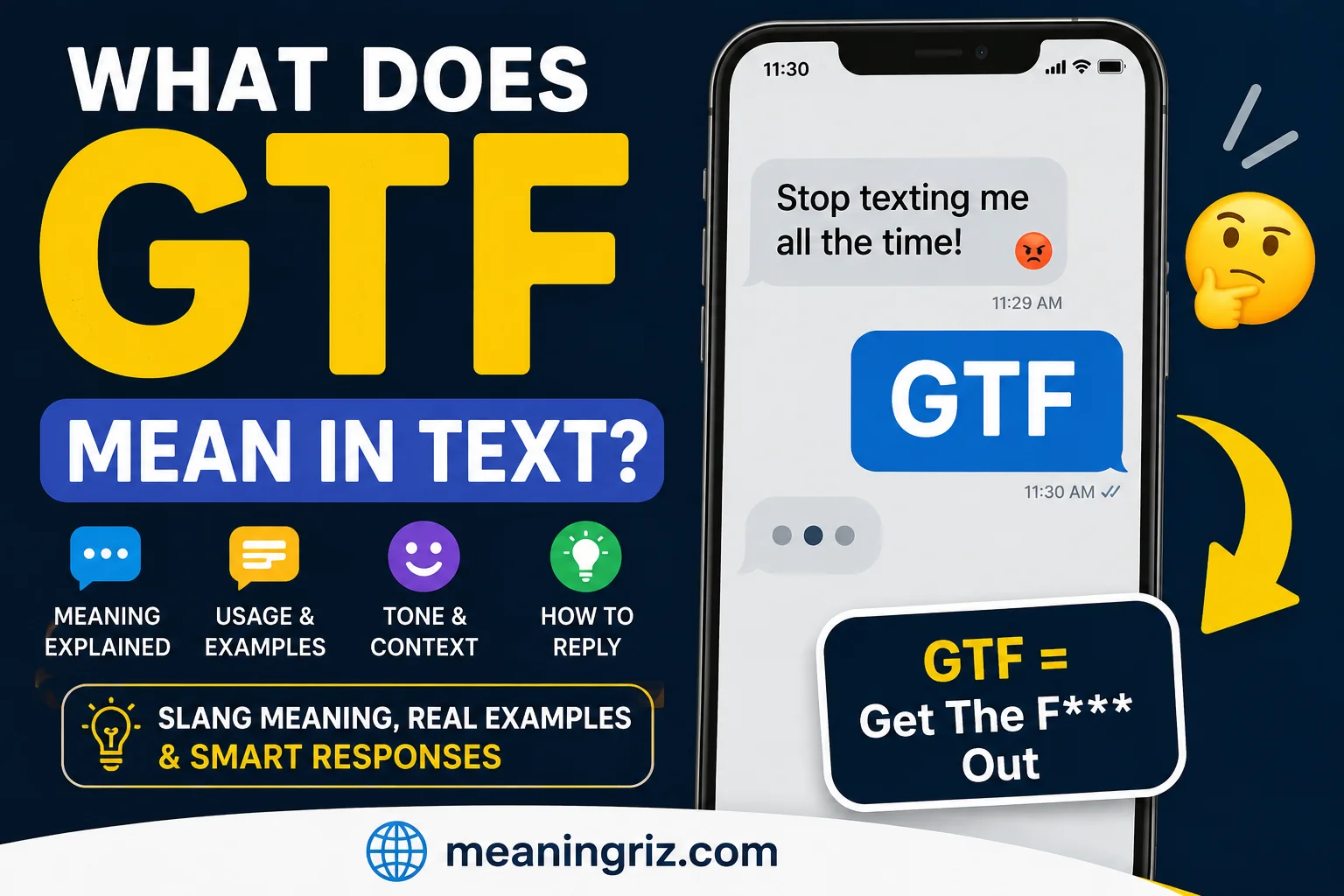
GTF stands for “Get the F**k” — it’s almost always part of a longer implied phrase, like “get the f**k out,” “get the f**k away,” or “get the f**k outta here.” The full phrase is rarely typed out — just the three letters, and the meaning gets filled in by context.
Less commonly, it’s used as “Go the F**k” — same emotional weight, slightly different phrasing, similar intent.
Quick answer: GTF = “Get the F**k” — a strong, vulgar expression used to show shock, frustration, disbelief, or to tell someone to leave. Tone depends entirely on context.
That’s the featured snippet version. But if you stop there, you’ll misread half the texts where this shows up — because GTF is not always negative. That’s the part worth understanding.
The Full Meaning of GTF — More Than Just Anger
Most explanations treat GTF as purely rude. That’s not accurate.
GTF carries intensity — but intensity can point in multiple directions. The same three letters can express genuine frustration or complete shock and excitement, depending entirely on the mood around it.
GTF as Frustration or a Command to Leave
This is the most common use. Someone is annoyed, fed up, or actively telling another person to go away. The emotional weight here is real — it’s not playful, and it’s not subtle.
“I told you three times. GTF out of my space.”
“If you’re not going to help, GTF.”
Used this way, it’s direct, blunt, and not meant to be taken lightly. Even between close friends, this version has an edge to it.
GTF as Shock or Disbelief (Not Negative)
This is the version most guides get completely wrong by leaving it out entirely.
“GTF outta here” — when said in response to surprising news — is an expression of shock, not anger. It functions the same way someone might say “no way,” “are you serious,” or “shut up” in a positive, disbelieving tone.
“I just got accepted to my dream school.” “GTF outta here, that’s AMAZING.”
This version is enthusiastic. The exact same words — completely different emotional reality.
GTF as Self-Motivation
This one surprises people. GTF is also used as a personal push — a way of telling yourself to get it together and move.
“Okay I need to GTF organized before this deadline.”
“GTF up and go to the gym.”
In this context it’s private, direct, and actually kind of motivating — like a rough internal pep talk with no audience. You’d never see this version in a conversation with someone else.
GTF as Playful Banter Between Friends
Between people with an already casual, rough-edged communication style, GTF can be completely affectionate. It’s a way of teasing, hyping someone up, or reacting dramatically in a way that’s understood as a joke.
“I can’t believe you actually pulled that off. GTF.”
The relationship makes all the difference here. The exact same message from a stranger would feel hostile. From a close friend mid-banter, it reads as impressed.
Real Chat Examples (How It Actually Looks)
Between Close Friends, Reacting to News
Alex: “bro I’m getting a PS6 for my birthday” Jordan: “GTF outta here 😭 lucky”
Here GTF is pure disbelief and jealousy — playful, not aggressive.
During an Argument or Conflict
“You seriously showed up an hour late again? GTF.”
No emoji, no follow-up. The silence after it is part of the message.
Self-Talk Before Something Stressful
“Presentation in 20 minutes. Need to GTF together.”
No one else is reading this — it’s internal pressure being turned into a sentence.
Banter in a Gaming Chat
“You just got eliminated by a level 4 player. GTF out 💀”
In gaming communities this is almost always light ribbing. The skull emoji is doing a lot of tone work here.
Someone Being Pushed Away (Seriously)
“I already told you I’m not interested. GTF.”
This one is firm and meant to be final. No room for misreading.
Does GTF Change Meaning on Different Platforms?
The core meaning stays the same everywhere. What shifts is how often each version appears and what tone is most common in that space.
GTF on TikTok and Instagram
Reaction comments are where GTF thrives in its positive form. Seeing something incredible in a video and typing “GTF” in the comments means “I can’t believe this is real.” It’s not aggression — it’s peak engagement energy.
GTF on Snapchat
Private chats between close friends. The tone here can go either direction depending on the relationship, but the most common version is casual and emotional — either venting frustration or reacting to something unbelievable.
GTF in Gaming Chats and Discord
Trash talk and banter territory. GTF is used constantly here, and almost never means anything deeply serious. It’s part of the emotional vocabulary of competitive play — heated, loud, but mostly performative.
GTF in Regular Texting (SMS/iMessage)
More likely to reflect genuine emotion here than on public platforms. When someone texts you GTF in a private message with no emoji and no follow-up, that’s worth taking seriously.
GTF on Twitter/X
Often used in quote-tweets reacting to shocking news or outrageous content — usually expressing disbelief, outrage, or dark humor, not a personal directive.
Is GTF Rude?
Technically, yes — it contains profanity by definition. But “rude” in real communication is a lot more contextual than that.
Between close friends who already communicate casually and bluntly, GTF doesn’t register as rude at all. It’s just how they talk. No offense intended, none taken.
The same message to someone you barely know, in a professional context, or when emotions are already raw — that’s a different situation entirely. There, GTF lands as aggressive and dismissive, even if that wasn’t the full intent.
When It Can Land Badly
- Sent with no context, no emoji, and no follow-up it reads as cold dismissal
- Sent during an already tense conversation it escalates things fast
- Sent to someone who isn’t part of your usual blunt-communication dynamic it almost always reads worse than intended
- Sent in any professional, work-related, or formal setting — genuinely inappropriate
When It’s Usually Fine
- Between friends who already use strong language casually
- In reaction to surprising or exciting news (the disbelief version)
- In gaming, meme, or online banter spaces where everyone understands the register
The honest answer: context and relationship determine whether GTF is rude, not the word itself.
Why People Use GTF (Psychology)
There’s a reason this kind of compressed, aggressive-sounding language became popular in texting and social media. It isn’t just laziness.
Strong emotion needs a strong outlet. When someone is genuinely shocked, excited, or frustrated, a measured sentence doesn’t feel like enough. GTF lets people match the intensity of the feeling to the intensity of the language, quickly, without having to build up to it.
Short slang signals familiarity. Using GTF with someone is an implicit signal that you’re comfortable enough with them to drop filters. It creates in-group closeness — the kind of communication shorthand that only works because both people understand the register.
It’s a pressure valve. The self-directed version — “GTF together,” “GTF up” — is actually a micro-psychological tool. It’s rougher than “I need to focus,” and for some people that roughness creates urgency where a gentler phrase wouldn’t.
One real observation worth noting: when someone switches to GTF mid-conversation after being calm and measured, that shift is itself a signal. The change in register often carries more information than the word itself.
A Common Mistake People Make With GTF
The most common misread is treating the disbelief version as an attack.
Someone texts “GTF outta here” after you share good news and you think they’re being hostile. They’re not — they’re just expressing shock in the only register they have for it. In that context, “GTF outta here” is closer to “that’s unbelievable” than to anything threatening.
The clue is always the surrounding message. Positive news → disbelief. Argument or boundary → command. No context at all → proceed carefully.
GTF vs. Similar Slang Terms
People often confuse GTF with other aggressive-sounding abbreviations. Here’s how they actually compare:
| Term | Full Phrase | Typical Tone | Emotional Weight | Rude Level | Best Context |
|---|---|---|---|---|---|
| GTF | Get/Go the F**k | Frustrated, shocked, or playful | High | High — depends on context | Close friends, gaming, reactions |
| GTFO | Get the F**k Out | Direct command to leave | Very high | High | Dismissal, strong frustration |
| GFY | Go F**k Yourself | Dismissive, hostile | Very high | Very high | Almost always negative |
| SMH | Shaking My Head | Mild disapproval | Low–Medium | Low | Casual disappointment |
| WTF | What the F**k | Shock or confusion | High | Medium | Surprise, disbelief, frustration |
| FFS | For F**k’s Sake | Exasperation | Medium–High | Medium | Venting frustration |
The key distinction: GTF is almost always commanding or reactive — it’s pointed at something or someone. WTF is more internally directed (shock). GTFO is a harder, more final version of the same thing as GTF in its “leave” mode.
How to Respond to GTF
If It Was Sent Playfully (Disbelief/Banter)
“I know right 😭” “Dead serious lmao” “Right?? I couldn’t believe it either”
Match the energy. This version invites you to share the moment, not defend yourself.
If It Was Sent Out of Frustration (But You Want to De-escalate)
“Okay I hear you, let me explain” “I get why you’re upset. Can we talk?” “That was fair, I messed up”
Don’t match the intensity here — lowering the temperature is usually the right move.
If It Was Sent as a Genuine Command (Leave Me Alone)
Give space. A response often makes things worse. If you need to respond: “Okay. I’ll reach out when things cool down.”
Pushing back on a clear “get away from me” rarely improves the situation.
If You’re Not Sure Which Version It Was
“Are you mad or is this a bit 😭”
Asking directly is almost always better than guessing wrong.
When to Use GTF — and When to Avoid It
Use it when:
- You’re close enough to the person that strong language is already part of how you communicate
- You’re reacting to something genuinely shocking or incredible
- The context is clearly playful — gaming, banter, meme-style messaging
Avoid it when:
- You’re talking to someone you don’t know well
- The conversation is already tense and you don’t want to escalate
- You’re in any professional, academic, or public-facing context
- You’re unsure how the other person will read it
A quick rule: if you’d regret sending it to the wrong person, don’t send it at all. Slang with profanity doesn’t explain itself if it lands somewhere it shouldn’t.
Frequently Asked Questions
What Does GTF Mean in a Text From a Friend?
From a friend, GTF is almost always either playful banter or genuine (but casual) frustration. The key is what was happening just before it. If you shared news, it’s probably disbelief. If you were already in a disagreement, it’s probably real.
Is GTF the Same as GTFO?
They’re related but not identical. GTFO — “Get the F**k Out” — is more explicit and more final. GTF is the shorter, slightly softer abbreviation that usually has an implied completion people fill in themselves. GTFO tends to read as a harder command; GTF has a broader emotional range.
What Does GTF Mean on TikTok?
On TikTok, GTF in comments almost always means “get the f**k outta here” as an expression of disbelief or amazement — not aggression. It’s a reaction to something shocking or impressive in the video.
Can GTF Be Used Positively?
Yes — the “GTF outta here” version used in response to good news or surprising information is genuinely positive. It’s an expression of shock that functions like “no way” or “are you serious?” rather than anything hostile.
Is GTF Appropriate for Teens to Use?
It contains implicit profanity, so it depends entirely on the context and the relationship. Many teens use it casually in friend groups with no issue. It becomes a problem when it’s used where those boundaries aren’t already understood — with adults, in school settings, or with people they don’t know well.
What Are Cleaner Alternatives to GTF?
If you want the same emotional energy without the profanity: “get out of here,” “no way,” “seriously?!”, “I can’t,” or “you’re kidding me” — for the disbelief version. For frustration: “back off,” “leave me alone,” or “I need space.”
The Bottom Line
GTF means “get the f**k” — but what follows those three letters is almost always implied, not written. That gap is where the real meaning lives.
It can be a command to leave, an expression of shock that reads as a compliment, a self-directed push, or just banter between people who communicate bluntly. The word itself doesn’t tell you which one — the relationship and the moment it showed up in does.
When you’re not sure, read the conversation around it before you react to the word itself. Most of the time, the context makes it obvious. When it doesn’t, asking is always better than assuming wrong.
DISCOVER MORE ARTICLES
FWIW Meaning in Chat, Texting & Social Media
GMFU Meaning in Text Explained (Usage, Tone & Real Examples)
What Does SMT Mean in Text? Meaning in Chat Explained (Usage & Examples)
What Does Beo Mean in Text? All Meanings Explained (With Examples)

I’m the person behind this website, handling both the writing and content management myself. I focus on explaining word meanings, slang, and modern expressions in simple, clear language, using real-life examples so readers can understand how these terms are actually used in everyday conversations.