You’re on a dating app, scrolling through someone’s profile, and right there in the bio it says:
“Not here for ONS.”
Or maybe someone just texted you “looking for ons?” and you paused, not 100% sure what they actually mean — or how seriously to take it.
Here’s the direct answer.
What Does ONS Mean in Slang?
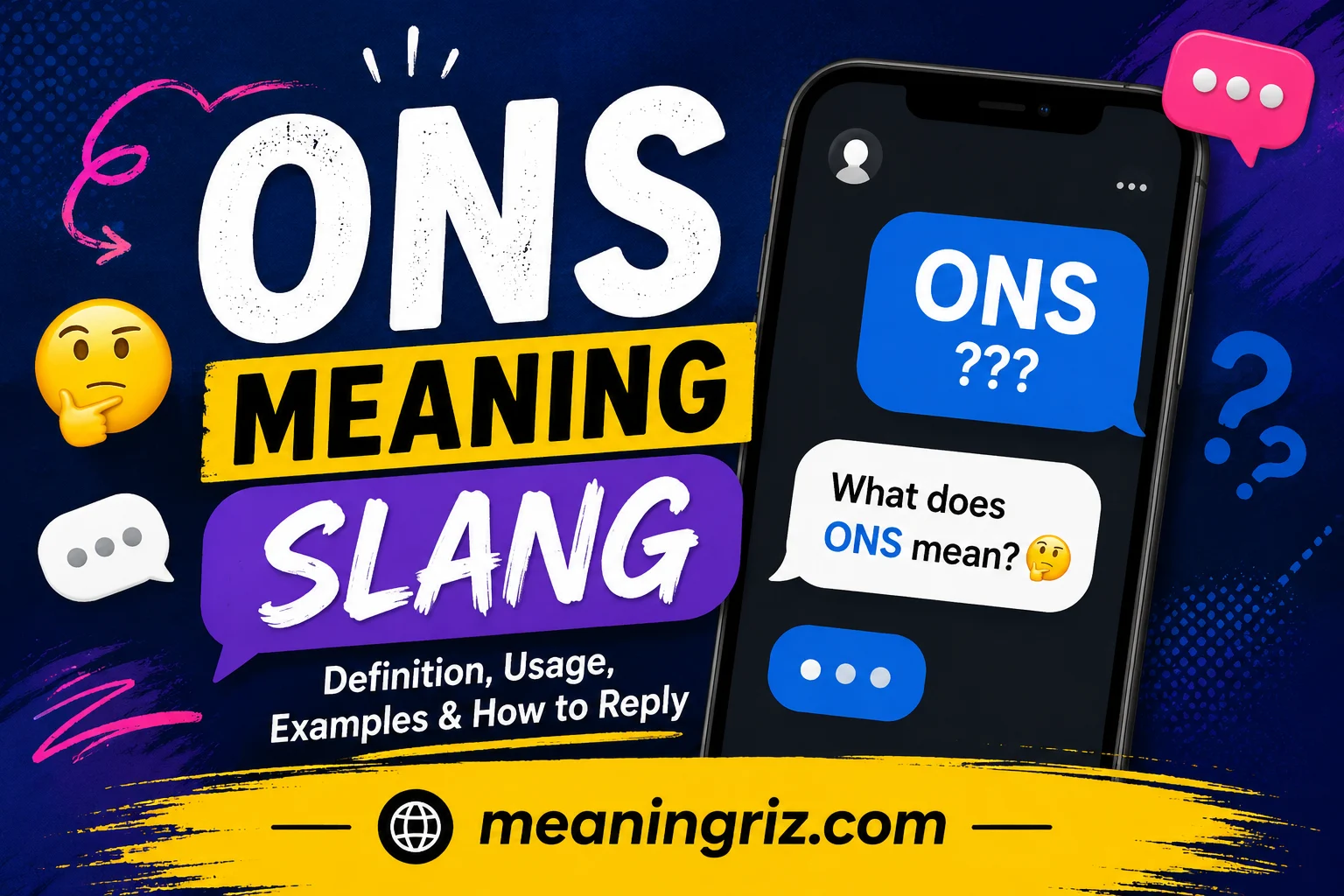
ONS stands for “One Night Stand.” In texting and online dating, it refers to a single, casual encounter between two people — physical, romantic, or both — with no expectation of anything continuing afterward. No follow-up. No labels. No plans.
That’s the definition in one line. But the way people actually use this word, the tone behind it, and what it signals about a person’s intentions — that’s where things get a lot more interesting.
Featured Snippet Answer: ONS is a slang abbreviation for “One Night Stand” — a one-time casual encounter with no commitment or emotional expectation attached. It’s most commonly used on dating apps, in private chats, and on social media to describe or signal relationship preferences.
Where Did the Term Come From?
The phrase “one night stand” goes back much further than texting culture. It originally described a single-performance show — a band or theatre act that played one venue for one night only, then moved on. Over time, the phrase shifted into everyday language to describe people who connected briefly and didn’t continue.
By the time texting and dating apps became the main way people met, “one night stand” was already common vocabulary. The abbreviation ONS came naturally — three letters that carry the full weight of the phrase without anyone having to type it out. As dating platforms like Tinder, Hinge, and Bumble grew, so did the need for shorthand to signal intentions quickly. ONS became part of that vocabulary.
The interesting thing is that shortening the phrase didn’t just save typing time — it also reduced the emotional charge. “I’m open to a one night stand” feels direct and heavy. “I’m open to ONS” feels more casual, like a preference rather than a proposition.
The Different Ways People Actually Use ONS
Most articles on this topic give you the dictionary definition and stop there. But ONS doesn’t always appear in the same way or carry the same weight. Here are the real variations:
As a Statement of Intent on a Dating Profile
This is the most common use. Someone puts “not here for ONS” or “open to ONS” in their bio to filter out the wrong matches before any conversation even starts. It’s efficient communication — saying something that might be awkward to bring up later, right at the start.
As a Question in a Direct Message
“Looking for ONS?” is a direct (some would say very direct) opener. It’s more common on certain apps than others. The tone can feel blunt or refreshingly honest depending on who’s reading it and what they’re looking for.
As a Casual Mention Between Friends
Friends discussing dating experiences will drop ONS into conversation the same way they’d say “situationship” or “talking stage.” It’s used descriptively — “we had an ONS and I honestly don’t know how I feel about it” — not as a request, just as a label for what happened.
As a Boundary-Setting Statement
“I’m not into ONS, I want something real” is a way of communicating emotional needs without writing an essay. It signals that someone is looking for connection, not just company.
ONS in Real Chat Examples
Not the stiff textbook version. The way it actually appears in messages.
On a Dating App Profile
“Here to meet people — open to seeing where things go. Not actively looking for ONS, but not rigid about labels either.”
This is the realistic middle-ground version. Most people aren’t completely on one side or the other.
In a Direct Message
Him: “Hey, just to be upfront — I’m mostly looking for something casual, maybe ONS or see how it goes” Her: “Appreciate you being honest, I’m looking for something more serious so probably not a match”
Notice how the clarity is actually useful here. Both people leave knowing where they stand.
Between Friends Talking About Dating
“Okay so I matched with this guy and he literally opened with ‘looking for ons?’ like, sir.” “Lmaooo. Delete.”
Same abbreviation, completely different context — here it’s being repeated as a bit of a story, not used as a request.
When Someone Is Figuring Out Their Own Feelings
“We met at the party and I thought it was just going to be an ONS but now I keep thinking about him”
This is the emotional version — ONS used as a label that someone’s trying to move past.
How ONS Is Used Across Platforms
ONS on Dating Apps (Tinder, Hinge, Bumble)
This is the natural home for the term. Dating app bios are short and people need to communicate their intentions fast. Seeing ONS in a bio is completely normal and expected. On Tinder especially, where the culture tends to be more casual, it appears more often and carries less shock value than it might elsewhere.
ONS on WhatsApp and iMessage
Usually appears in personal, private conversations — either between two people navigating what they want from each other, or between friends sharing dating stories. It’s not a term that tends to show up in group chats unless someone is telling a story.
ONS on Snapchat
Snapchat’s fleeting-message culture makes it a natural place for casual dating conversations. ONS might come up in a late-night DM exchange, usually as part of someone signalling what kind of connection they’re after.
ONS on Instagram
More likely to show up in DMs than public posts. You might see it in someone’s bio as a filter statement — “not here for ONS” is a common way of signalling on Instagram that the account isn’t for hooking up. In comments, it’s occasionally used humorously in meme-type contexts about modern dating.
ONS on TikTok
Often appears in dating story content — videos where someone narrates a situation and uses the term matter-of-factly. The TikTok dating conversation is enormous, and terms like ONS, FWB, and situationship are part of its everyday vocabulary.
When to Use ONS — and When Not To
When It’s Appropriate
- In your own dating profile to communicate your preferences clearly
- In private conversations where you’re establishing what you’re both looking for
- When talking to close friends about your dating experiences
- On platforms where casual relationship talk is already part of the culture
When to Avoid It
- In a first message to someone you know nothing about — it’s very forward and can come off as presumptuous
- In any professional or semi-formal context — it has no place there
- If the other person hasn’t given any signals about what they’re looking for, leading with ONS skips several steps of normal conversation
- In a conversation where someone has already signalled they’re looking for something serious — it reads as either oblivious or dismissive
A useful test: if the term would feel uncomfortable to say out loud to this person in a real setting, it’ll probably land the same way in a message.
Is ONS Rude?
Not inherently — but it can easily come across as rude depending on delivery.
Used in a profile or as part of an honest conversation about intentions, ONS is a normal and often useful piece of communication. There’s a real argument that being upfront about wanting something casual is kinder than being vague and letting the other person develop expectations.
Where it becomes an issue is when it’s used without warmth or any personal investment — “looking for ONS?” as an opening line to a stranger skips the part where you treat someone like a person first. The word itself isn’t rude. The approach sometimes is.
There’s also a cultural dimension. In some communities and social circles, openly using the term is completely normal and carries no stigma at all. In others, it’s considered too blunt or too casual to bring up at all, even when the feeling is mutual. Reading the room — or the app — matters.
Why People Use ONS (Psychology)
This is the part most guides skip, but it’s actually the most useful layer.
Abbreviations reduce emotional exposure. Typing “one night stand” in full makes it feel more deliberate, more real. “ONS” is the same meaning but it keeps things at arm’s length — more like stating a preference than making a confession. People choose the abbreviated form partly because it lowers the emotional stakes of saying it.
Using ONS in a bio is a form of pre-filtering. On a dating app, you get very little space to signal who you are and what you want. People who include ONS preferences in their bios — positively or negatively — are doing social triage before the conversation starts. It’s efficient, and for the right audience, it’s attractive. “At least they’re honest” is a real and common reaction.
ONS also shows up as a processing tool. When someone says “we had an ONS and it got complicated,” they’re using the label to try to make sense of an experience that didn’t go the way they expected. Putting a name to something helps people figure out how they feel about it. The slang exists partly for that reason — it’s language that helps people navigate situations that don’t always have a clean emotional shape.
One honest observation from how this plays out in real conversations: people who mention ONS clearly and early tend to have better outcomes than people who are vague. Vagueness might feel safer in the moment, but it usually creates more awkwardness later.
A Common Mistake People Make
The most frequent mistake is assuming ONS always signals purely physical interest with zero emotional content. In reality, people who have an ONS sometimes develop feelings afterward — and the existence of the label doesn’t prevent that from happening. Using ONS to set expectations is useful, but it’s not a guarantee that both people walk away feeling the same way. Managing that possibility honestly — acknowledging that humans don’t always separate things neatly — is something the abbreviation itself can’t do for you.
The other mistake is overthinking whether to use the word at all when the feeling is mutual and the context is right. If you’re on a platform where this kind of communication is normal and the vibe already matches, using the term is just honest and efficient.
ONS vs. Similar Slang Terms: What’s the Difference?
People often use ONS alongside FWB, NSA, and situationship — but they don’t mean the same thing.
| Term | Full Meaning | Duration | Emotional Tone | Expectation Level | Best Used On |
|---|---|---|---|---|---|
| ONS | One Night Stand | Once only | Low to neutral | None | Dating apps, private chats |
| FWB | Friends with Benefits | Ongoing | Friendly, casual | Low but repeated | Apps, close-friend conversations |
| NSA | No Strings Attached | Varies | Explicitly neutral | Zero | Dating apps, direct messages |
| Situationship | Undefined relationship | Ongoing | Often emotionally complex | Ambiguous | TikTok, friend conversations |
| Casual dating | Seeing people without commitment | Open-ended | Warm, social | Low to medium | All platforms |
The cleanest way to remember the difference: ONS is the shortest possible connection, defined by duration (one night). FWB is longer but still non-committed. NSA is about emotion (no attachment). Situationship is what happens when none of the above is defined at all.
How to Respond When Someone Uses ONS
If you’re interested and they’ve mentioned being open to it
“I appreciate you being upfront about it — I’m in a similar place right now actually”
If you’re not looking for that
“Not really what I’m after, but I respect that you were honest about it”
If you’re not sure yet
“I’m figuring out what I want honestly — appreciate you saying it though”
If it came out of nowhere and felt too forward
“That’s a pretty direct opener 😅 — how about we talk first and see how it goes”
The pattern that works in almost every version: acknowledge the honesty, be equally clear about where you are, and keep your own dignity in the process. You don’t have to be harsh or cold about it, but you also don’t have to pretend you weren’t caught off guard.
Frequently Asked Questions
What Does ONS Mean on a Dating App?
On a dating app, ONS stands for “One Night Stand” — a single, casual encounter with no expectation of a relationship. People include it in their bios or early messages to communicate their intentions upfront.
Is ONS the Same as FWB?
No. ONS (One Night Stand) is a one-time encounter. FWB (Friends with Benefits) is an ongoing casual arrangement between people who know each other. The key difference is frequency and the friendship layer.
Does ONS Always Mean Just Physical?
Mostly, yes — it refers to a brief, non-committed encounter. But people’s emotions don’t always follow neat categories. Some people go into an ONS and come out of it with stronger feelings. The term defines an intention, not a guaranteed outcome.
Is It Rude to Ask Someone About ONS?
It depends entirely on how and when you bring it up. Stating it in a dating profile is generally fine. Leading with it in a first message to a stranger is usually too forward and tends not to land well. Context and timing matter a lot.
What Should I Say If Someone Asks Me for ONS and I’m Not Interested?
Keep it simple and direct: “That’s not what I’m looking for, but thanks for being upfront.” You don’t need to explain further or apologize for your preferences.
Does ONS Mean Something Different Outside of Slang?
Yes. In formal UK contexts, ONS stands for the Office for National Statistics — the government body that produces UK census and economic data. You’ll see this usage in news articles and official reports. The context always makes it obvious which meaning is being used.
The Bottom Line
ONS means One Night Stand — a single, casual encounter with no commitment attached. It’s most at home in dating app culture, private conversations about relationships, and informal slang between friends. The word itself is neutral. What gives it tone is how, where, and with whom it’s used.
The most useful thing to know isn’t the definition — it’s that people who use ONS clearly and early are usually trying to be honest, not crass. And the smartest response, whether you’re into it or not, is to match that honesty with equal clarity of your own.
DISCOVER MORE ARTICLES
Bane of My Existence Meaning in Text: Usage, Tone & Examples
PU Meaning in Text Explained (All Meanings, Tone & Real Examples)
Mutt Meaning in Text Explained (Usage, Tone & Real Chat Examples)
LDR Full Form in Chat Explained (Meaning, Usage & Examples)
Cameo Meaning Explained: All Definitions With Real Examples
I’m the person behind this website, handling both the writing and content management myself. I focus on explaining word meanings, slang, and modern expressions in simple, clear language, using real-life examples so readers can understand how these terms are actually used in everyday conversations.