You’ve heard the word before — in a travel article, a history class, maybe a movie title. But “metropolis” isn’t quite the same as just saying “big city,” and most people sense that difference even if they can’t explain it.
So what does metropolis actually mean? And why does it feel like it carries more gravity than words like “town” or “urban area” or even “city”?
Here’s the full picture — meaning, origin, usage, and the things most definitions skip entirely.
What Does Metropolis Mean?
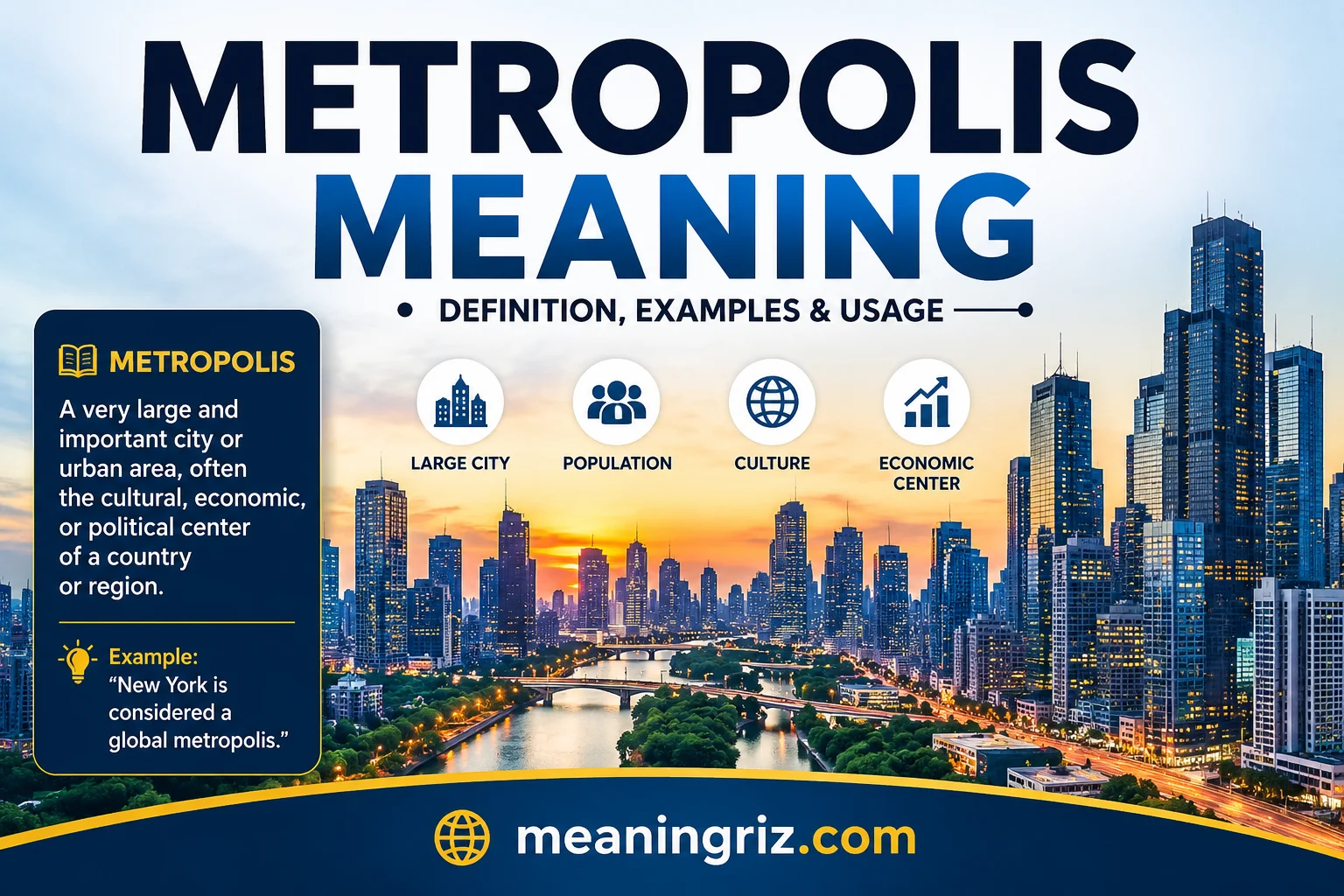
A metropolis is a large, important city that serves as a major hub of economic activity, culture, and often political power — usually the dominant city of a country or region.
Featured snippet version:
Metropolis (noun): A large, highly significant city that functions as a central hub of commerce, culture, and population — often the chief city of a country or region. Pronounced: meh-TROP-uh-lis. Plural: metropolises.
But here’s where most definitions stop too early. “Large and important” alone doesn’t explain why the word feels the way it does, or why writers and filmmakers reach for it when they want to evoke something specific. The real meaning lives in layers — and that’s what we’re going to unpack.
The Origin of the Word (And Why It Matters)
The word metropolis comes from ancient Greek — two roots joined together:
- mētēr — meaning mother
- pólis — meaning city or city-state
So at its core, a metropolis literally means “mother city.”
That wasn’t just poetic. In ancient Greece, when a city-state sent colonists out to found a new settlement, the original city was called the metropolis — the parent city that the colony traced its identity back to. Corinth, Athens, Miletus — these were metropolises in the truest historical sense. The new cities kept cultural and religious ties to the metropolis, the way a child keeps a connection to home.
Over centuries, the word traveled through Late Latin into Middle English (around 1350–1400) and gradually lost its colonial specificity. By the 16th century, “metropolis” was being used to describe London — not as a mother city of colonies, but as the undisputed center of English life. From there, the meaning broadened into what it is today.
What stayed, though, is the weight. A metropolis isn’t just big. It’s foundational — a place other places relate to.
The Full Meaning: More Than Just Size
Here’s something that separates a true metropolis from simply a large city: size alone doesn’t qualify it.
A metropolis must be:
- Large in population (usually millions of people)
- Economically dominant — headquarters, markets, major industries
- Culturally influential — arts, media, trends that radiate outward
- Infrastructurally complex — airports, transit systems, institutions built to serve millions
- Often politically significant — capital cities, major administrative centers
A city of five million people in the middle of nowhere with no cultural reach or economic pull isn’t really a metropolis in the full sense — it’s just a large city. Conversely, a city like London or Tokyo earns the word because of the gravitational pull they exert on the regions and countries around them.
When a City Becomes a Metropolis
There’s no single population number that officially makes a city a metropolis everywhere. In the United States, for instance, a metropolitan statistical area is defined as having at least 50,000 people — but most people wouldn’t call a city of 60,000 a metropolis in the everyday sense.
In casual use and in most writing, “metropolis” signals a city that genuinely dominates its region: New York, Tokyo, London, Paris, Mumbai, Lagos, São Paulo. These are cities people move toward, cities that attract talent, capital, and attention from far beyond their borders.
The Church Used It First in English
Here’s a fact most guides miss: in English, “metropolis” was originally an ecclesiastical term. It referred to the seat of a metropolitan bishop — the chief bishop of a province, to whom others answered. Canterbury was called a metropolis in this sense as early as the sixth century. The word only shifted to describe secular great cities starting with 16th-century London — and it was London’s dominance that spread that usage everywhere else.
How “Metropolis” Is Actually Used in Writing and Speech
The word shows up in a few distinct ways depending on context.
As a Straight Description of a Major City
This is the most common use — using “metropolis” in place of “city” to signal both scale and significance.
“She had spent twenty years building her career in the metropolis before finally moving back to the town where she grew up.”
“The earthquake struck the densely populated metropolis in the early morning hours.”
“Houston, the fourth most populous U.S. city, is a sprawling metropolis with a skyline that catches you off guard.”
The word adds weight without needing to add adjectives. You don’t have to say “major city” or “large and important city” — “metropolis” does that work on its own.
As a Cultural or Symbolic Reference
Writers and journalists often use “metropolis” when they want to evoke not just size but the experience of a big city — its energy, its anonymity, its pace.
“He arrived in the metropolis with a suitcase and no contacts, the way people have always arrived in great cities.”
Here, “metropolis” carries an almost mythological tone — the idea of the city as a place that tests and transforms people. This is the word Dickens would have reached for. The word suggests scale, but also something slightly inhuman about a city that can contain millions of lives without noticing any of them.
Ironically or Sarcastically
One use that most dictionary entries skip entirely: “metropolis” can be used with irony to make a small or unimpressive place sound grand.
“Welcome to the booming metropolis of Sandpoint — population 8,400 and one traffic light.”
The humor works precisely because “metropolis” carries so much weight. Applying it to somewhere tiny deflates that weight on purpose. It’s gentle mockery, and it works in spoken English too.
Metropolis vs. Similar Words: What’s the Difference?
People often use these words interchangeably, but they carry meaningfully different connotations.
| Word | Core Meaning | Scale | Key Emphasis | Emotional Tone |
|---|---|---|---|---|
| City | Any significant urban area | Small to huge | General settlement | Neutral |
| Metropolis | Major dominant urban hub | Large to massive | Influence & centrality | Grand, weighty |
| Megacity | Specifically 10M+ population | Enormous | Raw population size | Statistical, sometimes alarming |
| Capital | Seat of government | Any size | Political function | Official, formal |
| Urban area | Built-up non-rural zone | Variable | Land use classification | Dry, technical |
| Megalopolis | Network of merged metropolitan areas | Vast | Regional interconnection | Academic, geographic |
The key difference worth remembering: a metropolis is defined by influence and centrality, not just headcount. A megacity is a population statistic. A metropolis is a role a city plays.
The Word in Pop Culture and Media
Metropolis carries a second life in fiction that’s worth knowing about.
Fritz Lang’s 1927 silent film Metropolis — one of the most influential sci-fi films ever made — used the word to describe a towering, dystopian future city divided between an elite upper class and an underground working class. That film permanently attached “metropolis” to a visual: gleaming towers, shadowy underbellies, the beautiful and the brutal side by side. It influenced everything from Batman’s Gotham City to Blade Runner’s Los Angeles.
In DC Comics, Superman’s home city is literally called Metropolis — a deliberate choice to make it feel like the great American city, aspirational and gleaming, in contrast to Batman’s darker Gotham.
The word’s fictional life has reinforced something its literal meaning already contained: a metropolis isn’t just a place. It’s a symbol of what modern urban civilization can become — for better or worse.
The Psychology of the Word
Why does “metropolis” feel different from “city” even when describing the same place?
Part of it is etymology. Words with Greek or Latin roots carry an implicit formality in English — they feel older, more serious, more considered. “City” is common Anglo-French. “Metropolis” is classical Greek. That difference in origin creates a different register, a different weight in the sentence.
But there’s also something more human going on. The word “metropolis” activates a particular mental image for most people: towers, density, movement, crowds, opportunity, noise. It doesn’t just describe — it conjures. When a travel writer calls a place a metropolis, you start to picture it differently than if they’d said “large city.” You imagine arriving there and feeling small. You imagine the scale of it.
This is why the word gets used so much in journalism, travel writing, and fiction. It does emotional work that plainer words don’t.
A Common Mistake People Make
The most frequent misuse: treating “metropolis” and “megacity” as synonyms.
They’re not. A megacity is a technical demographic term for any urban area with over 10 million people. A metropolis is a qualitative description — it’s about centrality, influence, and the role a city plays in its region or country. Lagos is both. But there are megacities that feel more like overgrown sprawl than a true cultural metropolis, and there are cities — Vienna, for instance — that carry full metropolitan weight without hitting the 10-million mark.
When writing or speaking about cities, using “megacity” when you mean “metropolis” undercuts what you’re actually trying to say.
Real-Life Observation: What It Feels Like to Be in a Metropolis
Here’s something no dictionary entry covers: the experience of actually being in a metropolis is distinct and recognizable.
You feel it when you realize the city is operating at a scale completely indifferent to you personally. You’re surrounded by millions of people going about millions of separate lives, and the infrastructure around you — the transit system, the grid, the supply chains — exists to serve all of them, not any one of them. It’s humbling and energizing at the same time.
People who grow up in small towns often describe arriving in a metropolis as the first time they understood how large the world actually was. The city didn’t adjust to them. They had to adjust to it.
That sensation — that the city is too big to notice you specifically — is what separates a metropolis from a large city you can still mentally hold in one piece.
How to Use “Metropolis” in a Sentence
Correct, natural uses of the word:
- “New York is one of the most culturally diverse metropolises in the world.”
- “The ancient metropolis of Rome influenced urban planning for centuries.”
- “After years in the metropolis, she found the silence of the countryside almost unbearable.”
- “The film is set in a gleaming but deeply unequal metropolis of the future.”
- “He moved to the metropolis at 22, the way his grandfather had done decades before him.”
Frequently Asked Questions
What is the simple definition of metropolis?
A metropolis is a very large, important city that serves as a major center of economic activity, culture, and population — usually the dominant or chief city of a country or region. The word comes from Greek, meaning “mother city.”
What is the difference between a city and a metropolis?
Every metropolis is a city, but not every city is a metropolis. A metropolis specifically implies dominance, influence, and centrality — economic, cultural, or political. It’s a city that other cities, towns, and regions relate to and are shaped by.
What is the difference between a metropolis and a megacity?
A megacity is a technical term for any urban area with a population over 10 million. A metropolis is a qualitative description emphasizing a city’s centrality and influence, not just its population size. Some cities are both; others are one but not the other.
What are some examples of a metropolis?
New York, Tokyo, London, Paris, Mumbai, Lagos, São Paulo, Shanghai, and Istanbul are all widely recognized as metropolises — cities that dominate their regions economically, culturally, and demographically.
How do you pronounce metropolis?
It’s pronounced meh-TROP-uh-lis, with the stress on the second syllable. The plural is metropolises (in English usage) or, occasionally in academic contexts, metropoles.
Can a small city be called a metropolis?
Technically, no — though it’s sometimes done ironically. The word implies significant scale and influence. Using it for a genuinely small place is usually understood as sarcasm or humor.
Why is Superman’s city called Metropolis?
DC Comics named Superman’s home city “Metropolis” deliberately — to evoke an idealized, gleaming version of the great American city. It’s meant to feel aspirational and modern, in deliberate contrast to Batman’s darker, more gothic Gotham City.
The Bottom Line
Metropolis means more than “big city.” It means a city that functions as a hub — economic, cultural, historical — for the region or country around it. The word traces back to ancient Greek, where it meant “mother city,” and that original meaning still lives inside it: the idea of a city that others relate to and are shaped by.
When you call a place a metropolis, you’re saying it has gravity. It pulls things toward it — people, commerce, ideas — and sends its influence outward. That’s what separates the word from simpler alternatives, and why writers reach for it when they want to say more than just “large.”
DISCOVER MORE ARTICLES
Bane of My Existence Meaning in Text: Usage, Tone & Examples
PU Meaning in Text Explained (All Meanings, Tone & Real Examples)
Mutt Meaning in Text Explained (Usage, Tone & Real Chat Examples)

I’m the person behind this website, handling both the writing and content management myself. I focus on explaining word meanings, slang, and modern expressions in simple, clear language, using real-life examples so readers can understand how these terms are actually used in everyday conversations.