Someone just called you a hoss — or you spotted it in a comment thread, a sports article, or maybe your uncle dropped it casually at a cookout — and now you’re here.
It’s one of those words that sounds like it should be obvious but lands just differently enough to make you pause. Old-fashioned? A compliment? Southern thing? Kind of all three, actually.
Here’s the full picture.
What Does Hoss Mean?
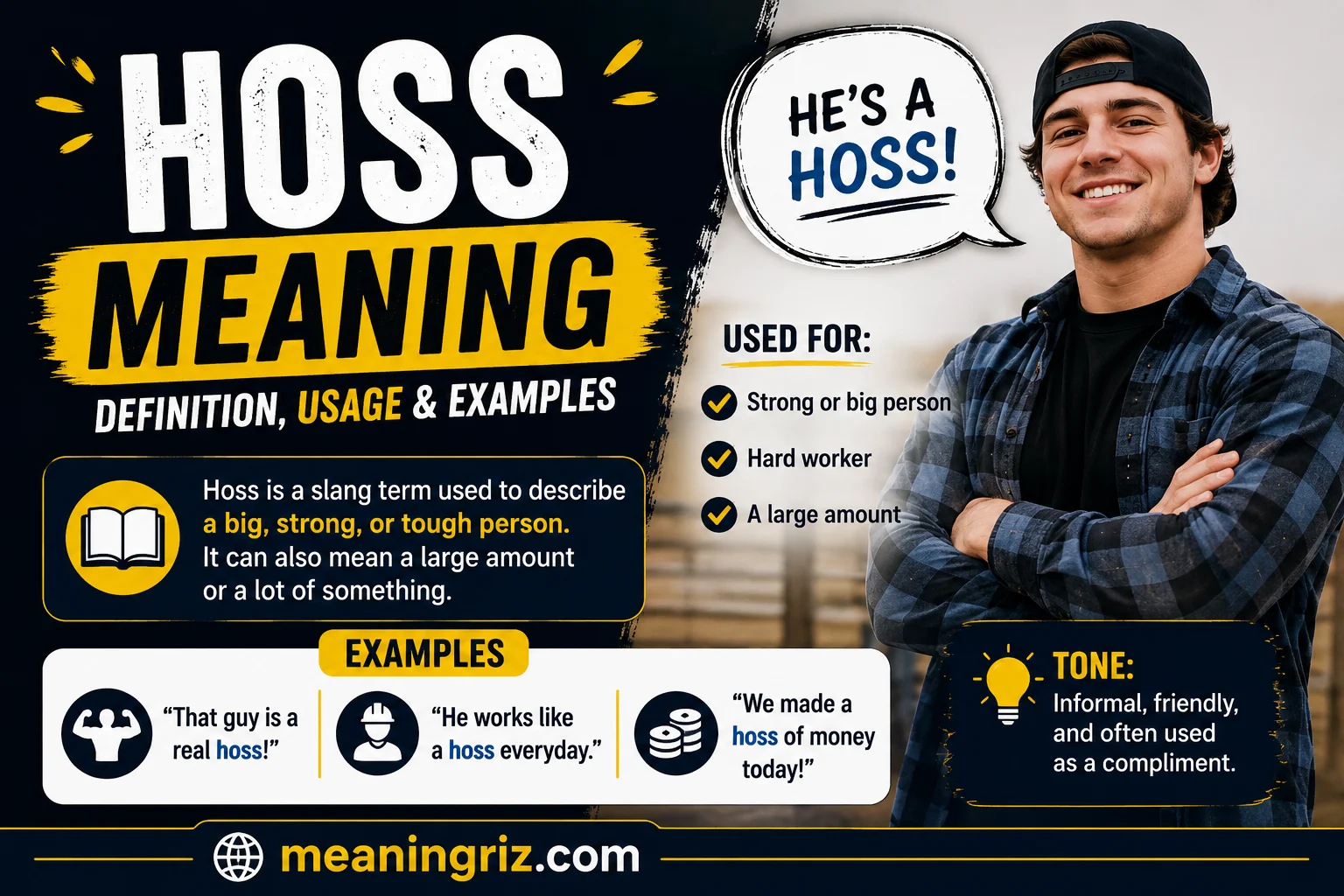
Hoss means a big, strong, dependable person — usually a man — someone you’d describe as solid, reliable, and not to be messed with. It’s used as both a nickname and a genuine compliment, depending on who’s saying it and in what tone.
It can also be used as a casual term of address — the Southern/rural equivalent of calling someone “buddy,” “chief,” or “man” — even when size has nothing to do with it.
Quick answer: Hoss = a strong, capable, dependable person (often large), or simply a friendly way to address someone. It’s warm, folksy, and slightly old-school — and whether it’s a compliment or a tease depends entirely on tone.
That’s the featured-snippet version. But the word carries more layers than that, and missing them is what makes people use it wrong.
Where Does Hoss Come From?
Understanding the origin actually helps you understand why the word feels the way it does.
It Started as a Pronunciation of “Horse”
“Hoss” is a phonetic spelling of “horse” — the way the word was (and still is) pronounced in rural Southern and Southwestern American English. In those dialects, the vowel shifted and the “r” softened, making “horse” sound more like “hoss.” Writers started spelling it that way to capture the dialect authentically in fiction, newspapers, and early American literature.
From there, the comparison was almost too natural: a horse was the biggest, strongest, most dependable working animal a person could own. Calling someone a hoss was calling them the human equivalent — big, powerful, and reliable.
Bonanza Made It Stick
The word had regional roots for decades, but it got its biggest cultural boost from Bonanza, the NBC Western that ran from 1959 to 1973. One of the show’s main characters was Eric “Hoss” Cartwright — a massive, gentle, good-hearted man played by Dan Blocker. He wasn’t the smartest Cartwright, but he was the most dependable and the one you’d want beside you in a fight or a crisis.
That combination — big, strong, kind, loyal — became the template for what “hoss” means when used as a compliment. The word stopped just describing body size and started describing character.
How It Evolved Into Modern Slang
Over the following decades, the word drifted away from its strictly regional roots. Sports writers picked it up to describe dominant athletes. Friends started using it as a term of address in casual conversation. Online, it got a second life in meme culture as a slightly ironic, nostalgic-sounding word that works perfectly when something or someone is impressively, almost absurdly large or capable.
Today, you’ll hear it from an older guy at a diner calling the waiter “hoss,” from a sports commentator praising a linebacker, and from someone posting a picture of a massive sandwich with the caption “absolute hoss.”
The Full Range of Meanings (Because There’s More Than One)
Most pages give you one definition and call it done. But hoss has shifted enough over time that there are actually a few distinct ways it gets used, and they don’t all mean the same thing.
Hoss as a Compliment (Most Common Today)
This is the dominant modern usage. Calling someone a hoss means they’re impressive — physically capable, dependable, or just someone who gets things done without drama. It implies respect.
“He played through the injury all season. Absolute hoss.”
“She carried the whole project herself. She’s a hoss.”
Note that it’s no longer strictly about physical size in this usage. It’s about the quality of being solid and dependable, regardless of how big you are.
Hoss as a Friendly Term of Address
In casual conversation — especially in Southern states or among older generations — “hoss” functions like “buddy,” “chief,” or “man.” It’s not necessarily saying anything about the person’s size. It’s just how you address a guy you’re comfortable with.
“Hey hoss, you headed to the game later?”
“What’s going on, hoss?”
Used this way, it’s warm and familiar. It implies you’re comfortable enough with someone to skip formal names.
Hoss as Gentle Teasing
Because “hoss” is historically tied to large size, it can be used to affectionately tease someone about their physicality — in the same way you might call a big friend “big guy” or “tank.” This only lands well if the relationship supports that kind of humor and everyone’s in on it.
“Look at this hoss finishing his third plate.”
This is friendly ribbing, not an insult — but only if the tone and relationship match.
The Older Negative Usage (Worth Knowing)
Older slang dictionaries recorded “hoss” being used to describe someone overweight or unattractive — essentially leaning into the horse comparison in an unflattering way. This usage is largely dated and rarely shows up in modern conversation, but it exists. Worth knowing so you understand why context and tone matter: the same word that means “absolute legend” in a sports article can be read differently by someone from a different generation or context.
Real-Life Usage Examples
Not hypothetical — the kinds of sentences you’d actually encounter.
In Sports Writing
“The offensive line finally found their hoss at center — he hasn’t missed a snap all season.”
This is one of the most common modern homes for the word. Sports writing, especially football, baseball, and wrestling coverage, uses “hoss” regularly to describe physically dominant performers.
In Casual Texting or DMs
Friend: “Bro I just moved all that furniture by myself” You: “You’re an absolute hoss”
Used like this, it’s a genuine, warm compliment. Slightly old-school energy, which is part of the charm.
In Online Comments and Memes
“That dog is an absolute hoss” — posted under a photo of an unusually large golden retriever.
Hoss thrives in this ironic/affectionate online register because the word is folksy enough to feel playful and retro. It’s meme-friendly in a way that “big dude” or “unit” isn’t.
In Everyday Conversation
“What can I get you, hoss?” — a diner owner to a regular customer.
Used completely casually, no meaning beyond “guy I’m comfortable talking to.”
When to Use Hoss — And When to Skip It
Use It When:
- You’re complimenting someone’s toughness, dependability, or physical performance
- You’re in a casual, relaxed setting with someone you already know
- You want a slightly retro or folksy flavor to your phrasing (online, it reads as charming rather than outdated)
- You’re writing sports content where it fits the register naturally
Avoid It When:
- You’re in a formal or professional context — it doesn’t translate
- You’re using it to comment on someone’s weight, even playfully, unless you know them very well and the relationship 100% supports that
- You’re speaking to someone who might not know the word — it can land as either confusing or unintentionally condescending depending on how it’s received
The safest version is always the compliment usage: “You’re a hoss” = “You’re impressive and dependable.” That reading holds across almost every context.
Is Hoss an Insult?
Not typically, no. In nearly all modern usage, it’s a compliment or a neutral term of address.
The confusion comes from two places. First, the older negative usage (overweight, unattractive) does technically exist in older slang records — but it’s rare and largely fallen out of use. Second, because the word is connected to being physically large, some people worry it’s making fun of someone’s size. In most cases, it isn’t — it’s comparing someone to a horse in the strongest possible sense, which was and still is a form of respect in the cultures where this word originates.
If someone calls you a hoss after you did something impressive, take it as a compliment. If the tone is sarcastic or the context is ambiguous, that’s when you read the room.
Why People Use This Word (Psychology)
There’s something specific that hoss does that “big” or “strong” or “capable” doesn’t.
It signals cultural belonging. Using a word like “hoss” — old-fashioned, regional, slightly niche — is a small in-group signal. It says: I know this word, you know this word, we’re in the same cultural space. It creates warmth the way any shared reference does.
It adds personality without effort. Calling someone “strong” is accurate but flat. Calling someone a hoss is accurate and human. The word carries history, warmth, and personality in a way that a neutral descriptor doesn’t.
It’s a way of giving big respect without making it weird. Complimenting another person’s strength or dependability can feel awkward if it’s too sincere and direct. “Hoss” packages that compliment in a casual, almost casual-to-the-point-of-breezy way that makes it easier to say and easier to receive.
Nostalgia plays a role too. In online culture especially, slightly retro slang has a comfort and warmth to it that newer slang often doesn’t. “Hoss” sounds like something your dad’s generation would say — and using it is a small nod to that.
A Common Mistake People Make
The most frequent misuse: assuming “hoss” is always about physical size.
It’s not. When you call someone a hoss for staying calm under pressure, or for being the person everyone relies on, or for finishing a difficult project quietly without asking for credit — you’re using the word exactly right. Size was the original metaphor, but dependability and quiet strength are what the word actually carries now.
Calling someone a hoss because they’re literally big, and nothing else, lands as less of a compliment than you probably intended. The word works best when it’s about what someone does or how they show up, not just how much they weigh or how tall they are.
Hoss vs. Similar Words: What’s the Difference?
People sometimes reach for a different word when they mean hoss, or vice versa. Here’s how they actually compare:
| Term | Meaning | Tone | Emotional Weight | Risk Level | Best Context |
|---|---|---|---|---|---|
| Hoss | Big, strong, dependable person; friendly address | Warm, folksy, slightly retro | Respect + familiarity | Low (unless teasing about size) | Casual compliment, sports, Southern speech |
| Unit | Physically large or impressive person | Blunt, online/internet | Admiration, sometimes ironic | Low | Online comments, memes |
| Beast | Someone performing at an exceptional level | High energy, modern | Strong admiration | Low | Sports, gym, performance contexts |
| Big guy | Large or physically strong person | Neutral to slightly teasing | Mild, casual | Low–Medium | Very casual only |
| Champ | Someone who handled something well | Encouraging, slightly parental | Warmth, mild condescension possible | Medium | Praise, but can sound patronizing |
| Legend | Someone highly respected for a deed | Enthusiastic, modern | High admiration | Low | Any casual context |
The key difference that sets hoss apart: it combines physical impressiveness with dependability and character. “Beast” and “unit” are about performance or size. “Hoss” is about the whole person.
How to Respond When Someone Calls You a Hoss
If It’s Clearly a Compliment
“Appreciate it, had to get it done.”
Keep it humble and brief. That fits the energy of the word.
If It’s Playful or Teasing
“You know it” or “somebody’s gotta be”
Match the lightness. Don’t over-explain.
If You’re Not Sure They Meant It Well
“Ha — I’ll take it.”
Neutral, confident, and doesn’t invite further commentary either way.
If Someone Addresses You as “Hoss” as a Nickname
Just reply naturally — they’re using it the same way they’d use “man” or “dude.”
You don’t need to acknowledge the word itself. Responding to it normally confirms you got the tone.
Frequently Asked Questions
What Does Hoss Mean in Slang?
In modern slang, hoss means a big, strong, or highly dependable person — someone who commands respect by how they show up and what they’re capable of. It’s also used as a casual, friendly term of address in Southern American English.
Is Hoss a Compliment?
Yes, in nearly all modern usage. Calling someone a hoss is saying they’re impressive, solid, and reliable. The word carries warmth and respect when used genuinely.
Where Did the Word Hoss Come From?
Hoss is a phonetic variation of “horse” — the way the word was pronounced in rural Southern and Southwestern American English. Over time, it shifted from describing a literal horse to describing a person with horse-like qualities: size, strength, and dependability. The TV character Hoss Cartwright from Bonanza played a significant role in cementing the word in popular culture.
Can You Call a Woman a Hoss?
Technically yes — the word has been used to describe women in older literature and occasionally in modern speech. But it’s less common, and because the word is so strongly associated with a specific type of masculine character (large, rugged, dependable), using it for a woman can land as confusing or unintentionally odd. Most people would use “beast,” “legend,” or similar terms instead.
Is Hoss Offensive?
Not typically. The word is almost always used with warmth or respect. The main exception is if it’s used specifically to make fun of someone’s weight, leaning into the older negative usage — and in most modern conversations, that’s not the intent. Read the tone and relationship, and you’ll know.
What’s the Difference Between Hoss and Boss?
They rhyme, which is part of why people confuse them. “Boss” as slang means someone excellent, skilled, or in charge. “Hoss” means someone physically impressive or deeply dependable. Boss is more about status or skill; hoss is more about character and presence.
The Bottom Line
Hoss is a word with genuine history behind it — one that started in rural American speech, got amplified by mid-century television, and found a second life online as the perfect word for something or someone impressively, dependably solid.
It’s a compliment. It’s a greeting. It’s a small cultural signal that you know how to talk to people the old-school way. Used right, it’s warm, specific, and oddly flattering. Used wrong — in formal settings, or with heavy irony that lands flat — it just sounds strange.
If someone calls you a hoss and means it sincerely, they’re saying something real: that you showed up, that you delivered, and that you’re the kind of person they want around when things need to get done.
DISCOVER MORE ARTICLES
LDR Full Form in Chat Explained (Meaning, Usage & Examples)
Cameo Meaning Explained: All Definitions With Real Examples
ONS Meaning in Slang: What It Really Means & How It’s Used
Contemplate Meaning: What It Really Means, How to Use It & Why It Matters