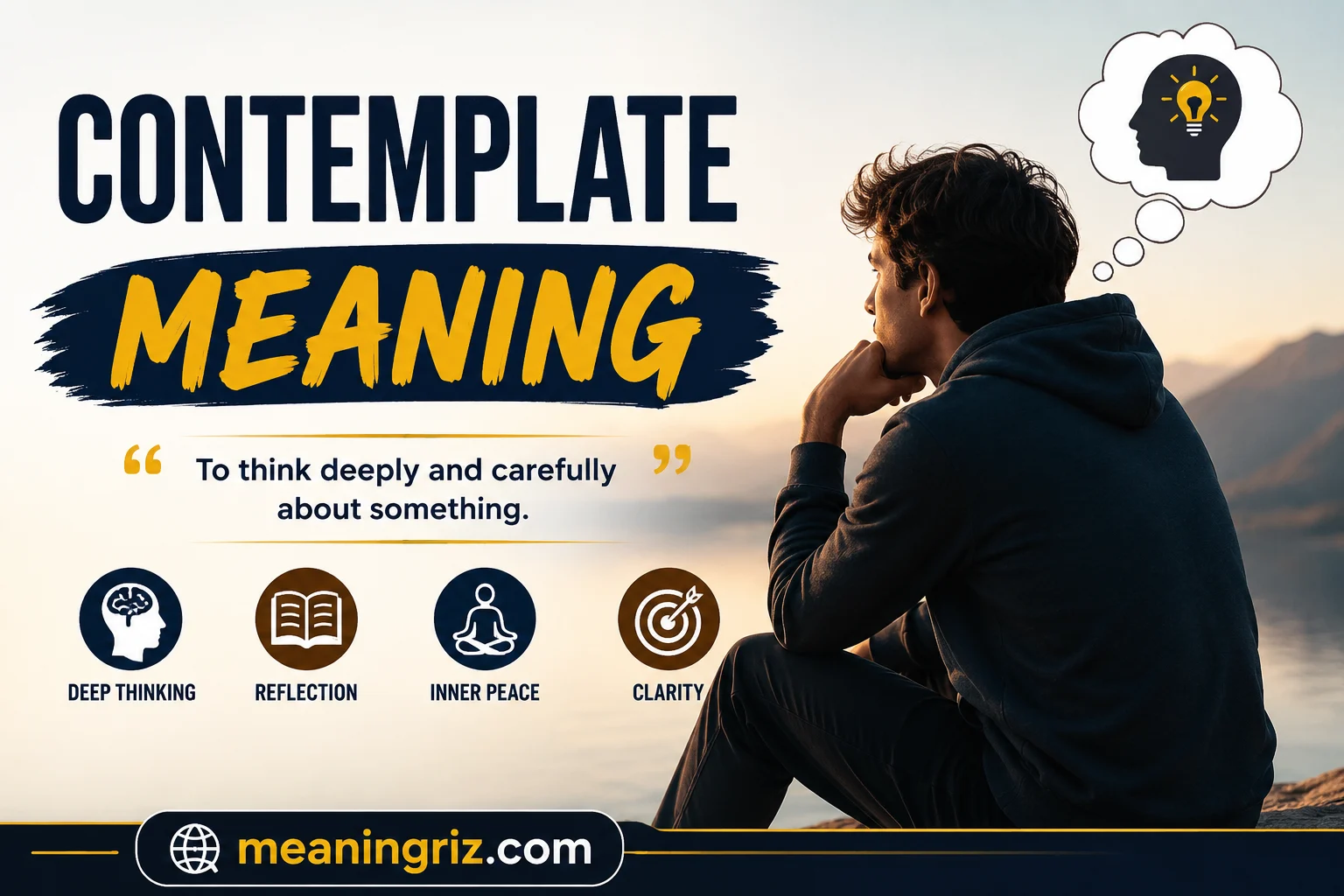
You’ve probably heard someone say “I’m contemplating a career change” or “she sat quietly, contemplating the view.”
And you understood the vibe — it felt deeper than just “thinking.” But if someone asked you to define it precisely right now, you might pause.
That pause? That’s actually what the word contemplate is about.
What Does Contemplate Mean?
Contemplate means to think about something deeply, carefully, and for a sustained period of time. It’s not a quick thought — it’s the kind of slow, focused mental attention you give to something that genuinely matters to you.
Here’s the simplest version:
Contemplate = to think deeply about something, often for a long time, without rushing to a conclusion.
It can also mean:
- Seriously considering doing something (a plan, a decision, an action)
- Looking at something quietly and thoughtfully (a view, a scene, a piece of art)
- Accepting the possibility of something — even something difficult or uncomfortable
That’s three distinct uses in one word, which is part of why it feels slightly richer than “think.”
The Full Breakdown: Three Core Meanings
1. To Think Deeply About Something
This is the most common use. When you contemplate something, you’re not just glancing at it mentally — you’re sitting with it. Turning it over. Examining it from different angles without forcing an answer.
“He spent the evening contemplating his future.”
“She contemplated the question for a long moment before answering.”
The key quality here is depth without rush. You can contemplate something and still not reach a conclusion — the thinking itself is the point.
2. To Seriously Consider Doing Something
This is where contemplate gets more practical. When someone says they’re “contemplating” a decision or action, they mean it’s a real possibility they’re weighing — not just a passing idea.
“They are contemplating moving to another city.”
“He contemplated quitting his job after the meeting.”
Notice the weight in those sentences. Contemplating something isn’t the same as deciding to do it — but it’s more serious than simply “thinking about” it. It implies the idea has your genuine attention.
3. To Look at Something With Quiet, Focused Attention
This one often gets overlooked in definitions, but it’s part of the original meaning. You can contemplate a landscape, a painting, or a scene — meaning you observe it with still, careful attention rather than just glancing at it.
“She stood at the window, contemplating the rain.”
“He contemplated the painting in silence for nearly twenty minutes.”
In this sense, the word connects looking and thinking — your eyes are on something, but your mind is working quietly behind them.
Where the Word Actually Comes From
This is one of those origin stories that genuinely makes the word more interesting.
Contemplate comes from the Latin contemplari, meaning “to survey or observe carefully.” The root includes templum — the same root as “temple.” In ancient Roman culture, a templum was a sacred space marked off in the sky or on the ground where priests would observe signs and omens.
So at its origin, to contemplate literally meant to observe within a sacred space — to look with intention, with reverence, with focus.
That history still lives inside the modern word. When you contemplate something, you’re not just thinking — you’re giving it a kind of special, dedicated mental space. That’s what makes it feel heavier than “consider” or “think about.”
Contemplate in Real-Life Sentences
Not textbook examples — the kind that show up in actual writing, conversation, and everyday life.
In personal decisions:
“I’ve been contemplating going back to school for months.” “She’s contemplating whether to stay in the relationship.”
In professional or formal contexts:
“The company is contemplating a major restructure.” “The board will contemplate the proposal at Thursday’s meeting.”
In emotional or philosophical moments:
“He sat alone, contemplating everything he’d lost that year.” “Contemplating your own mortality isn’t morbid — it can actually clarify what matters.”
In descriptive writing:
“She stood at the edge of the cliff, contemplating the horizon.” “The old man contemplated his reflection in the glass.”
When to Use “Contemplate” (and When Not To)
When It Fits Perfectly
- You’re describing slow, deliberate thinking (not a quick decision)
- The subject is significant — a life change, a serious question, a meaningful idea
- You want to convey that something has someone’s full, undistracted attention
- You’re writing formal or semi-formal English (essays, professional communication, literary writing)
When to Use a Different Word Instead
- For fast or casual thinking: use “think about” or “consider”
- For thinking about the past specifically: use “reflect on” or “look back on”
- For informal speech: saying “I’m contemplating lunch” works but can sound slightly overdressed
- When action has already been decided: contemplate implies ongoing deliberation, not a final choice
A useful test: if the thinking is quick or low-stakes, contemplate is too heavy a word. If the thinking involves genuine weight, time, or depth — it fits naturally.
Why People Use This (Psychology)
There’s a reason “contemplate” has survived for centuries while simpler words could have replaced it.
Contemplation is how humans process things that actually matter. Research in cognitive psychology consistently shows that slow, deliberate thinking — what psychologists sometimes call System 2 thinking — produces better decisions on complex problems than fast, reactive thought. When we contemplate something, we’re instinctively using the mental mode that’s built for depth.
The act of contemplation also creates emotional distance from difficult things. When people say they’re “contemplating a difficult situation,” they’re often doing something important: holding the situation at arm’s length mentally so they can look at it without being overwhelmed by it. That’s why contemplation often shows up around hard topics — loss, failure, big life decisions — it’s the mental posture that makes hard things a little more manageable to look at directly.
There’s also a cultural dimension. Across many traditions — Buddhist practice, Stoic philosophy, Christian mysticism, and modern mindfulness — contemplation is considered a discipline, not just an activity. The idea is that by practicing sustained, non-reactive attention, you develop greater clarity over time. Even outside religious contexts, this is why many people journal, take long walks, or sit in silence after a major event — they’re contemplating, whether they use that word or not.
One real observation worth noting: most people don’t contemplate often enough, not because they’re shallow, but because the pace of daily life actively works against it. The word itself has become slightly aspirational — we use it to describe the kind of thinking we wish we did more of.
A Common Mistake People Make
The most frequent error is using “contemplate” interchangeably with “consider” in casual speech, which dilutes the word’s actual weight.
“I’m contemplating getting coffee” is technically fine, but it sounds faintly absurd because coffee doesn’t warrant that level of mental gravity. Save the word for moments that earn it.
The second mistake is treating “contemplate” as automatically implying a decision will follow. It doesn’t. You can contemplate something for a long time and decide nothing — or decide to leave it open. The word describes the quality of the thinking, not its outcome.
Contemplate vs. Similar Words (The Real Differences)
People often swap these words around, but each one has a distinct center of gravity.
| Word | Core Meaning | Time Required | Implies Conclusion? | Typical Emotional Weight | Best Used For |
|---|---|---|---|---|---|
| Contemplate | Deep, sustained, focused thought | Long | No | High | Big decisions, meaningful ideas, quiet observation |
| Ponder | Turning something over carefully, weighing it | Moderate | Sometimes | Medium–High | Problems, questions, dilemmas |
| Consider | Examining an option or idea | Short–Moderate | Often | Medium | Decisions, choices, proposals |
| Reflect | Thinking about the past or one’s own experience | Moderate | No | Medium | Personal growth, lessons, memories |
| Meditate | Sustained mental focus, often inward or spiritual | Long | No | Medium–High | Spiritual practice, deep calm, inner attention |
| Mull over | Casual, informal thinking-it-through | Variable | No | Low–Medium | Everyday decisions, light deliberation |
The sharpest distinction worth remembering: contemplate moves forward (or stays still), reflect moves backward. When you contemplate, you’re thinking about what is, what might happen, or a big question. When you reflect, you’re thinking about what already happened.
Forms of the Word You’ll Actually Encounter
Knowing the word in all its forms helps you recognize it in reading and use it naturally in writing.
- Contemplate (verb): “She needed time to contemplate her options.”
- Contemplating (present participle): “He’s been contemplating the offer all week.”
- Contemplated (past tense): “They contemplated the risk carefully before proceeding.”
- Contemplation (noun): “After a period of quiet contemplation, she made her decision.”
- Contemplative (adjective): “He was in a contemplative mood after the funeral.”
- Contemplatively (adverb): “She stared contemplatively out the window.”
Frequently Asked Questions
What is the simplest definition of contemplate?
Contemplate means to think about something deeply and carefully for an extended period. It can also mean seriously considering whether to do something, or looking at something with quiet, focused attention.
Is contemplate the same as meditate?
Not exactly. Contemplation involves active, focused thinking about a specific subject. Meditation — particularly in modern mindfulness practice — often involves quieting or releasing thoughts rather than following them. They overlap, but contemplation is more directed; meditation is more about mental stillness.
Can contemplate be used negatively?
Yes. People often use it in heavy or difficult contexts — “he contemplated giving up,” “she contemplated the worst-case scenario.” The word fits anywhere deep thought is happening, regardless of whether the subject is positive or difficult.
What’s the difference between contemplate and consider?
“Consider” is lighter and more action-oriented — you consider your options before making a choice. “Contemplate” is deeper and less outcome-focused — you contemplate something when the thinking itself matters, not just the conclusion. Consider is quick; contemplate takes time.
Is “contemplate” formal or can it be used in everyday speech?
Both. It works naturally in formal writing (academic, professional, literary) and casual conversation when the context is genuinely weighty. It can sound slightly stilted in very informal small talk — “I’m contemplating lunch” works but has a slightly ironic edge to it.
What does “in contemplation” mean?
In contemplation means something is being seriously considered or planned — often in a legal or formal sense. “A merger is currently in contemplation” means it’s under active consideration, not yet decided.
The Bottom Line
Contemplate is one of those words that carries more weight than its syllables suggest. It means to think deeply — slowly, seriously, without rushing — about something that genuinely deserves your full attention. Whether it’s a decision you haven’t made yet, a question that doesn’t have an easy answer, or a moment you’re absorbing quietly, contemplating is what happens when thinking slows down and pays attention.
Use it when the thinking matters. That’s when it earns its place.
DISCOVER MORE ARTICLES
LDR Full Form in Chat Explained (Meaning, Usage & Examples)
Cameo Meaning Explained: All Definitions With Real Examples
ONS Meaning in Slang: What It Really Means & How It’s Used
What Does Disregard Mean? Full Meaning, Usage & Examples