Someone just replied to your message with “mk” and now you’re sitting there trying to figure out if they’re fine, annoyed, or just in a rush.
It’s one of the most misread two-letter combinations in texting — not because the meaning is complicated, but because the tone it carries changes so much depending on context.
Here’s what it actually means.
What Does MK Mean in Text?
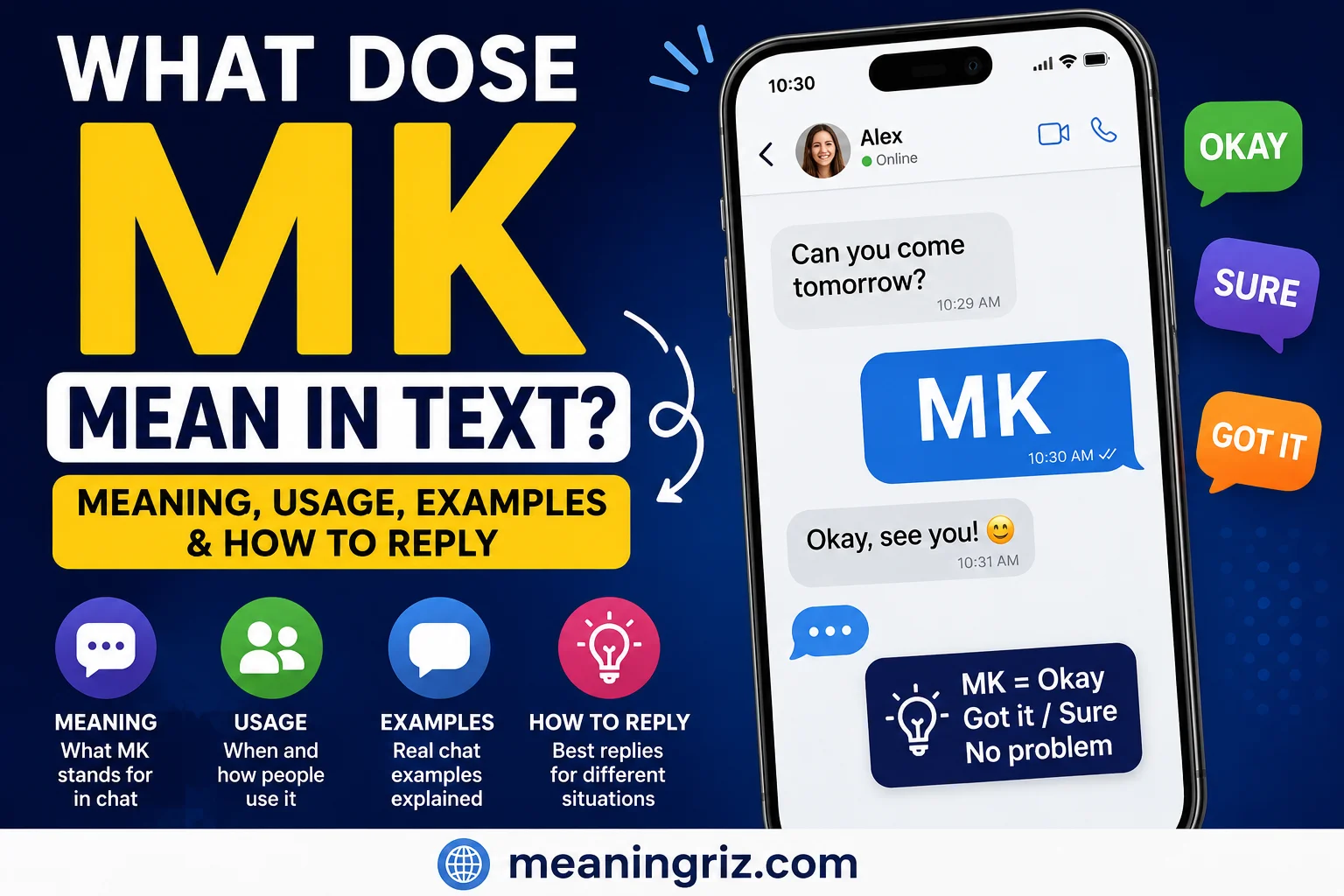
MK means “okay” or “mmkay” — a casual, shortened way to agree, acknowledge, or confirm something without typing a full response.
It comes from the spoken phrase “mm-kay,” the kind of soft, slightly drawn-out “okay” you say out loud when you’re half-listening, mildly agreeing, or not totally convinced. In texting, it got compressed into just two letters.
Featured Snippet Answer: MK in text means “okay” or “mmkay.” It’s used as a quick, informal way to agree, acknowledge, or confirm something. Tone can range from friendly and casual to slightly distant or passive, depending on context and what surrounds it in the conversation.
That’s the short version. The longer version — the one that actually helps you read a “mk” correctly — is what the rest of this article is about.
The Real Meaning Behind MK
At its most basic, MK is a speed reply. Someone’s acknowledging your message without committing to a whole sentence. It carries the same weight as “okay” but with less effort and, depending on the situation, slightly less warmth.
The key thing most people miss: MK is not the same as K, and it’s not the same as OK. They sit at different points on the same spectrum.
- K — the bluntest option. Often reads as cold or dismissive unless you’re already mid-flow in a fast conversation.
- MK — softer than K, but not enthusiastic. Neutral to slightly distant. Acknowledging without investing.
- OK — more complete, more neutral. Reads as calm and clean.
- Okay — the most formal and intentional of the group. When someone types the whole word, they usually mean it clearly.
MK lives in that specific space where you’re agreeing, but you’re not necessarily enthusiastic about it. That’s what makes it so easy to misread.
How MK’s Meaning Shifts With Context
The word itself doesn’t change. What changes is the emotional layer underneath it.
MK as Genuine Agreement
In a fast, casual conversation between friends, “mk” is often just a reflex. Someone says something, you confirm it, conversation moves on. No subtext, no attitude — just speed.
“Come over around 8?” “mk see you then”
That’s it. Nothing hidden. It’s the texting equivalent of a quick thumbs-up.
MK as Mild Resignation
This version shows up when someone agrees, but not enthusiastically. You’ve made a decision they weren’t fully sold on, and “mk” is how they accept it without making a big deal out of it.
“Let’s just stay in tonight.” “mk, fine”
The “fine” is optional — sometimes just the “mk” alone carries that same quiet acceptance. You can usually tell by what came before it in the conversation.
MK as Low-Key Dismissal
This is the one that causes misunderstandings. When “mk” lands at the end of a longer message — especially an emotional one — it can feel like the person isn’t really engaging. Like you wrote a paragraph and got two letters back.
“I just think we need to talk about what happened…” “mk”
That “mk” is doing a lot of work to not do much work. Whether it’s intentional or just thoughtless depends entirely on the person — but either way, it tends to sting a little.
MK as Playful or Flirty
Paired with the right emoji, “mk” flips entirely. The same two letters can become light, teasing, even inviting.
“Come on, just admit it was funny.” “mk maybe a little 😏”
Here, “mk” is a playful half-admission. The emoji is doing the softening, but the “mk” adds a casual confidence to the whole thing. This version shows up a lot in flirty exchanges where someone wants to agree without seeming too eager.
Real Chat Examples (How MK Actually Shows Up)
Between Friends, Coordinating Plans
Jess: we’re leaving at 7, be ready You: mk on my way
Short, functional, zero drama. This is MK in its most common, harmless form.
After Someone Shares a Decision You Didn’t Love
“I already told them we’d be there.” “mk… I guess”
The ellipsis and “I guess” make the reluctance obvious — but even without them, a lone “mk” in response to an announcement can carry the same quiet resignation.
In a Flirty or Playful Exchange
“Admit it, you missed talking to me.” “mk maybe 😊”
Classic deflection-agreement. They’re saying yes, just not quite directly. MK works perfectly for that.
In a Group Chat
“Everyone good with pizza?” “mk” “yeah sure” “fine with me”
Here, “mk” is just background noise — agreement without weight. Nobody reads anything into it in a group context.
When Someone’s Pulling Back
Long emotional message… “mk”
This is the version that sends people to search engines. When the conversation is heavy and the reply is just “mk,” it often signals disengagement — whether the person is overwhelmed, avoidant, or just not sure what to say.
Does MK Mean Something Different on Each Platform?
MK on Snapchat
Snapchat moves fast. “Mk” here is almost always a casual acknowledgment in a streak or quick back-and-forth. Given the visual and impermanent nature of the app, it rarely carries much weight. It’s noise, not signal.
MK on Instagram DMs
More likely to carry emotional weight here because Instagram DMs tend to happen in longer, more deliberate conversations. A lone “mk” in an IG thread after something meaningful was said is more noticeable than the same reply on Snap.
MK on WhatsApp
WhatsApp threads can range from family logistics to close friendships to work-adjacent chats. Context matters a lot. In a family group chat, “mk” is probably just confirmation. In a one-on-one conversation with someone you care about, it can feel short if the moment called for more.
MK on TikTok Comments
Mostly ironic or meme-adjacent here. People drop “mk” in comments the same way they’d say “sure, Jan” — not as genuine agreement, but as a deadpan reaction to something they find unconvincing. The tone is almost always playful.
MK in Regular Text Messages
The most direct and personal context. A “mk” in a regular text carries more weight than the same reply in a group app because it’s just the two of you. Read what came before it — that’s almost always the key.
When to Use MK (And When Not To)
When It Works
- Casual conversations with friends or people you text regularly
- Quick logistics and planning (“what time?” / “mk, 6 works”)
- Playful exchanges where the tone is already light
- Fast-moving conversations where a full “okay” would slow things down
When to Avoid It
- When someone just shared something emotional or vulnerable — “mk” can land as cold
- In any professional setting — it reads as informal at best, dismissive at worst
- When you’re the one who has a problem with the thing you’re agreeing to — it can feel passive-aggressive even if you don’t mean it that way
- First messages with someone new — it doesn’t warm up easily
A useful rule: if the moment deserves a real response, “mk” is probably the wrong one. It’s a reply for when acknowledgment is enough. When connection is what’s actually needed, reach for something longer.
Is MK Rude or Passive-Aggressive?
Not by itself — but it can absolutely come across that way without the sender meaning it to.
The problem is that “mk” has no warmth built into it. “Okay” still feels complete. “OK” feels neutral but clear. “MK” sits in a space that many people instinctively read as half-checked-out. Add it to a serious conversation, or send it with nothing else after a long message, and it often feels like a door being gently but firmly closed.
Whether someone meant it as dismissive is a different question from whether it lands that way. In texting, impact often matters more than intent — especially when you can’t hear a tone of voice.
The emoji test is useful here: “mk 😊” and “mk” are completely different messages. Same word, completely different emotional signal. If you want “mk” to read as warm, something has to carry the warmth — because the word itself won’t do it on its own.
Why People Use This (Psychology)
There’s a reason “mk” has outlasted dozens of other texting shortcuts — it does something specific that “ok” and “k” don’t quite do.
It mirrors how people actually sound when they’re agreeing casually. “Mm-kay” is a real spoken thing. It shows up when someone’s half-paying attention, when they’re agreeing without fully committing, when they’re being politely permissive. Typing “mk” preserves that sound — which is why it feels slightly different from a flat “ok.”
It lowers the emotional stakes of agreeing. Typing “okay” can feel like you’re putting thought into it. “Mk” signals casual acceptance without signaling enthusiasm. For people who don’t want to seem too invested — in a plan, in a person, in a conversation — “mk” keeps things light without being rude.
It’s genuinely ambiguous, and sometimes that’s the point. Some people use “mk” precisely because it can be read multiple ways. It lets you agree without committing to a tone. That ambiguity isn’t always passive-aggressive — sometimes it’s just conversational caution.
One real-life communication observation worth noting: people almost never think too hard about “mk” when they send it. But people almost always think too hard about it when they receive it. That gap — between how casually it’s sent and how carefully it’s analyzed — is where most MK-related misunderstandings actually live.
A Common Mistake People Make
The biggest error is assuming “mk” always means something is wrong. Most of the time, someone typed “mk” because it was fast and their brain was already on the next thing — not because they’re annoyed, checked out, or passively communicating something.
The better approach: look at the pattern, not the moment. If someone consistently replies with “mk” in all their messages, that’s just their texting style. If they usually write full sentences but suddenly dropped a lone “mk” after something emotional, that might actually be worth a follow-up.
Context is the whole game with a word this short.
MK vs. Similar Texting Responses
People mix up MK with K, OK, and a few other quick replies. Here’s how they actually compare.
| Term | Meaning | Tone | Emotional Signal | Risk Level | Best Used In |
|---|---|---|---|---|---|
| MK | Okay / Mmkay | Casual, slightly soft | Neutral to mildly distant | Medium — can feel cold in emotional moments | Casual chats, plans, light conversations |
| K | Okay | Blunt, minimal | Can read as cold or dismissive | High — easily misread as attitude | Only when the vibe is already very casual |
| OK | Okay | Neutral, clean | Calm and clear | Low | Most casual to semi-casual situations |
| Okay | Okay (full word) | Intentional, clear | Present and engaged | Very Low | When clarity or warmth matters |
| KK | Okay, cool | Warm, upbeat | Positive and enthusiastic | Very Low | When you want to sound friendly and agreeable |
| Sure | Agreement | Can be flat or genuine | Neutral to slightly reluctant | Medium | Depends heavily on punctuation and context |
The practical takeaway: if you want to sound warm, use “KK” or “okay.” If you want neutral, use “OK.” If you want fast and casual, use “mk” — but know that in sensitive moments, it risks reading as cold.
How to Respond When Someone Texts You “MK”
Friendly Response
“Mk works for me — see you then!”
Match the energy and keep it light. No need to overanalyze.
Neutral / Practical Response
“Cool. I’ll send the details.”
Just continue the conversation. A “mk” usually means they’re along for the ride.
Playful Response
“Just mk? Not even an exclamation point? 😂”
This only works if the relationship can handle light teasing. It’s a fun way to poke at the bluntness without making it a serious issue.
If Something Felt Off
“You good? That felt like a short reply.”
If the “mk” came in a moment where you expected more, it’s completely fair to ask directly. Most of the time, the answer is “yeah, sorry, I was just distracted.” Give people the chance to explain before you assume the worst.
Frequently Asked Questions
What does MK mean in a text from a girl?
It means the same thing — “okay” or “mmkay” — but the tone depends entirely on context. From someone you’re dating, “mk 😊” reads completely differently from a lone “mk” after you’ve said something important. Check the surrounding conversation, not just the word.
Is MK rude?
Not inherently. But it can land that way in emotional or serious conversations where a fuller response was expected. A lone “mk” after a heartfelt message often reads as disengagement, even if that wasn’t the intention.
What’s the difference between MK and K?
Both are shorthand for okay, but K is blunter. MK has a slightly softer sound to it — closer to the spoken “mm-kay” — which makes it feel marginally less cold than a flat “K.” Neither is warm by default though.
Does MK mean something different on Snapchat vs. Instagram?
The word means the same thing, but Snapchat’s fast format means “mk” there is usually just noise. In Instagram DMs, which tend to carry longer conversations, a lone “mk” can feel more noticeable.
Can MK have other meanings?
Outside of texting, MK can stand for Michael Kors (fashion brand), Mortal Kombat (the game), or be used as initials. In everyday texting between people who know each other, it almost always just means “okay.”
Is MK passive-aggressive?
It can be — but it usually isn’t intentionally. The person probably didn’t think about it that hard. Whether it reads as passive-aggressive depends on the history of the conversation and the relationship. When in doubt, ask rather than assume.
The Bottom Line
MK means “okay” — but the tone it carries depends entirely on who sent it, when, and what came before it. In a casual planning text, it’s nothing. After something emotional, it can feel like a wall. With the right emoji, it becomes playful. Without one, it often just reads as neutral at best.
The word is simple. The context is what makes it complicated. And the most common mistake people make with “mk” is reading too much into a reply that was sent in two seconds without a second thought.
DISCOVER MORE ARTICLES
FWIW Meaning in Chat, Texting & Social Media
GMFU Meaning in Text Explained (Usage, Tone & Real Examples)
What Does SMT Mean in Text? Meaning in Chat Explained (Usage & Examples)
What Does Hamm Mean? The Full Breakdown (With Examples)

I’m the person behind this website, handling both the writing and content management myself. I focus on explaining word meanings, slang, and modern expressions in simple, clear language, using real-life examples so readers can understand how these terms are actually used in everyday conversations.