Have you ever received a message like “I don’t think we can salvage this anymore” or seen someone comment “Let’s salvage the situation” and wondered exactly what they meant?
You’re not alone. While salvage is a common English word, its meaning changes slightly depending on the conversation. It can refer to saving damaged property, repairing a difficult situation, or trying to preserve a relationship that’s falling apart.
Salvage Meaning (Featured Snippet Answer)
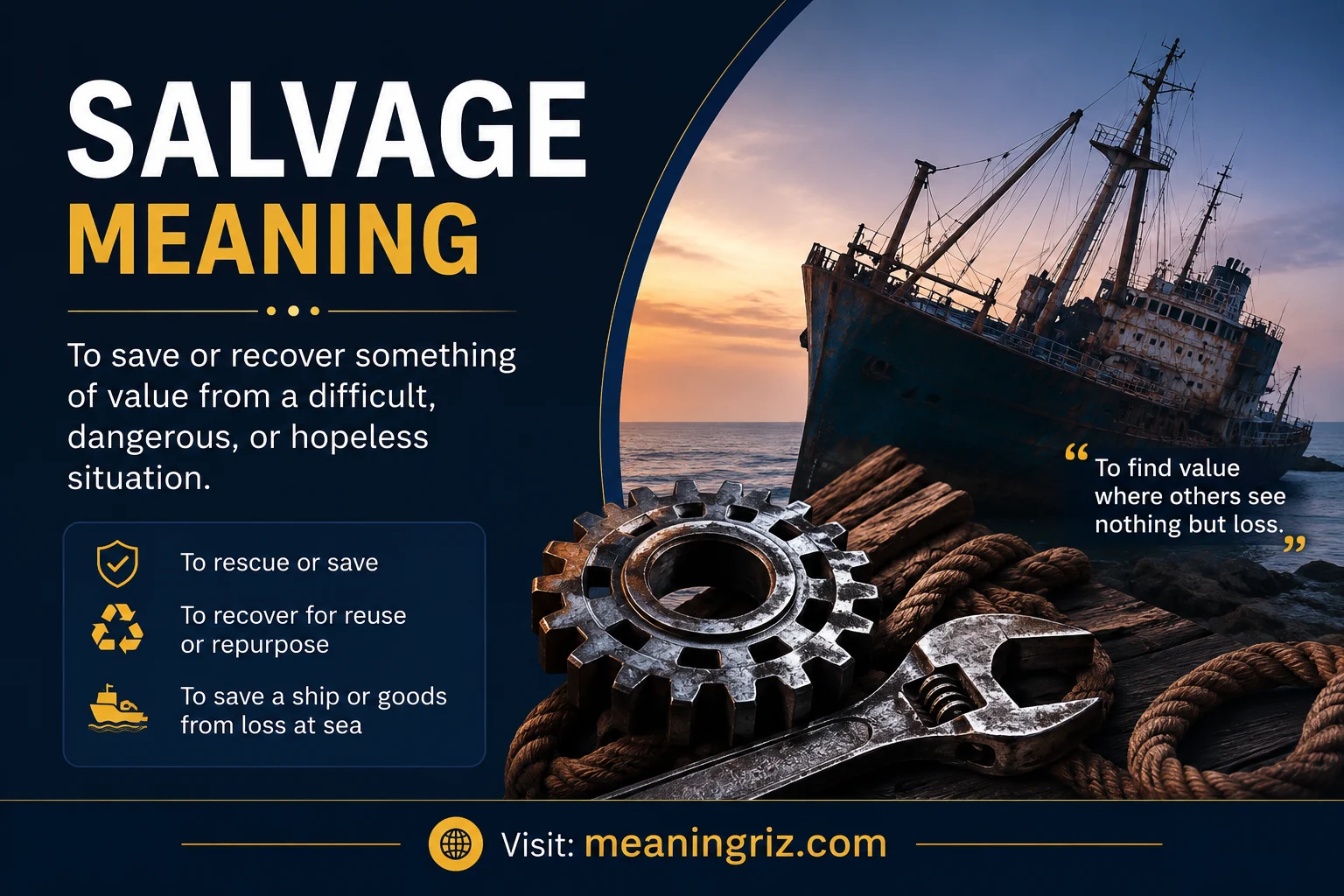
Salvage means to save, recover, or rescue something that has been damaged, lost, or is in danger of being completely ruined. In everyday conversations, people often use it to describe trying to fix a problem, repair a relationship, or make the best of a bad situation.
The word can be used in formal writing, daily conversations, texting, social media, and professional settings.
What Does Salvage Mean?
At its core, salvage means recovering something valuable after damage or loss.
Instead of throwing something away, you try to save what is still useful.
For example:
- Salvage a damaged car
- Salvage important files
- Salvage a friendship
- Salvage your reputation
- Salvage the project
In simple words:
Salvage = Save what can still be saved.
Different Meanings of Salvage Depending on Context
The meaning stays similar, but the situation changes.
Salvage in Everyday Conversation
People often use salvage when discussing mistakes or difficult situations.
Examples:
- “Maybe we can salvage the evening.”
- “We’re trying to salvage the project.”
- “Can this friendship still be salvaged?”
Here, it means fixing something before it’s completely lost.
Salvage in Relationships
This is one of the most common modern uses.
Examples:
- “Is there any way to salvage our relationship?”
- “They went to counseling to salvage their marriage.”
It suggests that the relationship has serious problems but isn’t completely over.
The emotional tone is often hopeful but uncertain.
Salvage in Business or Work
Professionals frequently use the word when discussing projects.
Examples:
- “Let’s salvage what we have.”
- “We can still salvage this presentation.”
- “The deadline was missed, but the project can be salvaged.”
Here it means recovering value despite setbacks.
Salvage in Insurance
Insurance companies use salvage differently.
A salvage vehicle is a car that has been declared a total loss after an accident or flood but may still have usable parts or be repairable.
Examples include:
- Salvage title
- Salvage value
- Salvage auction
This is a technical meaning rather than casual slang.
What Does Salvage Mean in Text Messages?
In texting, salvage usually means trying to save a conversation, friendship, plan, or relationship.
Examples:
Friend:
“I think we messed everything up.”
Reply:
“Maybe we can still salvage it.”
Another example:
“Let’s salvage tonight and grab dinner instead.”
Meaning:
The original plan failed, but you’re trying to make something good happen anyway.
Salvage Meaning on Social Media
Although salvage isn’t internet slang like “FR” or “IMO,” people regularly use it online.
People write:
- “Trying to salvage my weekend.”
- “Had to salvage the outfit.”
TikTok
Creators often say:
- “Watch me salvage this makeup look.”
- “Let’s salvage this recipe.”
The word usually appears in transformation or problem-solving videos.
Snapchat
Friends may send:
- “Can we salvage this conversation?”
It often means fixing awkwardness after an uncomfortable moment.
Common examples include:
- “We’ll salvage the meeting tomorrow.”
- “Let’s salvage the plan.”
Again, it simply means trying to save the situation.
Is Salvage Positive or Negative?
It depends on the context.
Most of the time, it’s cautiously positive.
It acknowledges that something has gone wrong but suggests there is still hope.
Positive tone
- “We managed to salvage the event.”
Neutral tone
- “Let’s salvage what we can.”
Slightly negative tone
- “I’m not sure this relationship can be salvaged.”
Notice that the word often carries a sense of damage before recovery.
When Should You Use Salvage?
Use salvage when something has already gone wrong but isn’t completely beyond repair.
Good situations include:
- Fixing mistakes
- Saving relationships
- Recovering lost work
- Repairing damaged property
- Improving failed plans
It naturally communicates effort and recovery.
When Should You Avoid Using Salvage?
Don’t use salvage when nothing has actually been damaged.
For example:
❌ “Let’s salvage our vacation.”
If the vacation hasn’t gone wrong yet, this sounds strange.
Instead:
- Let’s enjoy our vacation.
- Let’s plan our vacation.
Salvage works only after there has been some problem.
Real-Life Chat Examples
Example 1
Alex:
“I think I offended her.”
Sam:
“You should apologize. You might still salvage the friendship.”
Example 2
Chris:
“Our presentation crashed.”
Taylor:
“We can still salvage it if we stay calm.”
Example 3
Jamie:
“The cake burned.”
Morgan:
“Maybe we can salvage the frosting.”
Example 4
Emma:
“The date was awkward.”
Noah:
“Maybe texting afterward will salvage things.”
These examples sound natural because people often use salvage when trying to recover after a mistake.
Why People Use This (Psychology)
The word salvage reflects optimism after disappointment.
In real conversations, people rarely use it when everything is going well. Instead, they use it when they still believe there is a chance to recover something valuable.
Psychologically, saying “Let’s salvage this” communicates three things:
- The situation isn’t ideal.
- Giving up isn’t the first choice.
- Some hope still remains.
That’s why the word often feels encouraging rather than completely negative.
How People Actually Use Salvage in Real Conversations
Most people don’t use salvage as dramatic language.
Instead, it naturally appears after mistakes.
For example:
- Missing a deadline
- Forgetting an anniversary
- Breaking something
- Ruining dinner
- Having an awkward conversation
Rather than saying everything is ruined, people say:
“Let’s salvage what we can.”
This feels practical and solution-focused.
Common Mistakes People Make
Mistake 1: Thinking salvage means “repair”
Repair focuses on fixing.
Salvage focuses on saving whatever still has value.
Sometimes you salvage something without completely repairing it.
Mistake 2: Using it before anything goes wrong
Salvage assumes there has already been damage or loss.
Mistake 3: Assuming it’s only about objects
Many learners think salvage only refers to cars or ships.
In reality, native English speakers frequently use it for:
- Relationships
- Conversations
- Careers
- Events
- Projects
- Plans
Salvage vs Similar Words
| Word | Meaning | Tone | Emotion | Risk Level | Best Used For |
|---|---|---|---|---|---|
| Salvage | Save after damage | Hopeful | Recovery | Medium | Problems, relationships, projects |
| Save | Prevent loss | Positive | Relief | Low | General situations |
| Recover | Get something back | Neutral | Improvement | Low | Health, files, money |
| Rescue | Remove from immediate danger | Urgent | Serious | High | Emergencies, people, animals |
| Repair | Fix physical damage | Practical | Neutral | Low | Objects and equipment |
How to Respond When Someone Says “Let’s Salvage This”
Friendly Responses
- “Good idea.”
- “Let’s give it another try.”
- “I’m with you.”
Neutral Responses
- “It’s worth trying.”
- “Let’s see what we can do.”
- “We’ll figure it out.”
Playful Responses
- “Challenge accepted!”
- “Time for damage control.”
- “Let’s work some magic.”
Smart and Confident Responses
- “Not everything is lost yet.”
- “We still have good options.”
- “Let’s focus on what we can recover.”
Cultural and Communication Notes
Across English-speaking countries, salvage carries a similar meaning.
However, in everyday American, British, Canadian, and Australian English, people are more likely to use it figuratively than literally.
Instead of talking about damaged ships or cars, they’ll often say:
- “Salvage the meeting.”
- “Salvage the friendship.”
- “Salvage the weekend.”
This metaphorical use has become especially common in modern workplace communication and online conversations.
Frequently Asked Questions
Does salvage mean save?
Not exactly.
Save is broader, while salvage specifically means saving something after it has already been damaged or gone wrong.
Is salvage a negative word?
No.
It usually acknowledges a problem but also suggests hope and recovery.
What does “salvage the relationship” mean?
It means trying to repair or preserve a relationship before it completely ends.
What does salvage mean in texting?
In texting, it means trying to save a conversation, friendship, plan, or situation that isn’t going well.
Is salvage slang?
No.
It is a standard English word that people naturally use in everyday conversations, social media posts, and professional settings.
Can salvage be used for people?
Usually not directly.
Instead, people say they salvage a relationship, salvage someone’s reputation, or salvage a situation rather than salvage a person.
Final Thoughts
The salvage meaning is simple once you understand the idea behind it: saving something that has already suffered damage or is close to being lost.
Whether you’re talking about a car, a friendship, a business project, or an awkward conversation, salvage expresses hope mixed with realism. It recognizes that something went wrong—but also that it may not be too late to make things better.
In today’s conversations, both online and offline, it’s a practical word that shows resilience, problem-solving, and the willingness to recover rather than give up.
DISCOVER MORE ARTICLES
LDR Full Form in Chat Explained (Meaning, Usage & Examples)
Cameo Meaning Explained: All Definitions With Real Examples
ONS Meaning in Slang: What It Really Means & How It’s Used
304 Meaning: What It Means in Text, Social Media, and the Internet

I’m the person behind this website, handling both the writing and content management myself. I focus on explaining word meanings, slang, and modern expressions in simple, clear language, using real-life examples so readers can understand how these terms are actually used in everyday conversations.