You put real words into that message — maybe something exciting, maybe something vulnerable, maybe just a normal plan — and what came back was:
“alr”
That’s it. No punctuation that helps. No emoji to soften it. No follow-up. Just alr, sitting in the chat like it answered something when you’re not even sure what it said. So here’s what it means, why it feels the way it does, and how to actually read it — not just the dictionary version, but the real one.
⚡ Quick Answer — Featured Snippet
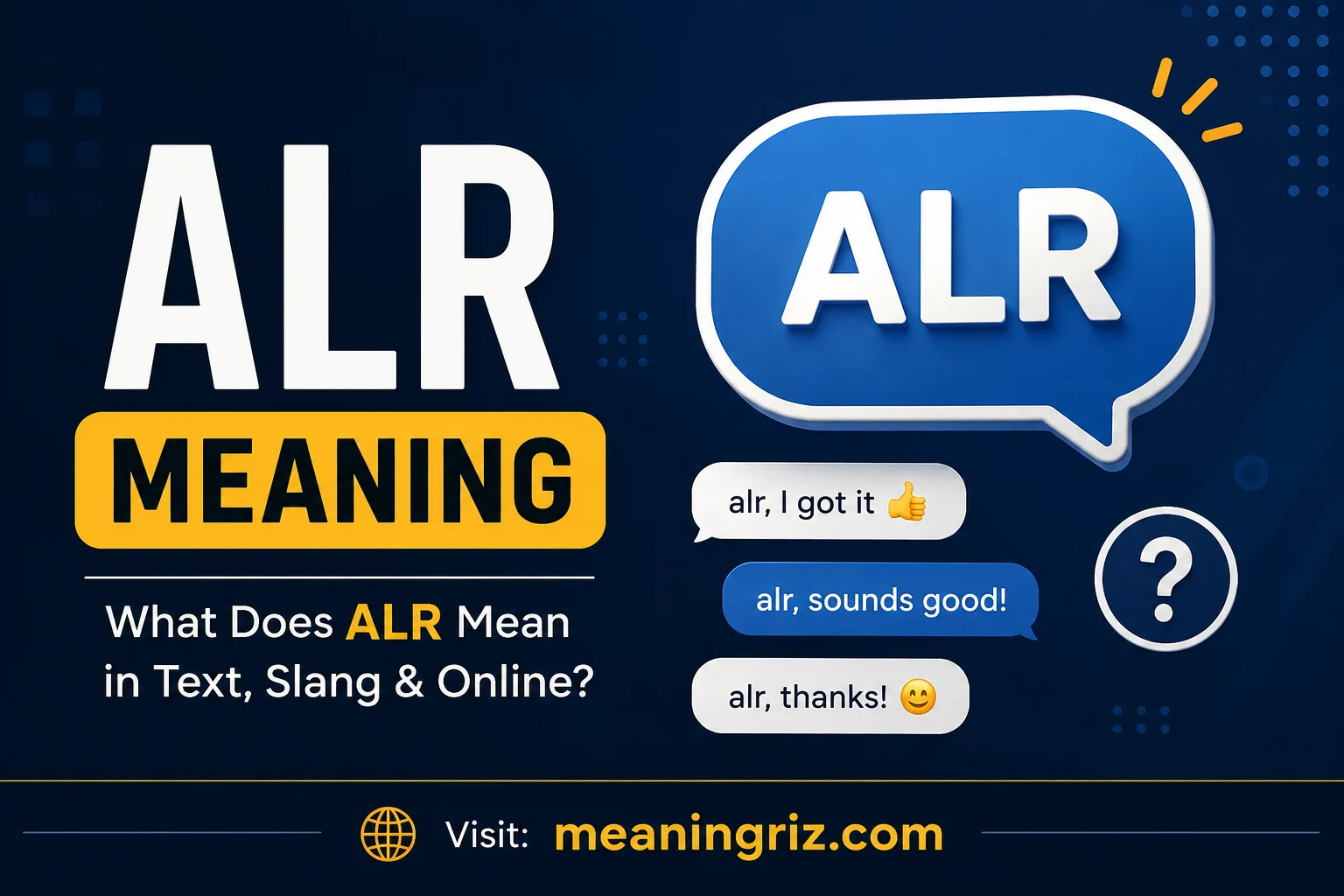
ALR means “alright” — it’s one of the most common casual abbreviations in texting right now. People use it to agree, confirm, acknowledge, or simply close out a thought without typing a full sentence. It can also mean “already” in certain sentence structures, though that’s far less common.
What Does ALR Mean in Text?
ALR stands for “alright.” It’s a shorthand way of saying okay, got it, sounds good, or understood — depending on what came before it in the conversation.
That’s it. No hidden agenda. No secret second meaning (well, almost — we’ll get to that). Most of the time, someone who types “alr” is just confirming they heard you, agreeing to something, or moving the conversation forward without typing a full sentence.
ALR = “Alright” — a casual one-word reply used to show agreement, acknowledgment, or acceptance in texting and online chats.
This is the definition you’d use in a featured snippet. But the definition alone doesn’t tell you how the word actually lands, and that’s what most people are really trying to figure out when they search for this.
The Two Meanings of ALR (And How to Tell Them Apart)
ALR as “Alright” — The Main Meaning
This covers probably 95% of all the times you’ll see it. Someone texts “alr” and they mean one of the following:
- Agreement: “alr let’s do it” — they’re in, they’re on board
- Acknowledgment: “alr I saw it” — message received, no further comment
- Moving on: “alr so anyway…” — closing one topic, starting another
- Acceptance: “alr fine” — not thrilled, but going along with it
All of these are “alright.” Same word, different emotional weight each time.
ALR as “Already” — The Less Common Meaning
This one trips people up occasionally. In certain contexts — especially when it’s mid-sentence rather than a standalone reply — “alr” can mean “already.”
“I finished it alr” → “I finished it already” “she left alr” → “she already left”
The giveaway is placement. When “alr” comes at the end of a sentence and describes something that happened, it’s likely “already.” When it stands alone or starts a response, it’s almost always “alright.”
If you’re ever genuinely unsure, just re-read the sentence both ways. One will make more sense than the other — usually immediately.
How ALR Actually Feels in a Conversation
This is the part that explains why people search for this word even though the definition is simple. “Alr” has a tone problem. The same three letters can feel completely different depending on punctuation, context, and who’s sending it.
“alr” — Neutral, Clean, Normal
No punctuation, lowercase, nothing attached. This is the most common version and the most neutral. It reads as “okay, cool” — nothing more, nothing less. Between close friends, this is just how people text. It’s not cold, not enthusiastic, just efficient.
“alr!” — Warm, Agreeable, Upbeat
The exclamation point does a lot of work here. Suddenly “alr” sounds genuinely excited or at least clearly positive. If someone replies to your plans with “alr!” they’re probably actually happy about it.
“Alr.” — Flat, Dry, Possibly Displeased
A full stop after “alr” — especially with a capital A — is where people start reading into things. Full stops in informal texting often signal deliberateness. It can read as short, closed off, or mildly annoyed. It’s not definitely any of those things, but it’s the version most likely to make someone wonder.
“alr alr” or “alr alr 👀” — Playful, Teasing, Interested
Repeating it like this, especially with an emoji, completely changes the vibe. This is a playful, almost flirtatious version. You’ll see it a lot in TikTok comments and DMs — “alr alr I see you” — where it’s basically saying “okay, I’m noticing what you’re doing and I like it.”
“alr…” — Reluctant, Uncertain, Not Fully Convinced
The ellipsis after “alr” signals hesitation. Someone agreeing but not quite there yet. It’s the text version of saying “fiiine” out loud with mild skepticism in your voice.
This is the key insight most explanations miss: “alr” isn’t one thing — it’s a shell that punctuation and context fill with meaning. The word itself is neutral. Everything around it does the emotional work.
Real Chat Examples (How It Actually Shows Up)
In a Friend Group, Confirming Plans
Jordan: dinner at 7, that place on Fifth You: sounds good Mia: alr bet
“Alr bet” is about as warm and casual a confirmation as you can get in texting. The “bet” adds energy — it’s enthusiastic agreement without being over the top.
When Someone’s Not Thrilled But Going Along With It
You: we’re doing escape rooms, not bowling Them: alr…
That ellipsis is doing all the emotional lifting. They heard you. They’re not fighting it. But they wanted bowling.
As a Conversation Ender
You: k I’ll let you know tonight Them: alr
One word, conversation paused. This is “alr” as punctuation — not agreement exactly, just a clean close. Most people use it this way dozens of times a day without thinking about it.
In the “Already” Context
You: did she text back? Them: she alr replied, check your phone
Here “alr” clearly means “already.” The sentence wouldn’t make sense the other way.
In a TikTok or Instagram Comment
“alr alr this tutorial actually worked 👀”
Playful, impressed, slightly teasing. This is the social-media version — less about logistics, more about vibe and personality.
ALR Across Platforms — Does the Meaning Change?
The definition stays the same everywhere. What shifts is the flavor of how it gets used.
ALR on Snapchat
Snapchat is where “alr” probably lives most naturally. Short-form messaging, quick replies, streak culture — “alr” fits that pace perfectly. Here it almost always means acknowledgment or agreement, and it’s rarely over-thought.
ALR on Instagram
In DMs, it functions the same as texting. In comments, it tends to lean more playful — especially the repeated “alr alr” version you see under videos or Reels where someone’s showing off something impressive.
ALR on TikTok
TikTok comment culture has given “alr” a whole second life as a reaction. “Alr I’ll try this” under a recipe or hack means they’re convinced. “Alr alr 👏” under a performance means they’re impressed. It reads less like a reply and more like a vocal reaction typed out.
ALR on Discord or Gaming Chats
Fast-paced group chats and gaming lobbies use “alr” as a quick ready-check or acknowledgment. “alr let’s go,” “alr I’m in,” “alr give me 2 min” — pure logistics, no tone reading needed.
ALR in Regular Texting
The most literal version. A plain “alr” in a text is about as neutral as neutral gets. No subtext assumed unless the conversation before it gave you reason to think otherwise.
When to Use ALR — And When to Skip It
When ALR Works Well
- Casual back-and-forth with friends you text regularly
- Confirming plans, times, or locations quickly
- Acknowledging something without needing to add a full response
- Any chat where you’d comfortably say “cool” or “okay” out loud
When ALR Doesn’t Fit
- Serious or emotional conversations — one word can feel dismissive when someone shared something real
- First messages to someone new — it can come across as uninterested before they know your texting style
- Work, school, or professional messages — “understood” or “sounds good” will always land better
- When the other person is clearly expecting engagement, not just acknowledgment
The practical rule: if the conversation has emotional weight, “alr” is probably too light. Match the energy the other person put in.
Is ALR Rude?
Not inherently. But it can feel that way in specific situations, and understanding why helps you avoid sending the wrong signal by accident.
“Alr” feels cold when it’s a response to something that needed more than one word — like if someone shared something personal and got “alr” back. That’s not rudeness in intent, usually, but it reads as dismissiveness because of the mismatch between what was shared and what was given back.
It also feels off when tone has already gone sideways. If two people are in a mild argument and one sends “alr,” it can read as passive-aggressive — “fine, whatever” — even if that’s not what was meant.
Between people who text this way normally, it’s never rude. The same message means something completely different depending on the baseline of how two people usually communicate.
Why People Use ALR — The Psychology Behind It
Short replies like “alr” aren’t laziness for most people. There’s something more going on.
It keeps emotional exposure low. Writing “I’m really glad you told me, I totally agree and I’m looking forward to it” puts a lot of feeling on the table. “Alr” confirms you’re present without showing much of your hand. This is especially common in newer conversations or ones where the dynamic hasn’t fully settled yet.
It signals in-group familiarity. Using slang with someone is a quiet social signal: “I’m comfortable enough with you that I don’t need to be formal.” The shift from “sounds great!” to “alr” in a conversation is actually a small marker of the relationship getting more relaxed — most people just don’t notice it consciously.
It fits the pace of how texting actually works. In real back-and-forth texting, not every message deserves a paragraph. “Alr” is the texting equivalent of a nod — it keeps the rhythm going without requiring either person to slow down and compose something.
One thing that’s easy to miss: the speed of an “alr” reply often tells you more than the word itself. An “alr” that arrives in thirty seconds usually means genuine agreement. An “alr” that arrives twenty minutes later with nothing else can carry a very different feeling — and most people read that gap intuitively, even if they can’t articulate why.
A Common Mistake People Make
The most frequent misread is treating “alr” as confirmation of enthusiasm when it’s actually just acknowledgment.
If you share exciting plans and someone replies “alr,” they heard you — but they haven’t told you whether they’re excited. Don’t assume. The neutral version of “alr” is just a receipt, not a reaction. If you actually want to know how they feel, one follow-up question gets you there faster than re-reading the word for a hidden meaning that may not be there.
The second common mistake is assuming “alr” is always passive-aggressive in an emotional context. Sometimes people just text short. Some people have texted this way for years and it genuinely means nothing beyond “got it.” You probably know which kind of texter the person is — trust that before you spiral.
ALR vs. Similar Texting Slang
People often use “alr” interchangeably with similar terms that actually have subtle differences worth knowing.
| Term | Meaning | Tone | Emotional Feel | Risk Level | Best Context |
|---|---|---|---|---|---|
| ALR | Alright | Neutral to casual | Acceptance, acknowledgment | Medium — can feel flat | Friends, casual plans, quick replies |
| OK / Okay | Okay | Neutral, slightly formal | Confirmation | Low | Any context, all ages |
| K | Okay | Very flat, often cold | Minimal engagement | High — easily reads as annoyed | Only with close friends who know your style |
| BET | Agreed / for sure | Energetic, confident | Enthusiasm, buy-in | Low in casual chat | Strong agreement, excitement |
| AIGHT | Alright | Very casual, laid-back | Easy agreement | Low | Close friends, informal texting |
| FR | For real | Validating, confirming | Agreement with emphasis | Low | Agreeing with something said |
The most useful distinction: “alr” lands somewhere between “k” (cold) and “bet” (enthusiastic). It’s the middle-ground acknowledgment — not dismissive, not excited, just present. That makes it versatile but also the most context-dependent of the group.
How to Respond When Someone Texts You “ALR”
Friendly Response
“alr cool, see you then!”
Mirrors their energy and keeps things warm without overdoing it.
Neutral / Practical Response
“sounds good, I’ll confirm later”
Good for logistics chains where you’re both just coordinating, not connecting.
Playful Response
“alr alr, we’re doing this then 👀”
Bounces the energy back in a relaxed, fun way — works well between friends.
If You Want More Than One Word Back
“alr — you actually good with that though?”
Sometimes “alr” is closure when you wanted a conversation. This reopens it directly without being confrontational.
Frequently Asked Questions
What Does ALR Mean in a Text?
ALR means “alright.” It’s used as a quick, casual way to agree, confirm, or acknowledge something in a text or chat. In rarer cases — usually mid-sentence — it can mean “already.”
Is ALR the Same as “K”?
They’re both short replies, but they feel different. “K” is widely read as cold or dismissive, especially in tense situations. “ALR” feels more neutral and is generally received more warmly, partly because it comes from a full word rather than just one letter.
Can ALR Mean “Already”?
Yes, occasionally. If someone writes “I finished it alr” or “she left alr,” it means “already.” But this is far less common than the “alright” meaning. When in doubt, check whether it comes at the end of a sentence describing a completed action — that’s the “already” position.
Is ALR Rude?
Not by default. It can feel cold if it comes after something that needed a fuller response, but between friends who text casually, it’s completely normal. The rudeness — when it exists — is more about tone mismatch than the word itself.
Is ALR a Gen Z Thing?
It started as Gen Z slang, but it’s spread widely enough now that it crosses age groups on most messaging platforms. You’ll see it from teenagers and adults alike, especially in any informal texting context.
Should I Use ALR at Work?
No. Stick to “sounds good,” “understood,” or “alright” (spelled out) in professional messages. Short slang like “alr” can read as unprofessional or careless in a work context, even when it’s genuinely casual.
The Bottom Line
ALR means alright. The definition is easy. The harder part — and the part actually worth knowing — is that this one word changes tone dramatically based on what’s around it. Lowercase with no punctuation is neutral. A full stop makes it flat. Repeated playfully it becomes a compliment. Add an ellipsis and it becomes reluctant.
You’re not decoding a mystery when someone sends “alr.” You’re just reading the room — same as you do in every other conversation. Once you see how punctuation and context shape it, the word stops being confusing and starts being exactly as simple as it looks.
Related Articles
Ambition Meaning: Definition, Examples, Types & Real-Life Usage
LMR Meaning: What It Means in Text, Snapchat, TikTok, and Online (2026 Guide)
Chuzz Meaning: What It Means in Slang, Text, and Social Media
Skank Meaning: What It Really Means, Is It Offensive, and How People Use It Today
IMK Meaning in Text: What It Really Means & How to Reply

I’m the person behind this website, handling both the writing and content management myself. I focus on explaining word meanings, slang, and modern expressions in simple, clear language, using real-life examples so readers can understand how these terms are actually used in everyday conversations.